

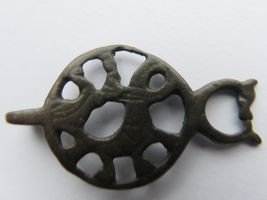
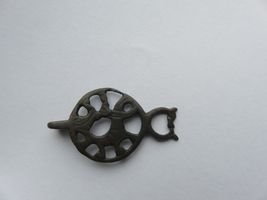

Found in Deventer, according to the seller Luuk Wiersma during the redevelopment/structuring of a park, this bronze object – length 40 mm, width 22.5 mm (at the widest point) and width of the suspension loop 5 mm, weight 5.08 grams – is possibly a silent witness to Scandinavian presence there, either through trade or otherwise.
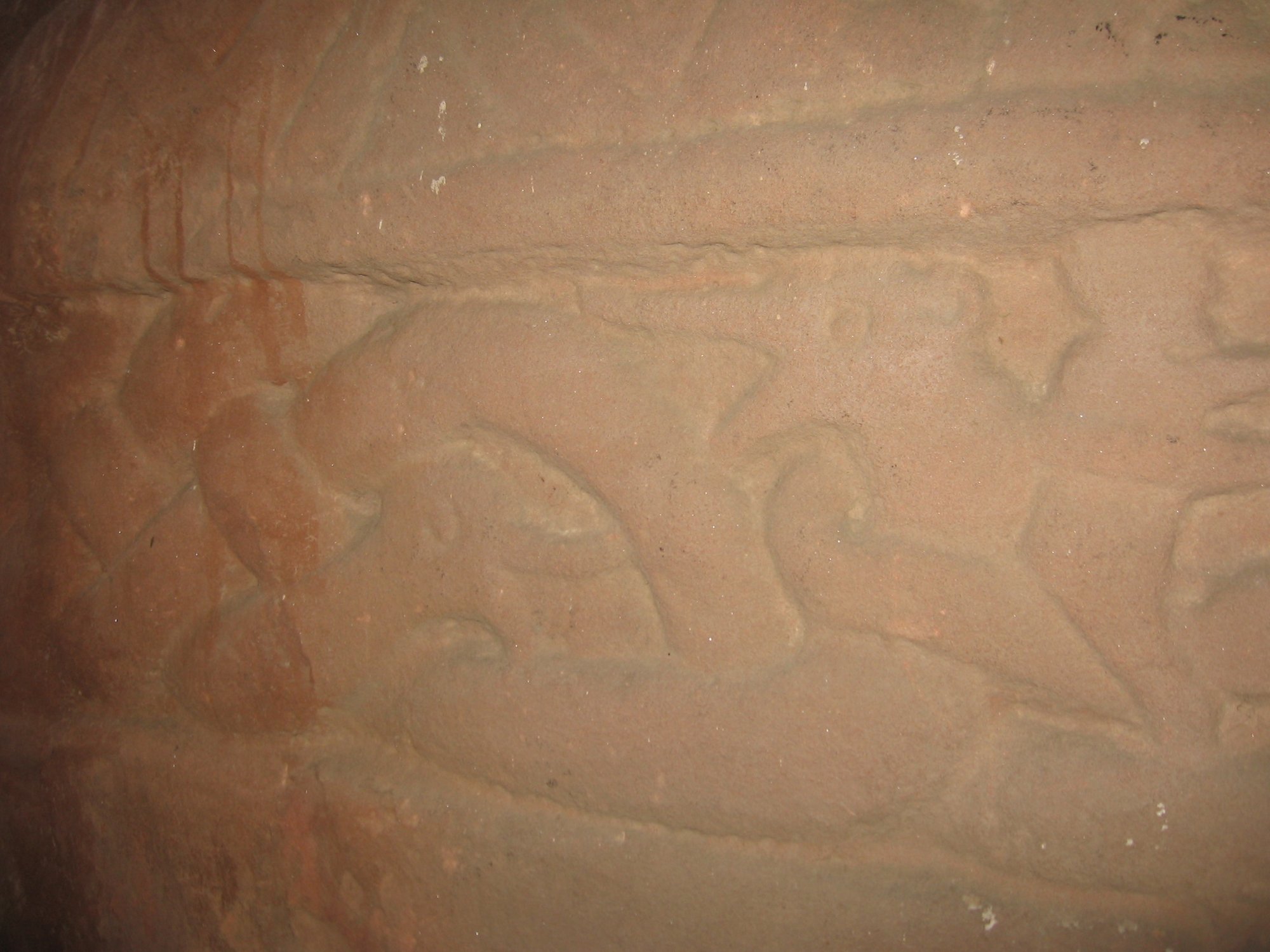
Given the loop on the back, I suspect that this is a horse harness pendant, just as the horse harness pendant with the two wolf figures has a similar suspension on the back. The decoration on the front – the back is not decorated – also a characteristic of a horse harness pendant – shows various elements. In the circle of the pendant, a backward-looking mythical animal with an almond-shaped eye can be seen. The almond-shaped eye is somewhat reminiscent of the snake/dragon (?) heads on the stave church of Urnes, after which the Urnes style is named. The animal is surrounded by a circle that seems to have its origin and end in the form of a dragon’s head meeting its tail.
At least: those were the initial thoughts….
Progressive insight and additional research indicate that the piece, style-wise, must originate from the late 11th or 12th century. According to Steven Ashley, the pendant style-wise can be categorized under the 12th century Romanesque style. Similar examples are known from England and can be found in the Portable Antiques Scheme under the registration numbers SF-951660, DENO-D26DDD and NLM-00B934. Whether we are dealing with an original example from England, or an Ottonian example that was made in our region, cannot be said.
 www.vikingartefacts.com