contact: vikingsandartefacts@yahoo.com

Artefacts from the Viking Age and Norman period

See for my blog here and the artefacts under the image.

‘…hold the roots…’


‘It is people like you who hold the roots and give back to many who thought they were lost.’ Rhiannon Scharfetter – Vienna, Austria https://myskaldkonur.com

I have been suggested to contact you, a Viking specialist, for your competence and sensibility to the problems of those interested in ancient objects.’ Antonio Barsotti – Pisa, Italy. 

Book Vikings and the artefacts from the Viking Age (published October 2025) image on front: Luit van der Tuuk. (Wessel Spoelder on Facebook group Medieval Finds: “Sometimes you come across a book that manages to present a well-worn subject with such clarity and freshness that it immediately captures your attention. That is exactly what happens when you open Vikings and Artefacts from the Viking Age.
Unlike many other books on this period, this work does not get bogged down in dry dates. It succeeds in a unique way in explaining who the Vikings really were and where they came from. The text is accessible and enlightening, bringing history to life before your eyes.
What makes this book a real ‘breath of fresh air’, however, is its focus on the metal artefacts. The beautiful, detailed photographs of the objects – from fibulae to weaponry – draw you into the story. You can see the craftsmanship and the spirit of the makers reflected in every item discussed. It is not just a book to read, but also a visual tribute to Viking culture.
For anyone who is even slightly curious about this fascinating period: look no further. This book is an absolute must-read and a gem for your bookshelf!”

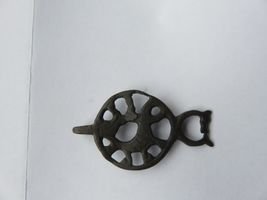
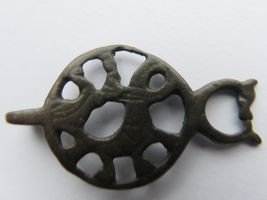
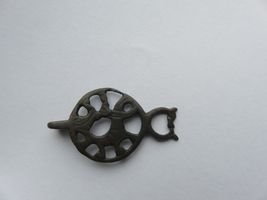
A pendant or horse harness pendant in romanesque or Ottonian style found in the Netherlands.

Found in Deventer, according to the seller Luuk Wiersma during the redevelopment/structuring of a park, this bronze object – length 40 mm, width 22.5 mm (at the widest point) and width of the suspension loop 5 mm, weight 5.08 grams – is possibly a silent witness to Scandinavian presence there, either through trade or otherwise.
Given the loop on the back, I suspect that this is a horse harness pendant, just as the horse harness pendant with the two wolf figures has a similar suspension on the back. The decoration on the front – the back is not decorated – also a characteristic of a horse harness pendant – shows various elements. In the circle of the pendant, a backward-looking mythical animal with an almond-shaped eye can be seen. The almond-shaped eye is somewhat reminiscent of the snake/dragon (?) heads on the stave church of Urnes, after which the Urnes style is named. The animal is surrounded by a circle that seems to have its origin and end in the form of a dragon’s head meeting its tail.


At least: those were the initial thoughts….

Progressive insight and additional research indicate that the piece, style-wise, must originate from the late 11th or 12th century. According to Steven Ashley, the pendant style-wise can be categorized under the 12th century Romanesque style. Similar examples are known from England and can be found in the Portable Antiques Scheme under the registration numbers SF-951660, DENO-D26DDD and NLM-00B934. Whether we are dealing with an original example from England, or an Ottonian example that was made in our region, cannot be said.