
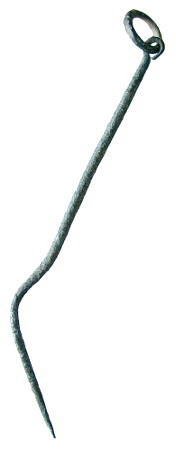
A complete viking bronze ring headed pin with long slender body that flattens out slightly near the base before it tapers to the point.
Circa 9th century AD. North Yorkshire. 130 mm long. Weight 9,36 grams.
Ring headed pins are extremely rare finds from England, especially when in complete working condition “just as it was used” shape.

A good book on ring headed pins to read see Fanning, T. Viking Age Ringed Pins from Dublin, Dublin, 1994
More on ring headed pins from the Viking Age:
Adrián Maldonado (National Museums Scotland)
‘Ringed pins are the calling card of the Viking Age in Britain and Ireland: small, low-value metal cloak fasteners, found in dressed burials, and frequently encountered as stray finds. They have a complex trajectory, beginning as Irish dress items in the pre-Viking period. From the middle of the ninth century, they began to be mass produced in the newly-founded trading settlements of the Viking Age Irish Sea, particularly in Dublin. For a short period into the tenth century, they are found across the Scandinavian-speaking diaspora, as far as Iceland and L’Anse aux Meadows, Newfoundland showing that they were worn by a new class of migrant seafarers. However, in Ireland and Scotland, ringed pins continued to be made and evolved into a variety of ringed and unringed styles long after they fell out of fashion in Scandinavia. A new assessment of the Scottish corpus of ringed pins is showing they were more prevalent here than previously suspected, in areas with little connection to ‘viking’ settlement. It is argued that ringed pins of the ninth to eleventh centuries had an understudied afterlife as part of the archaeology of Gaeldom in Ireland and the kingdom of Alba in modern-day Scotland.’
 www.vikingartefacts.com