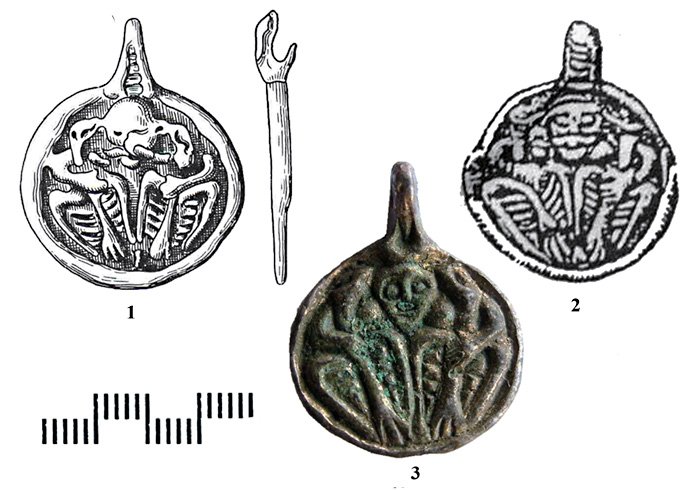
A rare Rus-Viking ‘Odin’ bronze Pendant.
Copper alloy, 1.17 grams, 22.93 mm. Circa 10th century AD. A small round disc pendant depicting the gruesome image of Odin peering out from between two skeletal birds, Hugin and Munin (Thought and Memory), his arms around the necks and he’s clutching them by the breast. The bodies of both birds appear to be representing shields, this could symbolize Odin taking the bodies of men fallen in battle. Odin was also called All-father because he was father of all gods, he was also known as Valfather (father of the slain) because all who fell in battle became his adopted sons. An excessively rare item in very fine condition. Ex old European collection.
See publication also in Minerva Magazine – The International Review of Ancient Art & Archaeology of november/december 2011 p. 21, item 7:
http://minervamagazine.co.uk/archive_pdfs/2011_Vol_22_06.pdf
An interesting reference to this kind of pendants and their findspots – mainly Russia, Sweden and Northern-Germany – can be found here:
http://www.kulturologia.ru/blogs/180813/18704/
Also take a look at the example found in England:
http://finds.org.uk/database/artefacts/record/id/636553
Another reference can be found in : Pagan zoomorphic pendants ancient Russia 10 -14 centuries.” V.E.Korshun. Vol.#3

In Norse mythology, Huginn (from Old Norse “thought” and Muninn (Old Norse “memory” or “mind”) are a pair of ravens that fly all over the world, Midgard, and bring the god Odin information. Huginn and Muninn are attested in the Poetic Edda, compiled in the 13th century from earlier traditional sources; the Prose Edda and Heimskringla, written in the 13th century by Snorri Sturluson; in the Third Grammatical Treatise, compiled in the 13th century by Óláfr Þórðarson; and in the poetry of skalds. The names of the ravens are sometimes modernly anglicized as Hugin and Munin.
In the Poetic Edda, a disguised Odin expresses that he fears that they may not return from their daily flights. The Prose Edda explains that Odin is referred to as “raven-god” due to his association with Huginn and Muninn. In the Prose Edda and the Third Grammatical Treatise, the two ravens are described as perching on Odin’s shoulders. Heimskringla details that Odin gave Huginn and Muninn the ability to speak.
Migration Period golden bracteates, Vendel era helmet plates, a pair of identical Germanic Iron Age bird-shaped brooches, Viking Age objects depicting a moustached man wearing a helmet, and a portion of the 10th or 11th century Thorwald’s Cross may depict Odin with one of the ravens. Huginn and Muninn’s role as Odin’s messengers has been linked to shamanic practices, the Norse raven banner, general raven symbolism among the Germanic peoples, and the Norse concepts of the fylgja and the hamingja.

Is their intelligence a coincidence.. ? Have they learned it from us, or we just from them……?
Link to amazing facts about ravens
Due to their intelligence, ravens are very playful. They prank with the wolves. Once a raven headed towards a sleeping wolf and pinched it by its tail. When the wolf dashed to bite the raven, the bird jumped out. When the wolf approached tiptoe to the raven, the bird let it approach till 30 cm and flew away, landing a few meters of the wolf’s back and repeating the prank.