On this page blogs will be published about artefacts (or: objects) connected with the Viking period. Preceding blogs can be found under the newest blog.
August 28th 2025
For collectors who want my advice concerning selling their collection (or otherwise)
Lately, I’ve been receiving—suddenly—questions from collectors (or: metal seekers) asking me about Viking Age objects in their collections, asking for advice on what to do with them now that they want to find a new purpose (sell them or transfer them to an institution for further research).
After some further questioning, it turns out they want to sell their collection because they need to make money from one thing or another.
Because I want to manage expectations, I’m writing this blog. First of all: I offer advice on Viking Age objects. This concerns authentication—is it genuine/period; is it Viking Age or not; is it Viking at all—based on its decorative style or shape.
In doing so, I often research the object in question, and if the object’s decorative style or shape is beyond my immediate recognition—a process I’ve accumulated over more than twenty years—I consult sources, delve into new ones, and/or seek advice from other experts if I still can’t figure it out, which doesn’t happen often. If I truly can’t give a satisfactory answer, I will be upfront about it.
When someone asks me for advice on what to do with their collection, I can offer advice from the perspective of someone who wants to sell it. There are several options, and the primary consideration is the intended purpose of the collection. Is monetary return the primary consideration, or is preserving the objects in a consistent environment with a consistent story about their provenance and interpretation?
Personally, I favor the latter, because someone with an object from the Viking Age, acquired through their own discovery or through collecting, is only a temporary holder of an – often – unique object.
What should you do in that case? A few tips:
If the collection originated from personal discoveries, then the context is obviously much more valuable than objects purchased “loosely” online without (satisfactory) context. Keep this in mind. True collectors—or: museums—with a passion for preserving this unique piece of material history will view the objects through this lens throughout their lives, seeking out their contextual value and/or preserving them for future generations who will want to marvel at them, conduct further research, or, simply, appreciate that these objects—under the radar of current researchers in museums or institutions/academics—may, at some point in the future, provide contextual information and interpretation for (currently) unknown finds, or finds gathering dust in a museum’s depot, that will one day resurface.
If you agree with such an approach and recognize that preserving objects is of greater intrinsic value than making money from them (are you listening, auction houses?), then the way to go is to contact local museums. The question then becomes whether the museum (or other official institution) is interested in incorporating the objects into their museum. They might want them, but what actually happens with them? Will they be exhibited? Will it disappear into storage? Or will it be further investigated/made available for research online or on-site? How do you “see” your collection (or: object) in such a museum, and do you have any wishes or expectations that the museum in question can accommodate?
If you’re more of the “other school” and want to sell your collection, there are other options. However, don’t overestimate the online interest in terms of potential revenue. Auction houses nowadays charge a 24% purchase fee and will often deliberately conceal the provenance if they think there’s money in it for them. On online auction sites like eBay or Catawiki, the selection of “junk Viking items” is so vast that I doubt there’s still a “public” there that recognizes or appreciates authentic Viking Age objects (given the many sales of objects that have absolutely nothing to do with Viking artefacts). Then look for smaller, reputable antique sellers with their own websites, who, at all costs, preserve the provenance and story for a future owner.
I am not a seller. If you choose the latter option, then you are the seller. First of all, I don’t know you and I won’t bet on the provenance of the objects you have in your collection and show me. That is the owner’s own responsibility.
The philosophical core question here is perhaps this:
What do you want to be: an owner or a custodian?
I hope these ‘tips’ provide some insight into my approach when it comes to advice and prevent and answer some questions—or, more importantly, expectations—in advance.
As always, I am happy to assist you in this philosophical consideration.
November 25th 2024.
A rare Viking Age pommel cap, found in Friesland.
Objects found in the Netherlands that can be described as ‘Viking’ – loosely translated – are extremely rare. Of course, there are the well-known objects from the Viking Age, which were found at Wijk bij Duurstede – the former Dorestad –, the silver treasures of Westerklief and the objects with a Scandinavian or ‘Frisian-Scandinavian’ decoration style, found in the 19th century on the beach at Domburg, in Zeeland. In addition to these, already older, finds, a gold or bronze ring is very occasionally found that, mainly based on their design, can be attributed to the Viking Age. However, objects with an unmistakable Scandinavian decoration style, as was in vogue in the Viking Age, are very rarely found. They can be counted on the fingers of – at most – two hands.
With some regularity, metal seekers show an object they have found, always asking whether it is ‘Viking’. Always, or: almost always I have to disappoint them because the piece in question does not meet the definition. Often such an object is from the early Middle Ages, but in terms of shape and/or style it cannot technically be assigned to the ‘Viking Age’ – which is also a concept that was formed in retrospect. The inhabitants of – the part of Northern Europe now called Scandinavia – of course did not have a ‘Viking Age’ at the time of the Vikings.
As mentioned, the objects are then still early medieval, but then to be described as Ottonian, or Frankish and sometimes Carolingian.
The undersigned is then very excited when Sander Visser, a metal seeker, reports with a so-called pommel cap he found – the upper part of a sword – with a suspiciously Scandinavian-looking shape, but above all: decorative style. Just for the layman: The sword pommel consists of two parts; the pommel cap and the crossguard underneath. The pommel cap found by Sander Visser dates from the first half of the 10th century. Later in time we come across pommels that consist of one piece and are therefore only called pommel. The pommel cap is the upper part of the pommel, the pommel is the part of a sword that provides a counterbalance to the end of a handle of a sword or a knife. The name pommel comes from the Latin name for “small apple”.
The first photo that is shown – and that I get to see – is how the pommel cap was found. The shape and the decoration in the middle of the pommel cap already raises an eyebrow of excitement in me; yet I am still cautious. This is partly due to unfamiliarity with the type of pommel cap.
Of course, the scheme that Jan Petersen designed of time chronology and types in sword handles from the Viking period is already over a hundred years old, and, in particular, metal detection, has of course significantly expanded the catalogue of pommel caps and pommels, certainly in the past twenty to thirty years. Petersen based his typology of 26 types on 1,700 finds of Viking Age swords found in Norway.
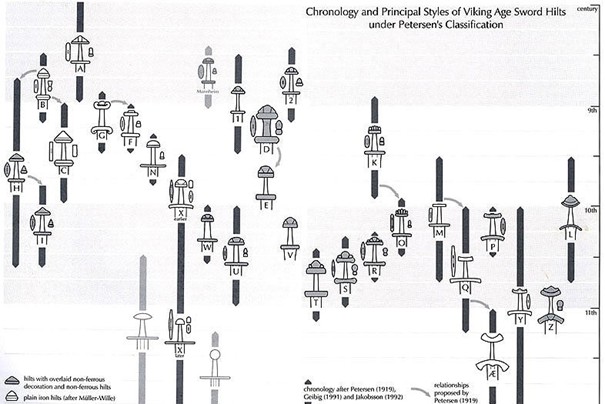

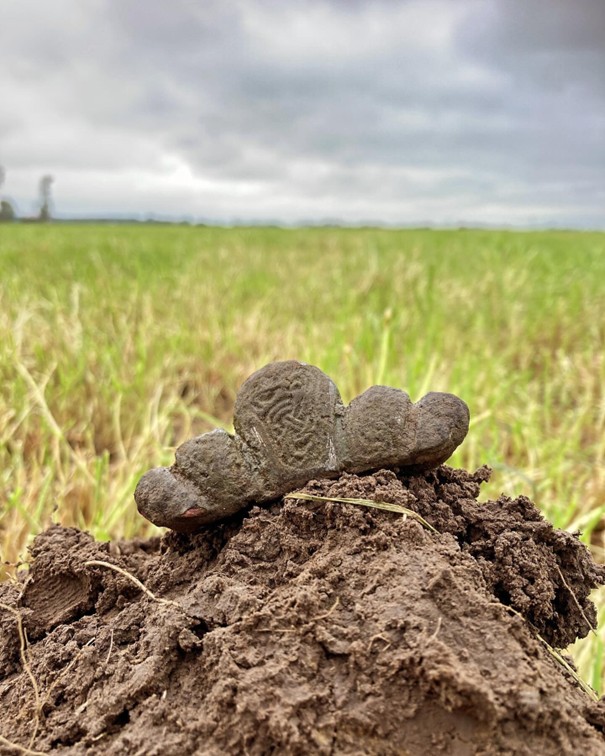
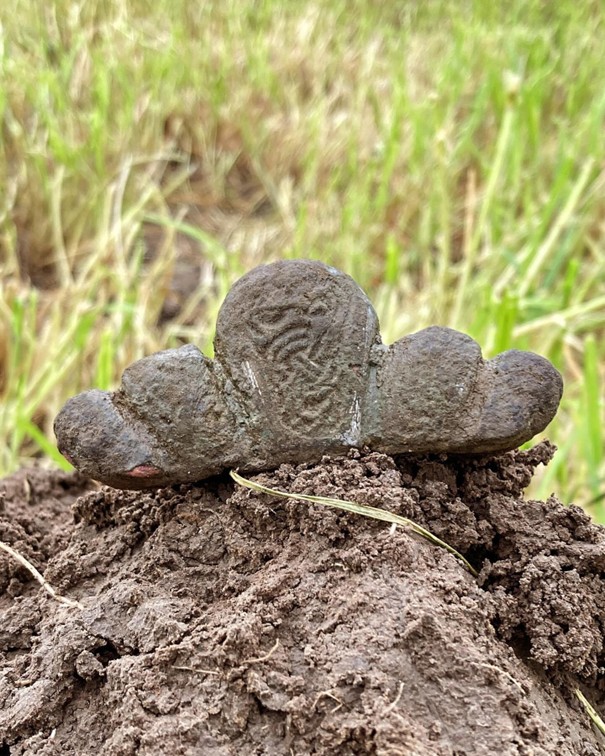
Raker typified is type R within the classification scheme of Petersen, as a find from England shows, and then specifically within this type R, type III which is found mainly in the northwest of Germany and southern Scandinavia. This shows, in addition to a somewhat wider central part, on either side two animal (resembling) heads, probably boar heads, in, what James Graham Campbell, the well-known authority when it comes to publications about the Vikings and the decoration styles from the Viking period, calls a hybrid or: transverse Borre/Jellinge style and thus gives a dating of 925 – 1000 A.D.
Ny Björn Gustafson noted: ‘It is like a transitional mix between Wheeler’s type III/Petersen R, i.e. two (more or less) beaked heads, and Wheeler’s type IV/Petersen O, i.e. “five knuckles” (five-lobed type, ed. ) It is hard to tell wich way it is going in terms of design, but it has some traits (e.g. the snouts) in common with this W/IV/Petersen O pommel from North Yorkshire in the PAS (Portable Antiques Scheme, ed.) database https://finds.org.uk/databse/artefacts/record/id/995783.’

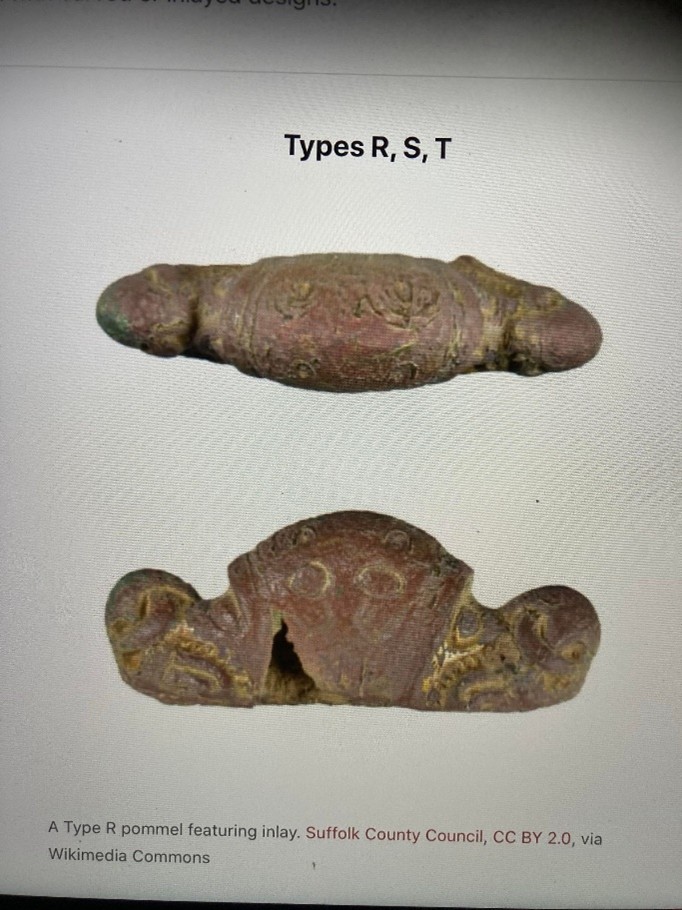
An exactly similar type, though fragmentary, was purchased by a collector of Viking objects in California, 45 years ago, from a person in the north of England.

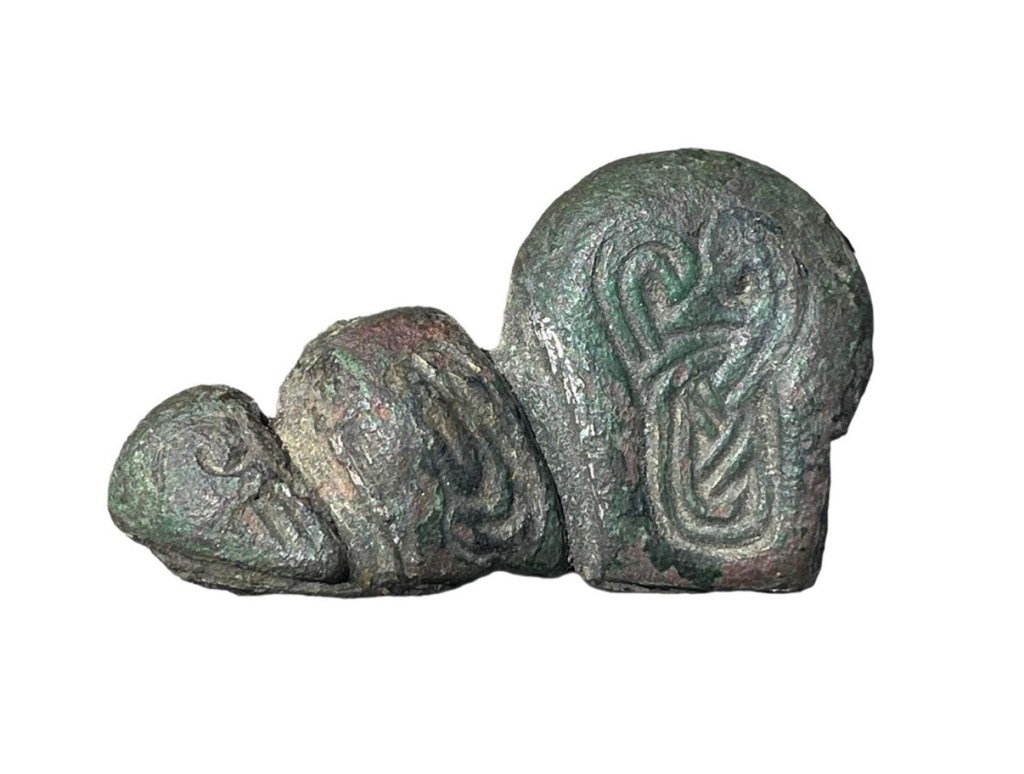
This one also has traces of silver and gold. This collector believes that the pommel cap comes from the period of the so-called Danelaw – an area in Northern and Eastern England colonized by Danish colonists in the 9th and 10th centuries. The finder of the pommel cap from Friesland concluded from this that this type of pommel cap came from Denmark with Danish Vikings around 900. This is possible, but for me it is not a foregone conclusion (that these would come exclusively from Denmark, ed.). Caroline Paterson gave this response:
‘I am no expert on this pommel type, but it would appear to belong to Petersen’s type S, though is clearly closely related to his type R with its prominent animal-head terminals. Although this type is found throughout the Scandinavian world (though rare in Sweden according to Androshchuk (2014) and Norway – though there is now such a find from Leirong, Tysvaer). Most finds appear to come from Denmark, England and also Gotland. Although with a distinctive curved base and raised central portion (more in keeping with type L hilts) the high quality Anglo-Saxon pommel from the Seine, Paris (Wilson 1964, no. 66, 166-7) with its filigree panel may be an early forerunner for the type with its pair of outward facing animal heads. Moreover, Fuglesang and Petersen both regarded the type as being based on West European models, but later the ornament is more markedly Scandinavian in style. Interlace executed in the Mammen style decorates the central dome of the pommel from Grasand, Denmark (Fuglesang 1980, Pl. 15 B-C) and several of the English finds have a stylized en-face Mammen style human head in the central lobe and Jan Petersen refers to some Scandinavian parallels for this (173-4).
There is an interesting online article (A Viking Period Metalworking Hoard from Alvena in Mästerby parish, Gotland, ed.) on a find from Pacuiul lui Soare, Romania which discusses the group and illustrates some of the finds from Gotland – including the five Alvena pommels which were unfinished. I wonder where your Frisian find was manufactured? Perhaps Gotland or even England?
The article A Viking Period Metalworking Hoard from Alvena in Mästerby parish, Gotland deals with a find made in October 2010 on Gotland in which, in addition to fourteen found – semi-finished – so-called fish pendants, also five – again semi-finished – pommel caps with – somewhat – similar animal heads on either side of the pommel.
But back to the find from Friesland. ‘Viking’ or not, the finder had made a fine find. The photos of the pommel cap after conservation (by Johan Langelaar, ed.) really made the undersigned enthusiastic. It was here that it became clear that we are dealing with an unmistakably Scandinavian, if you like: ‘Viking’ decoration style pommel cap. Traces of silver colour and gold can be found on the bronze – copper alloy – pommel cap. The dimensions of the pommel cap are length 70 mm and width 20 mm. The height is 30 mm and the weight is 60.3 grams. It is made of a copper alloy that has been gilded.

The middle section shows an intertwined decoration, typical of the Jellinge style, which ends in a – seemingly – heart-shaped spiral, as I have also seen on small fittings from the Baltic area during the Viking period. This makes this pommel cap exude “two worlds” for me. The – very clear – world of the Vikings, given the decoration and shape of the animal (resembling) heads and a partly Slavic-looking decoration at the top of the middle section. It is Scandinavian, but not completely. The inwardly circling shape at the top of the middle section is reminiscent of a bronze fitting found in Grobina, Latvia. The two – considered to be boar heads – on either side have a hybrid Jellinge / Borre style decoration. First of all, it is fortunate that the decoration has been preserved so well. Many objects have been seriously damaged and/or eroded over the last twenty years by the use of artificial fertilizers, which has all too often had a devastating effect on bronze objects.

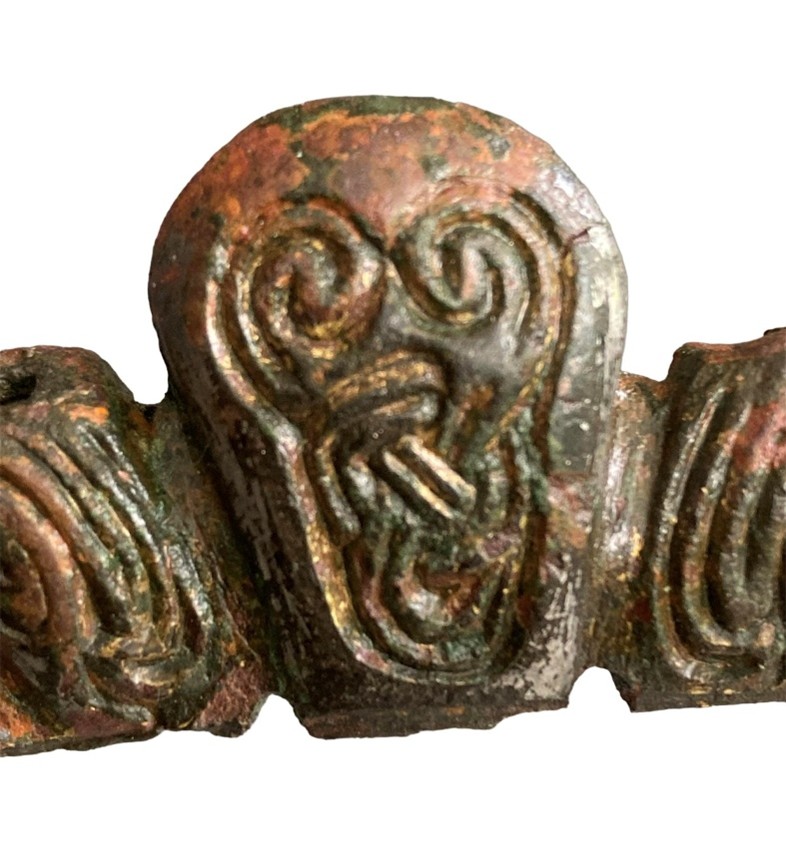

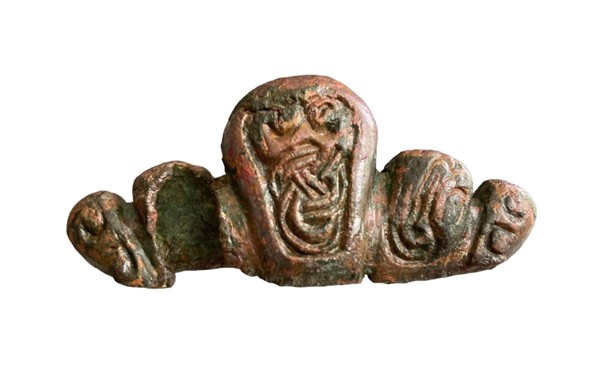
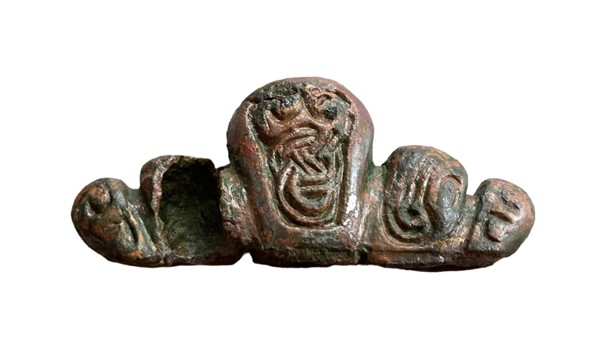
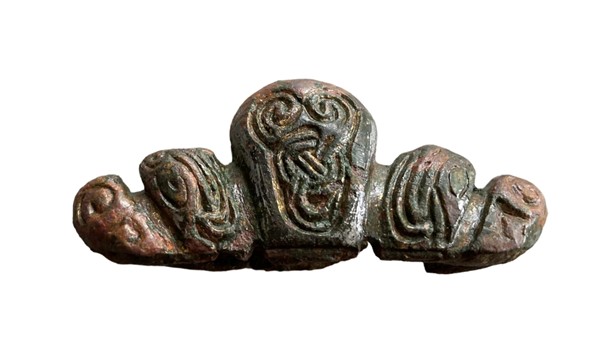
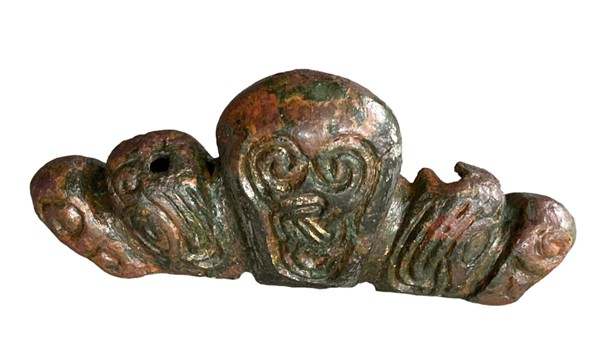


The distribution area of this very specific type of pommel cap – north-west Germany and southern Scandinavia – clearly shows the possibility that this pommel cap could have been brought – and most likely made – in/from one of these areas. We must therefore look at the object itself and then we can call it a ‘Viking’ without further ado, purely because of its decoration style, nor apart from the ultimate function it had. Because these are of course two different things.
The pommel cap is of course part of a so-called loose find, without further context. If this pommel cap had been found together with – demonstrably – other Scandinavian objects, then the find spot could indicate a (small or larger) settlement of people from Scandinavia in this part of Friesland, which at the time extended from Zeeland to Friesland. Such a – most likely – settlement in the Frisian area was Walcheren, where various objects with a Scandinavian or, as I described in Vikings and the objects from the Viking Age (2023) ‘objects with a hybrid’ Frisian-Scandinavian decoration style.’ It would have been even more spectacular if this pommel had been found in the context of a grave. But both – with emphasis: possibilities – are not relevant here, for the time being, because the find is a loose metal detector find. However, that may still change, because the Fries Museum has been granted exclusive access to continue searching in the soil where the pommel was found.
This does not make this find inferior or secondary for the undersigned. On the contrary: it is one of the most exciting finds made in our country in many years. It shows, once again and unmistakably – for those who still doubted it – that there was a Scandinavian presence in our Low Countries. Although this is (still) difficult to see in archaeology, it must have lasted longer in certain coastal areas of the area that used to be called Frisia and that ran from Zeeland to beyond Groningen. An aspect that is still relatively unknown to many is that Frisians themselves sometimes went on raids or traded with these Vikings as mercenaries or out of conviction. Some Frisians were therefore themselves subject to Viking behavior. It is therefore very possible that one of these two aspects caused the pommel cap to end up in the ground near Witmarsum. To be found again a thousand years later.
The object could therefore have been part of a sword that was used for fighting, or it could have had a decorative value and was exclusively associated with it.
A book or novel could be written about this beautifully decorated pommel… for those who can imagine it!
In the meantime, the pommel has been registered with the Dutch equivalent of the PAS, the PAN (Portable Antiquities Netherlands, ed.) under number PAN-00156039 and has been given a place in the Fries Museum, where, after first being exhibited in the National Museum of Antiquities, it will have its “final resting place”, in the heart of the province where it was found.
Sources:
https://nl.wikipedia.org/wiki/Pommel
http://www.vikingage.org/wiki/wiki/Swords
https://uu.diva-portal.org/smash/get/diva2:537484/FULLTEXT01
Gustafsson, N.G., A Viking Period Metalworking Hoard from Alvena in Mästerby parish, Gotland, Fornvännen 106 (2011)
https://finds.org.uk/databse/artefacts/record/id/995783
https://www.portable-antiquities.nl/pan/#/object/public/156039
https://www.miamiherald.com/news/nation-world/world/article295985799.html
Thanks to: Sander Visser, Caroline Peterson and Ny Björn Gustafsson.
October 30th 2024.
Often overlooked: the viking horse harness cheekpiece part.
In this blog I’d like to discuss an – easily overlooked – object type from the (late) Viking period, wich have been found, be it scarcely. The horse harness cheekpiece part imaged hereunder had been found in Norfolk and is measuring 5,7 centimeters in length, 4 centimeters in width and weiging 24,13 grams.
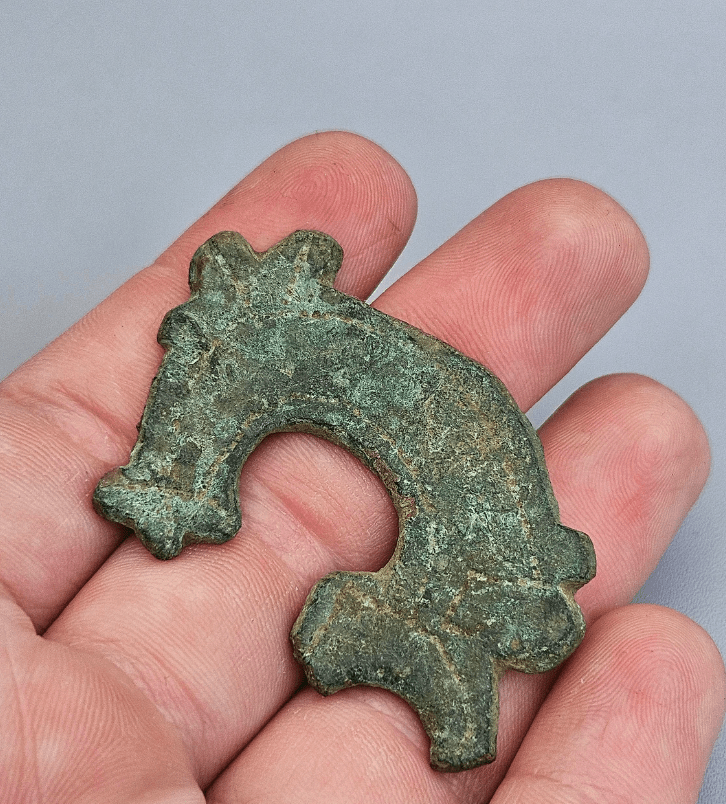
The (late) viking horse harness cheekpiece (part) is somewhat puzzling when it comes to terminology. Being it the proper describtion, it also is being categorized as ‘harness fitting’, ‘bridle fitting’, ‘bridle cheek’ piece and even ‘bridle bit’ (object types decribtions used by the Portable Antiques Scheme).
The horse harness cheekpiece – both described as ‘cheekpiece’ as two seperate words ‘cheek piece’ linked the end of the bit to the cheek strap of the bridle. The so called cheekpiece thus belongs to the horse harness and would have been attached to the reins, allowing the rider to control the horse. Sometimes fragments of this cheek piece are being found. Complete cheek pieces being found are extremely rare, because the way of their use. The fragment would have been one of two symmetrical loops forming part of an Anglo-Scandinavian horse’s cheekpiece – I will discuss the Anglo-Scandinavian nature of these cheekpiece(parts) further on. These fragments would have joined together at their inner edges with a hole in the centre forming a larger openwork plate. This would then have linked the end of the bit to the cheek strap end of the bridle.
Sometimes this hole has been worn through friction against the bit, causing the cheekpiece to be discarded. It is easily to imagine the fierce force being executed on the cheekpiece controlling the horse, especially in sudden situations. The breaking off of a part of the cheek piece not unimaginable.

The decoration seen on horse harness cheekpiece (parts) being found in England derived from the late Viking Ringerike style wich was in fashion during the reign of Cnut (1014-42) and may have had a longer life in England. The decorational style is considered as a ‘late viking inspiration.’ The Anglo – Saxon adorers or Norse inhabitants from the Danelaw adopting it and spreding it further – interpretation of the Scandinavian Ringerike style developed into a distinct own style within England: the Anglo-Scandinavian Ringerike style. The cruder form of ornamentation and decoration is characteristic within this so called ‘sub’ or ‘hybrid’ style.
The Ringerike style, named after the place in Norway, first appeared in the 11th century in England. This style was popular just before the Norman Conquest of 1066. The style originated in Norway, but use spread throughout England and the majority of Ringerike objects found in England where made there. After the Norman Conquest the Norman rulers replacing the older ones favoured different styles of art and design, drifting away from the (Anglo) Scandinavian art style into romanesque art style. By 1070 AD seemingly the Ringerike style was out of fashion, though Jonas Lau Markussen argues that ‘The Ringerike style was widespread throughout Scandinavia and all the Norse settlements, particularly in the British Isles, where it inspired many of the local styles, and even found great popularity in the Irish regions, were it was extensively adopted and, among other things, directly inspired a few manuscripts. It continued to be used in this region even after it faded and transitioned to the Urnes style in Scandinavia.’
Mostly representing a crudely formed horse’s head, on – much – rarer occasions horse harness cheekpiece parts are being found witnessing a more puzzling – seemingly one-off – design. The example shown hereunder – also having been found in England – is showing the Ringerike style in a more clever, puzzling way.

Although it is virtually impossible to acertain, different images seems to appear turning the part of this horse harness cheekpiece around, recalling the “hidden faces” imagery so often to be recognized in artefacts from the Viking period.
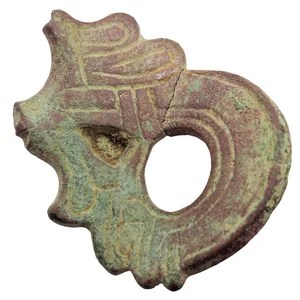
The “beast” could have has a long bill or snout and the body encloses an oval opening – but imagery is, as always, in the eye of the beholder !
See also:
References:
Portable Antiques Scheme England
https://elmbridgemuseum.org.uk/a-special-donation-to-elmbridge-museum/
June 12th 2024
In this blog, David Mullaly shares another intriguing artefact with us from the Viking period.
A reconsideration of a familiar Viking stirrup mount
Viking Period bronze stirrup mounts, installed to fasten stirrups to the leather straps hanging down from saddles, are artifacts frequently found in random places. They had a practical design, but it would appear that they frequently failed their riders, with one or more of the three iron rivets becoming loose—and the mount subsequently lost. One of the most familiar Viking stirrup mounts, given the many known examples of the artifact, is the roughly triangular one which David Williams identifies in his Late Saxon Stirrup-Strap Mounts as a Class A Type 8 form. Often displayed upside down so that they look like large wolf heads, these are among the most clearly defined examples which he illustrated:

At their best, the mounts include beast heads which are fairly abstract, and many of the other features are relatively shallow. Williams suggests that a review of examples of this type tends to confirm what appears to be a gradual
deterioration or “debasement” (his word) in form, and he asserts that this type offered the best example of a rapid stylistic attenuation in a stirrup mount. The examples which Mr. Williams pictures above—there are twenty nine in his catalogue—he presents as the prototypes of later diminished stirrup mounts.
That conclusion may have been premature.

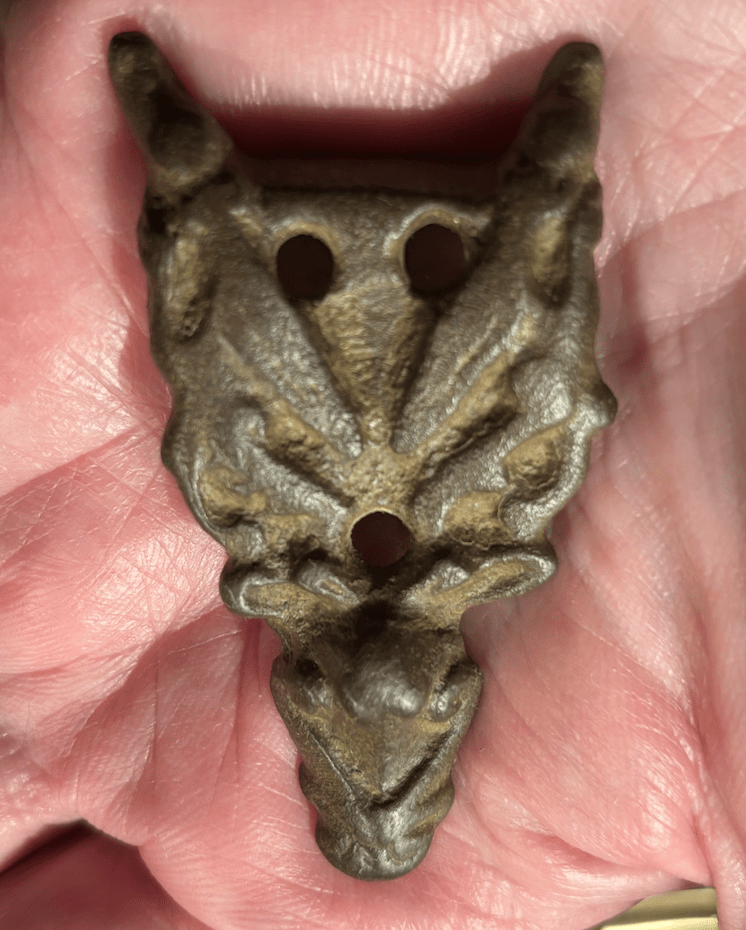
In fact, a recent find in Lincolnshire seems to offer an even earlier version of this stirrup mount. Found not far from Boston, the example pictured above is larger—at 63mm—than most of the pictured Williams mounts. In fact, almost all are considerably smaller. More noticeably, the head of the beast at the top is much larger proportionally, and more defined than any examples provided by the author. Interestingly, between the large ears of the beast are two stubby-looking horns. None of the examples Williams provided, or any other examples that I’ve seen, have a feature resembling horns.
Like a few of the illustrated mounts, this one seems to have the remains of inlaid silver wire on what the author labeled as wings. The narrow ledge on the bottom reverse is typical, and unremarkable. However, the raised elements of the beast body seem unusually distinct.
Honestly, I had always believed that this type of stirrup mount pictured a cowering animal, belly up, with its four legs tucked under it, but this example provides a clear winged beast with its back to the observer.
Whether this particular stirrup mount represents an extremely early version of the Class A Type 8, or if it was simply an unusual variant produced contemporaneously is unknown. However, if one accepts Williams’ scenario about the “debasement” of the type over time, then this newly discovered example is likely one of the earliest forms of the type made in the United Kingdom.
June 6th 2024
In this blog, David Mullaly, a long time friend of mine and passionate vikingolist shares an intriguing artefact with us from the Viking period.
A Viking artifact and an appeal for Valhalla
One of the most intriguing and evocative Viking-related finds from the Rus Viking region that has been found – and that’s figuratively covering a lot of ground – is a dark bronze figure of a Scandinavian-looking man with a sword, carrying in one hand what looks like a huge bracelet made from twisted metal. There is no evidence of a fastening element on the reverse or a suspension loop, so the artifact was not intended to be worn. One writer has suggested this subject for the artifact: “the triumphal entry of a fallen warrior into Valhalla with a ring of oath.”

We know that during the Viking period Norse men were often given bracelets or armrings by leaders as a reward for their general loyalty, or fidelity to an specific oath or commitment that was made. And these typically gold or silver armrings were apparently proudly worn. Staying true to an oath was an extremely important virtue for a Viking. If you gave your word, you had to mean it.
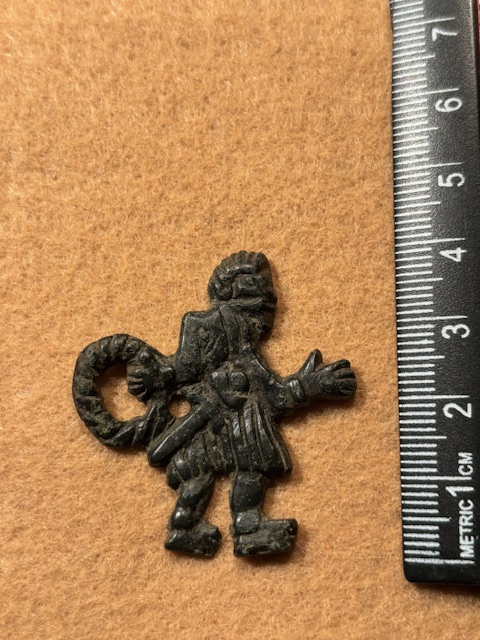
The following commentary is from a Russian website: “At the end of the XIX century, in one of the mounds of the Mogilev [Belarus] province, a bronze figurine of a man with a sword at his belt and a circle in his right hand was found (Fig. 5.4). It was wrapped in bark and covered with planks. Exactly the same figurine comes from the Daugmale hillfort in Latvia. Several works are devoted to both finds. F. Balodis considered the Latvian figurine as an import from Sweden. According to E. S. Mugurevich, both figurines, probably cast in the same mold, were made on the territory where the Daugava – Dnieper route passed. A detailed analysis of these items, undertaken by V.P. Petrenko, led the author to the conclusion that the castings of Latvia and Belarus depict a Scandinavian and both figurines are the products of a Scandinavian artist.” http://ulfdalir.ru/literature/735/2182
Given the description of the context of the find in Belarus, it’s plausible that this type of amulet was intended to be a burial object for a deceased warrior, and thus a statement about his having taken an oath seriously—therefore deserving of a place in Valhalla. Given the obviously pagan aspect of the figure, the item was likely made in the 9th or early 10th century. Whether this type of artifact was made in Scandinavia and brought to the distant Rus Viking lands, or if a Scandinavian craftsman far from home made it, is open to question and further research.
The Daugmale example is currently the only featured and pictured artifact on the home page of the website of the National History Museum of Latvia, indicating its importance. Another example was found near Chernigov in central Ukraine. Including the intriguingly packaged figure described on that Russian website, there have apparently been seven examples found. Each offers a fascinating glimpse into the lives and perspectives of the far-traveling Vikings.
January 10th 2024
Two Viking Artifacts and the Fates
In this blog I give way for an article written by a longtime friend from the States with wich I feel honoured to share the same passion about the Viking period and the artefacts of that time for almost two decades now, David Mullaly.
One of the most distinctive elements of the Norse world-view involved a belief in the power of destiny, which determined how their lives would unfold, and of course how and when they were fated to die. Embodying that sense of inevitability were the three Norse fates or Norns, These were the Norse goddesses of destiny, identified as three sisters named Urd, Verdandi, and Skuld. They lived underneath the world tree, where they wove the strands which make the tapestry of life.
There are historical precursors. Unlike the Norns, the Greek version of the Fates each had a particular function. Their names were Clotho (Spinner), Lachesis (Allotter), and Atropos (Inflexible). Clotho spun the “thread” of human fate, Lachesis dispensed it, and Atropos cut the thread. And the derivative Roman version was the Parcae. Presumably, these earlier trios had a direct influence on the Norse belief in the Norns.
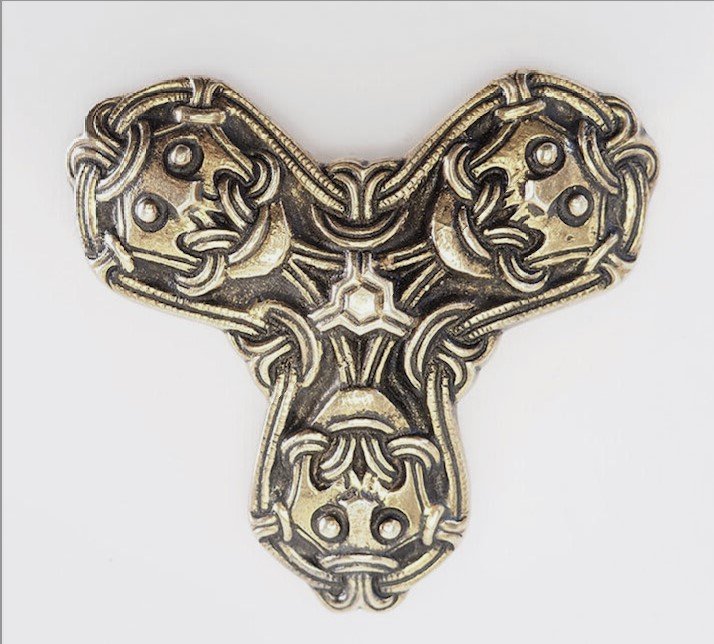
Given the importance of the role of Fate and the Norns for the Nordic people, one would have expected that some sort of representation of them would have been found among the artifacts which have survived, and such would seem to be the case. However, the rarity of those is obvious. One very strange-looking trefoil brooch was found at Kvarberg Hill in central Norway, and is currently in the Museum of Cultural History of the University of Oslo.

A fairly flat bronze three-lobed brooch, it features three large heads with double strands looping into the open mouths from the sides and then out from below the chins. Note that the strands connect to the other heads through a trefoil shape in the middle of the brooch. Although the faces are recognizable, their features are unrealistic, and are closer to cartoons than human heads.
The only commentary I’ve found for that Kvarberg trefoil is in Jan Petersen’s seminal work Viking Age Jewelry (Oslo, 1928) on p.108. There he says that it’s “highly peculiar,” and is a “genuine product of the Viking Age’s imagination.” He also notes that it was an isolated find (and so not reliably datable), but “is clearly characterized by the Borre style” of decoration. He says nothing about the possible subject of the decoration.
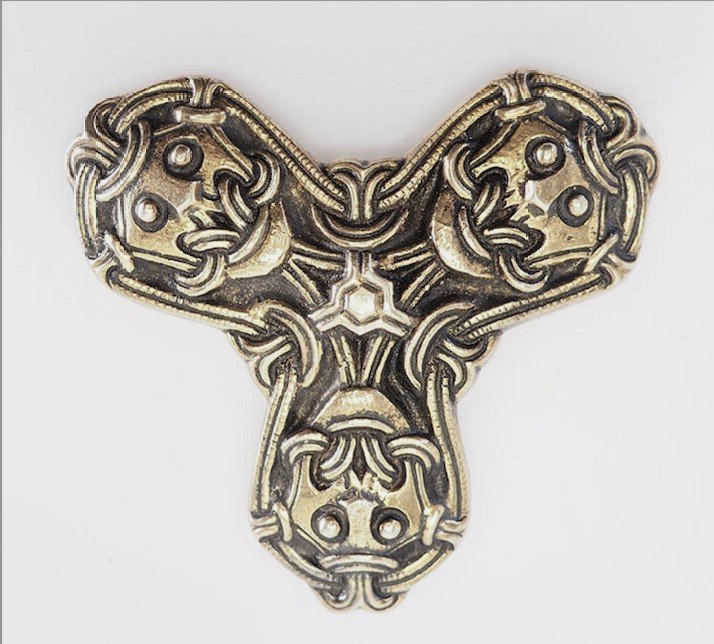
Modern jewelry designer David Andersen made many reproductions inspired by that find. Although the contours of the modern brooches are considerably deeper, the basic design is the same: three large heads with double strands looping into the open mouths from the sides and then out from below the chins. Although a large number of this type of reproduction have been sold on Ebay and elsewhere, no one has tried to analyze or even describe the distinctive image.
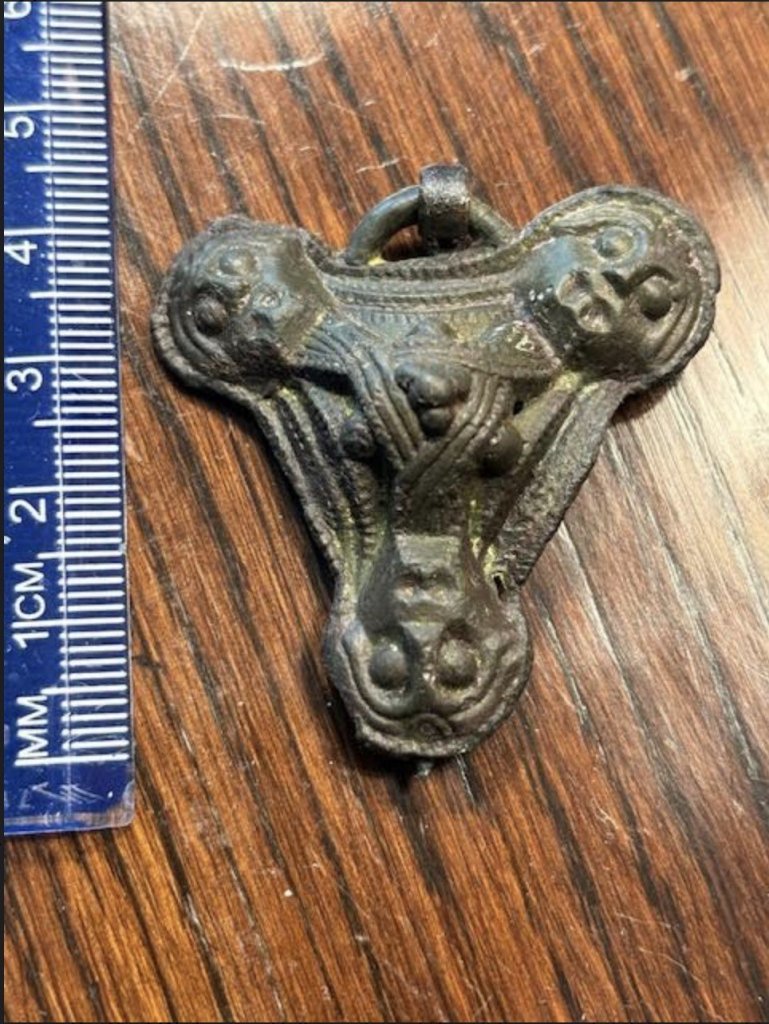
Another intriguing artifact has been found in the Rus Viking region, and therefore it probably originated in Viking Sweden—or was created far from home by a Swedish craftsman. Like the brooch found in Norway, it has a trefoil shape, but it includes a startling number of differences. First, the faces seem more realistic than the Norwegian find. Although the eyes are bulging, the visage is distinctively human-like, and may suggest an Oseberg style. The shape and details are all representational. The pair of triple cords or strands lead to the chin, rather than involving interlace around the face and under the chin.

The divided shape of the mouth suggests that the pair of triple cords are meant to be seen as emerging from the mouth—perhaps they are speaking the fates of men. There is also a roughly semi-circular emblem on the forehead of each face, which must have had some sort of symbolic significance. As the twin cords leave the face, they cross each other and join with the others to create an interlaced raised mound or boss in the middle with three small balls defining the central trefoil shape. All three faces are linked to each other by the interlaced strands.
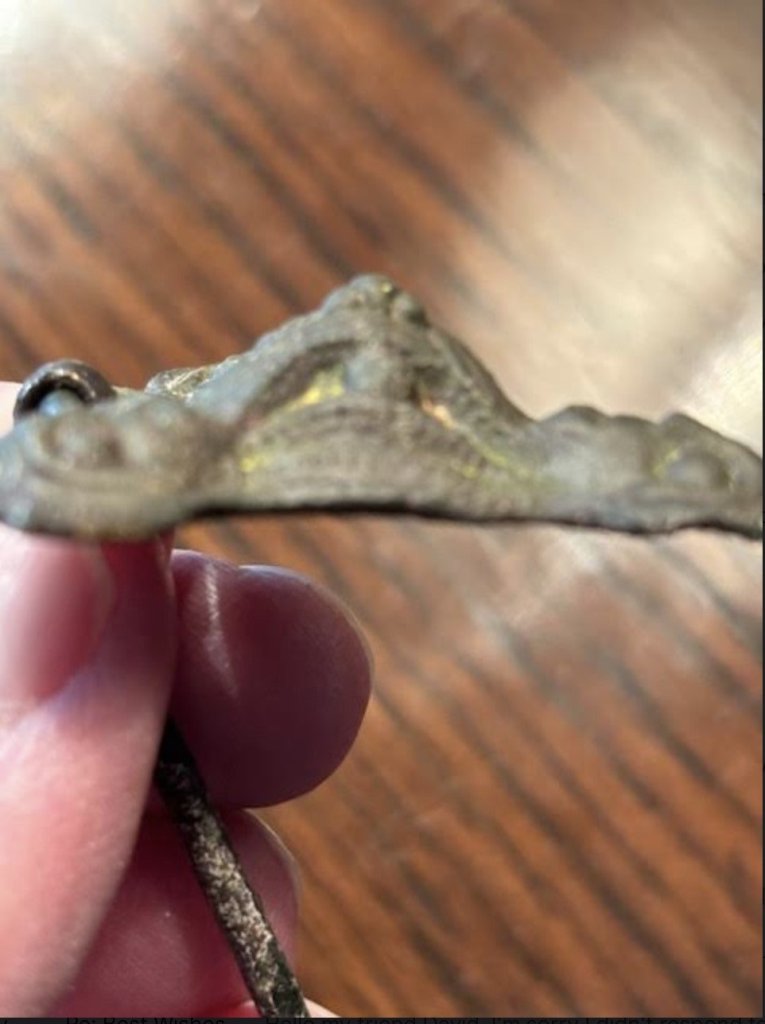

Unquestionably the most startling structural feature of the brooch is the pin assembly. Typically, trefoil brooches, and almost all types of Viking brooches, show at least traces of a pin pivot and a catchplate on the reverse. In this case, however, there is a single integral loop on the outside between two lobes, with a long pin and the slight remains of a catchplate on the back. Jan Petersen’s book has pictured thirty-one examples of trefoil brooches, and none of them have even a trace of that loop at the top between the two lobes. I’ve never seen that sort of pin assembly on any trefoil—or any other type of brooch.
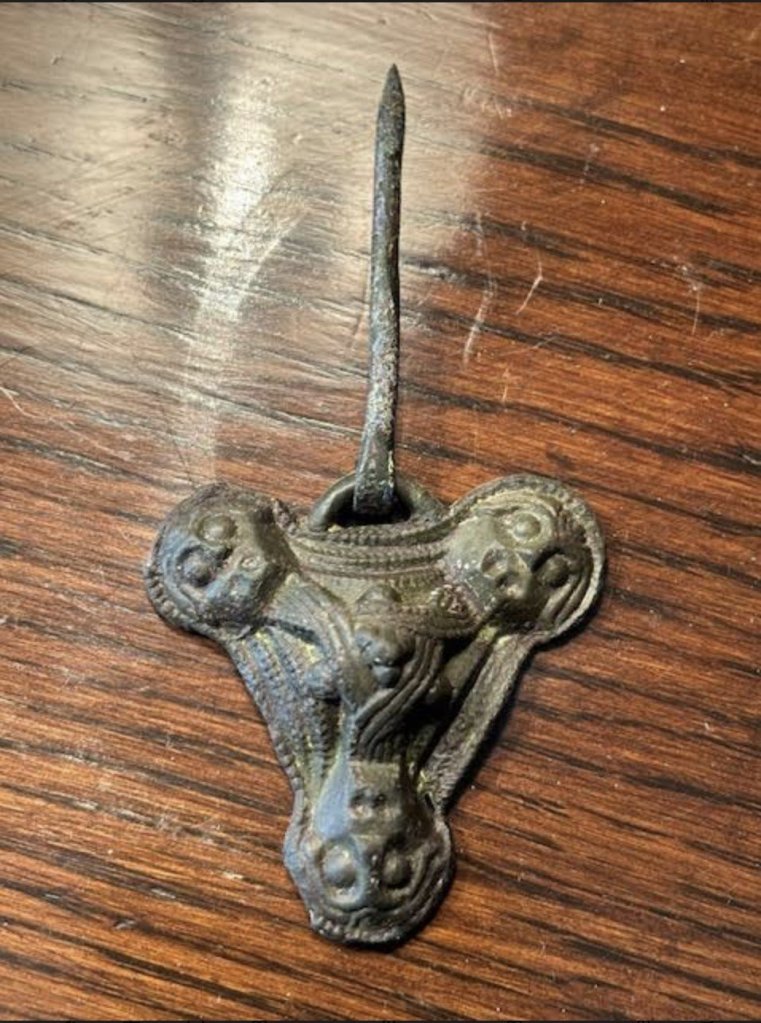
There’s almost no possibility that this trefoil brooch was a one-off—a single item which was unique when it was made. Given the labor and expertise which would have been required to make the mold for the brooch, there surely would have been multiple examples made. The casting involved in the creation of this brooch is impressive. The texture covering almost every part of this piece of jewelry suggests great skill and an attention to detail.
Because of the Borre characteristics of the Kvarberg trefoil brooch, a tenth century dating for its making is reasonable. Given what must be described as a much more complex design of the Rus Viking example, an even earlier date is quite likely. One often sees types of artifacts being slowly degraded or attenuated over time in their decorative complexity, and the Kvarberg example seems to be a simpler version of the other one. Plus the distinctive and relatively primitive pin arrangement of the latter hints at an earlier time frame as well. This could be a 9thcentury item of jewelry.
Identifying the imagery of these two trefoil brooches as a representation of the Viking Norns is admittedly conjectural, but it seems as good of an interpretation as any. If only the Norse people had provided clearer cues or commentaries about some of the “highly peculiar” objects they created, our jobs as historians or analysts would be so much simpler. However, they were busy living their lives, and exploring the world that they knew. Ultimately, some of their artifacts, like these two trefoil brooches, simply whisper quietly to us, and we must listen carefully in order to try and decipher what they say.
September 17th 2020
The Elusive Face of the Viking God Thor
In this blog, I like to give way to an article, written by David Mullaly, author of novels about the Viking Age addicted lover of artefacts from the Viking Age, but, above all, a by me truly valued estimated specialist when it comes to knowledge of Viking Age artefacts. My ally overseas and soul mate.
Hereunder he discusses the representation of the Norse god Thor on artefacts from the Viking Age.

In this blog, I like to give way to an article, written by David Mullaly, author of novels about the Viking Age addicted lover of artefacts from the Viking Age, but, above all, a by me truly valued estimated specialist when it comes to knowledge of Viking Age artefacts. My ally overseas and soul mate.
Hereunder he discusses the representation of the Norse god Thor on artefacts from the Viking Age.
The Elusive Face of the Viking God Thor
The two most popular gods in the Norse pantheon were Odin and Thor, and it’s reasonable to expect that the Norse people would want to represent them in decorations on their jewelry and other items. Some artifacts decorated with images of human-like figures, the identities of some of which are unclear, provide a few clear markers for Odin.
If the face has only one eye, and the other eye is unquestionably absent, then the object was presumably intended to provide an image of Odin, the Allfather. He was willing to give up one eye in exchange for wisdom. If the human-like image includes the figures of two birds, Odin again is indicated. He was provided with two ravens, Hugin and Munin, who traveled the world to get information about whatever interested Odin. As I suggested in another commentary, The Odin Mount Revisited – The Converting Element, this supernatural being may also have been represented wearing some sort of interlaced crown or head piece.
Other artifacts featuring a realistic face of a Norse male with large round eyes have been identified as a representation of Odin, although one should take that attribution with at least a few grains of salt.
Finding images intended to represent Thor is more complicated. Of course, Thor has his hammer, called Mjölnir, as a symbol. Many examples of hammer pendants have been found over the years—in gold, silver, bronze, bone, lead. In fact, some were probably made of wood, although long-term survival was always unlikely. However, exchanges with experienced metal detectorists, and by extension with UK Finds Liaison Officers, suggest that some artifacts found with more abstract faces were intended to represent Thor. These are in some cases clearly representative of the “hidden faces” inclinations of Norse craftsmen as I have written about in The hidden face motif in Viking Age artefacts.
Example A is a bronze buckle plate with some surviving gilding, found at Pocklington, near York. A pair of flanking vertical beasts lead one to a crude face in the center surmounted by what might be seen as a pointed helmet, and the beasts become long hair next to the face. This was identified by a FLO as a face of Thor.

Example B is a lead weight or game piece with a gilded bronze insert showing an alien-looking face with an elongated neck and slanted eyes, found near York. Again, a FLO identified this as a representation of Thor. The shape of the head and long neck is similar to faces found on various Norse-Finnic tortoise brooches and other artifacts, but the eyes are very different.

Example C is a more complex artifact. Found near Malton in the Yorkshire Wolds, it is a complete large lead strap end with a minor period repair on the back of the fastening plate. When the item is examined with the flat area at the bottom, one can see at the top a raised area which provides the shape of a winged beast, and on the outsides snake-like animals with gaping mouths about to swallow something round. When the flat fastening area is at the top—which is how the piece would normally be viewed–a clear stylized face with prominent round eyes, a nose, and a smiling mouth is visible.
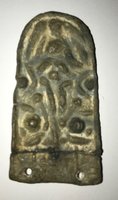
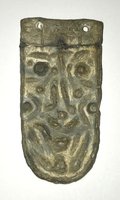
Example D is a very large (63mm long) bronze strap end found near Blackpool, north of Liverpool. While the decoration is fundamentally a Borre knot chain with deep contours, there is a clear stylized face featuring a frowning expression with a prominent nose created by joined knot triangles. Below that appears to be a grimacing mouth. A typical Borre knot chain involves a deliberate symmetry, involving loops of an equal size (see the darker example), whereas this one is much larger at the top, emphasizing the asymmetrical face element. The difference is subtle, but quite visible.


In each example, the face of the being displayed is mysterious: the features are either just hinted at by a shortage of details, or obscured by stylized features which distance us from a human-like representation. Whether the Norse believers in Odin and Thor saw one as more human-like and relatable, and the other as enigmatic and less so is open to question, but that difference wouldn’t surprise me.
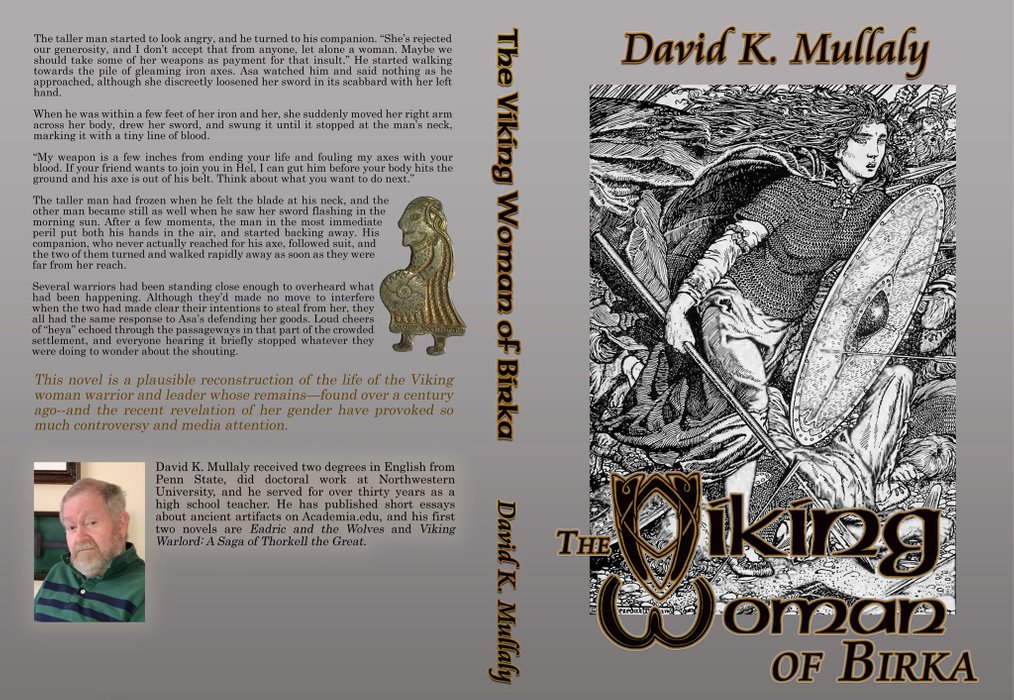
Note: after publishing Eadric And The Wolves: A Novel of the Danish Conquest of England and Viking Warlord: A Saga of Thorkell the Great have published his third novel: The Viking Woman of Birka.
See for latest news on David Mullaly on his Facebook page.
See for other articles written by him about Viking Age artefacts on:
https://psu-us.academia.edu/DavidMullaly
November 4th 2019
Exhibition We Vikings in the Fries museum *****

Yet another exhibition about the Vikings? One would think it light in the last decade with all the Viking violence that has flooded us via museums and festivals etc. How the Viking crack can still be pleasantly surprised becomes clear during a visit to Wij Vikingen in the Fries Museum.
Admittedly: the undersigned is of course spoiled rotten and not representative of the average visitor. A museum must come from a good home if it is not easily surprised by beautiful objects, if it is to be taken by the scruff of the neck and not let go. That is exactly what happens at Wij Vikingen, which lets the history of Frisians and Vikings in the coastal area of the Low Countries shine upon us in a chiaroscuro.
First of all, the title of the exhibition is well chosen: what always seemed ‘something Scandinavian’ now also appears to appeal to a national identity. And that always works well in these times. An interesting perspective is shown immediately upon entering. The coast of Friesland seen from Scandinavia. A coastline that, projected in this way, forms a much more natural-looking part of ‘the other side of Scandinavia’.
What is an exhibition without appealing objects? The Fries Museum does exactly this: exhibiting as much as possible of what has been found in this province – or just outside it. And not just the usual suspects such as the silver treasure of Wieringen or the gold bracelet found in Dorestad, but numerous ‘off the grid’ objects. Just as Scotland has The Lewis Chessmen, Leeuwarden has its own Leeuwarden chess piece. Never knew that. Recent finds such as a dragon-shaped end of a ring-brooch, found in Hallummerhoek or half of a Hiberno-Scandinavian bracelet, made in Ireland and found in Texel are shown. Beautiful golden bracteates in Scandinavian style with Odin and animal figures from the terp area of Friesland or a glass bead necklace with an enamelled cross from the early Christian period, they show a very diverse jewellery and utility splendour that takes you back to other times. Cloak pins in Jellinge style; these were also found in Friesland, or diamond-shaped brooches in the Borre style. During a tour of these objects, Friesland feels more like the southern post of Scandinavia than like one of our northern provinces. A claw animal amulet, a pendant with Wodan figure, enamelled… it is all very intriguing. Was this in a depot all this time? It should be on permanent display. Such an exhibition from October to March next year is of course much too short. In addition to the native objects, objects from other countries where the Vikings and Norsemen stayed are also exhibited. However, they are complementary to the objects that steal the show: the finds from the Frisian coastal area. Far beyond the rather infantile barbaric one-sided representation of matters that people often want to convey about this Viking age, these objects speak for a highly gifted, refined, creative culture that deserves much more study and attention.
The second pleasant surprise is that this exhibition is simply one for adults. Of course, there are also all sorts of things organised for children, but nowhere does this overpower the design. And yes, behind me I suddenly see a man in shirtsleeves with a plastic Viking helmet on who, together with someone else, grabs a fake sword and sees their own shadows projected on a wall, making it look like you are fighting as a Viking and then you have to take pictures of that. It turns out that this cannot be eradicated completely, but they remain – thanks to Odin – incidents. In a replica – to scale – Viking ship, a seated tour is given and an explanation is given of what it was like on such a ship. Around it are display cases with various coin treasures that are beautifully lit. There is still a downside to the exhibition: not all objects are shown to their best advantage due to somewhat poor placement and lighting; sometimes the dark Middle Ages are given too much honour. But lo and behold.. another pleasant surprise: the accompanying exhibition book
Wij Vikingen – Frisians and Vikings in the coastal area of the Low Countries. This does exactly what it should do: provide further explanation in text and – and above all: show all those beautiful objects – here now – beautifully illuminated, enlarged. Hurray.. hurray! This is what you’ve been waiting for. Beautifully designed – of course, there must have been a budget for it, as evidenced by the daily advertisements on public broadcasting on TV, but compiling such a book is also an art in itself. It has truly become one of the most beautiful exhibition catalogues/publications I have ever seen. This is the way it should be done!
A jewel in every bookcase or on the reading table.
The Fries Museum has done exactly what it had to do. Returning treasures found on site to the light of day and thus showing a part of our history in all its glory. Let it also be an encouragement to metal seekers to show their finds on loan – whether or not temporarily at an exhibition. How much richer we have become in our knowledge of objects thanks to these seekers. Please show them. For the sake of beauty, for research, for our historical awareness!
There is definitely more than Rembrandt and Van Gogh.
Of which note.
November 28th 2018
About horses and gable top signs..
For a number of years now I have had the pleasure of knowing the east of the country and getting to know it even further. Here you see all kinds of things that embody the connection with the pre-Christian. Gable top signs on farms and barns are an example of this. Below you see my dream house. Having moved last year from the increasingly crowded The Hague to Zwolle, I can already enjoy the peace and space that is here, but one must keep a dream in the offing. Apart from that I have experienced once again that it is good to change your place of residence once every 10 or 15 years.
Back to the dream house below. It is located somewhat remote, near Nutter in the Twente Dinkelland in the typical ash/coulisse landscape of these regions. The wooden roof molding is embellished by a so-called gable top sign, with two crossed horses.

The horse head motif is a very old motif. The oldest horse heads that have been preserved – from a find in a well of the rampart castle Altenberg in Hessen-Nassau – date from the last century BC and are considered Germanic. The origin of the wooden horse heads as facade decoration is somewhat obscure, as will become apparent later. It is sometimes stated that they originate from the horse skulls on poles. In German these ‘Neidstangen’ are known and already appear in old Norse texts. The horse head construction has a function of warding off evil and is called ‘nidhstaong’ in these texts: various main characters from sagas try to drive away opponents with this pole.
As late as the 1970s it is mentioned that in Schleswig-Holstein the popular belief is that a horse skull on the house and its inhabitants brings luck and prosperity. In various German areas it is known that horse skulls are placed above the stable doors in order to protect the horses present from disaster and disease. How you would think about this as a human being, if a human skull were to serve in this way, is a good second, but since a horse has a larger head, one should leave the thinking to that.
The horse skull was also well used in Poland; above the entrance door it protected against the plague.
In Northeast Twente, horse heads remained in use as a gable sign the longest, especially east of Tubbergen and north of Losser. The horse was an inseparable symbol for the Twente farmer, on which in fact his entire existence depended. In the Holtstein village of Jevenstedt there were still five houses with horse heads in 1875, one of which was called ‘Hengst’ and the other ‘Hors’. Associations with the names of the Saxon conquerors of England have been made in this context.
Nightmare
The horse heads above the entrance doors of the barn in the eastern Netherlands are also associated with the nightmare (corrupted to nightmare). Depicted as a tormenting spirit, it would sit on the bodies of sleeping residents of the house, thus obstructing their breathing. The nightmare wandered around in the form of a woman – nowadays this would of course lead to heated debates, but in the past the world was clear-cut. The witch was a woman, so was the nightmare. The nightmare was even more eager for horses and these were then deadly tired early in the morning by this uninvited rider. Originally, the nightmare was supposed to be an air elf. Mistletoe and – there they are again – crossed horse heads served to avert this disaster. The horseshoe nailed to the stable door was also supposed to have the same purpose. Scattering salt crosswise in front of the bed was also supposed to provide a solution – see the link with the crossed horse heads.
Lightning and thunder brooms
In Northern Germany and Westphalia, people believed in the lightning-deterring powers of crossed horse heads on the farmhouse. In addition to horse heads, the thunder broom gable signs bear witness to this popular belief. Until after the Second World War, there were folk storytellers who told traditional stories about ‘the Wild Hunt’ ‘an ’n heerd’, in which the horse plays a role as a destructive force that can also strike a farmhouse. The wild horse could be scared off by its own image on the house.
Problematic
In the development of horse heads, if you like: visual language, it remains problematic to find out how strongly constructive, unintentional factors played a role, and to what extent certain elements were intended symbolically. Some see the wedge-shaped ends of ridge beam supports on prehistoric Western European house shapes as the elementary initial stage of the horse head motif. People protected themselves against the evil eye by sticking their index and middle fingers up in a V-shape, as a means of defense.
Be that as it may, these types of gable top signs remain visible and appeal to the imagination, even today. Even if, like the undersigned, people knew nothing about them in particular until recently.
Want to read more?
Jans, J. and Jans, E. Gevel – en stiepeltekens in Oost-Nederland (1977).
Blog september 20th 2018
Greenlandic mythology – about a dog’s head on a human body.

Gitz-Johansen sighed, already in 1949, that young people from West Greenland had no idea what a tupilak was anymore. Progress – technical progress – in Greenland was proceeding rapidly, causing the old, original culture to die out and be forgotten. He decided, like a kind of Edward E. Curtis, to interview the ‘last of the Mohicans’ in Greenland and to record his impressions of the specific Greenlandic Inuit myths.
When – Vikings or not – from Scandinavia ‘discovered’ Greenland in 985 A.D. they were of course unfamiliar with the peoples who had lived there before them. The first inhabitants had already appeared around 2500 BC. The so-called Dorset culture manifested itself around 700 BC. This culture eventually disappeared, but the Late Dorset culture came to the island around 800 AD. and limited itself to the northwest of Greenland, to disappear around 1300 AD.
Greenland seems to have been uninhabited at the time of the first Norse settlement, but after a few centuries people did have to deal with the Inuit. The Thule-Inuit were the successors of the Dorset culture. The Iceland Annals are one of the very few sources that describe contact between the Inuit and the Norse population. Hostilities are mentioned on both sides, but archaeological evidence shows that trade must have been the main motive for encounters.
Many Norse artefacts have been found at locations where Inuit lived. Conversely, very few Inuit artefacts have been found at Norse settlements. Reasons for this have been described in very diverse ways. Indifference to the Inuit culture and decorative expressions thereof, among the Norse population, is one of them. Another is that the Norse population was only interested in perishable goods of the Inuit, such as meat and fur.
The mythology of the Inuit must have surprised the Norwegian population – if they were ever told about it at the time – but it must not have sounded completely alien to their ears. According to the Inuit of Alaska, Siberia and North America, the creator of the Earth and humanity was a raven. Because the raven has a creative function, people were also afraid of him in a certain sense. If you killed a raven, you could be sure that bad weather was in the offing.
There are differences in the stories about how the Raven ‘made’ man. For example, there are versions where he emerged from the bark of a vine. In other versions, he emerged from a pea pod. To explain the fact that the race evolved, they said that more people later emerged from the bark.

Certainly less recognizable creatures, such as Ajumaq, were of the more unpleasant kind. Half dog, half man, this dog-man monster caused everything it touched to rot and disappear. It was a creature that did not walk, but floated through the air, like a fly. I would have liked to show you a picture of this, but when I googled Ajumaq, I only got to see a beautiful lady – one has to be so careful with one’s words these days.
Another representative of this illustrious company of Inuit spirits and beings is Imap Ikua, who watches over the sea as an alternative Lorelei. The bad deeds of mankind appear as mud in her hair. Therefore she is angry, and collects all the seals in her hair, where they live as lice. From this it follows that, when the hunt is not successful, a sorcerer must dive for her, and comb her hair clean. Then she releases the seals and the hunters are successful again with the hunt.
As one of the last of the Mohicans in 2018, I spotted this outdoor exhibition in Quaqortoq. Inspection with binoculars revealed that we were dealing with an old-fashioned Inuit tanner, who kept a very alternative washing line. I was actually surprised not to have seen these scenes again. But anyway, it has been recorded again, for posterity. What remains of deep-sea monsters were hanging out to dry, besides the seal skins, has not become clear to me.
Hunting remains, even today, a risky business. After all, on the highest mountain peaks live small naked monsters, Makakajuit, always on the lookout for hunters when they come home from the hunt. As soon as they see a hunter coming home with prey, they fall on him and devour him.
Apparently this hunter was lucky this time.


Finally, the tupilak, which I bought as an amulet in Narsarsuaq, has a decidedly less poetic origin.
Tupilak is an evil spirit, which is created by sorcerers or witches. Bones of animals or birds were collected together and buried and hidden in a secluded place. When one day the sorcerer can no longer restrain himself, he visits the pile of bones and tinkers them together in the shape of a fantastic creature, but he is only allowed to touch it with his thumb and little finger, otherwise the tupilak loses its magic power.
It continues illustriously, ‘As he is reciting magic words over it, it draws nourishment from the sorcerers sexual part’.. an inflatable doll avant la lettre?
When it has acquired the desired shape, he sends Tupilak into the sea. One day, when the need arises, he issues a curse and orders it to go and kill its enemy. The latter usually dies at the mere sight of the tupilak’s terrifying shape.
In the Netherlands we have pretty much lost all faith, but those were illustrious times of faith, there in the far northwest of Europe. Still boring, if one would no longer believe in anything..
Read more (selective biography):
Gitz-Johansen: Figurer I Grønlandsk Mytologi – 2009;
Matthews, J. The Shamanism Bible – 2013
September 7th 2018
Where did Erik the Red stay and why did the Norwegian population eventually dissapear?
Greenland and the Vikings – or rather: Norwegian newcomers – are extensively told in the sagas. The Saga of Erik the Red, for example. How he and contemporary city marketing meet, I learned on our trip to the south of Greenland.
What in Narsaq is no more than a bunch of scattered stones, with apparently little coherence, may have more history than we suspect, based on the sources. Certainly, the story of Erik the Red who sailed to Quassiarsuk – better known as Bratthalid – and established his settlement there, is well-known. The manager of the museum in Narsaq added a new insight to that.
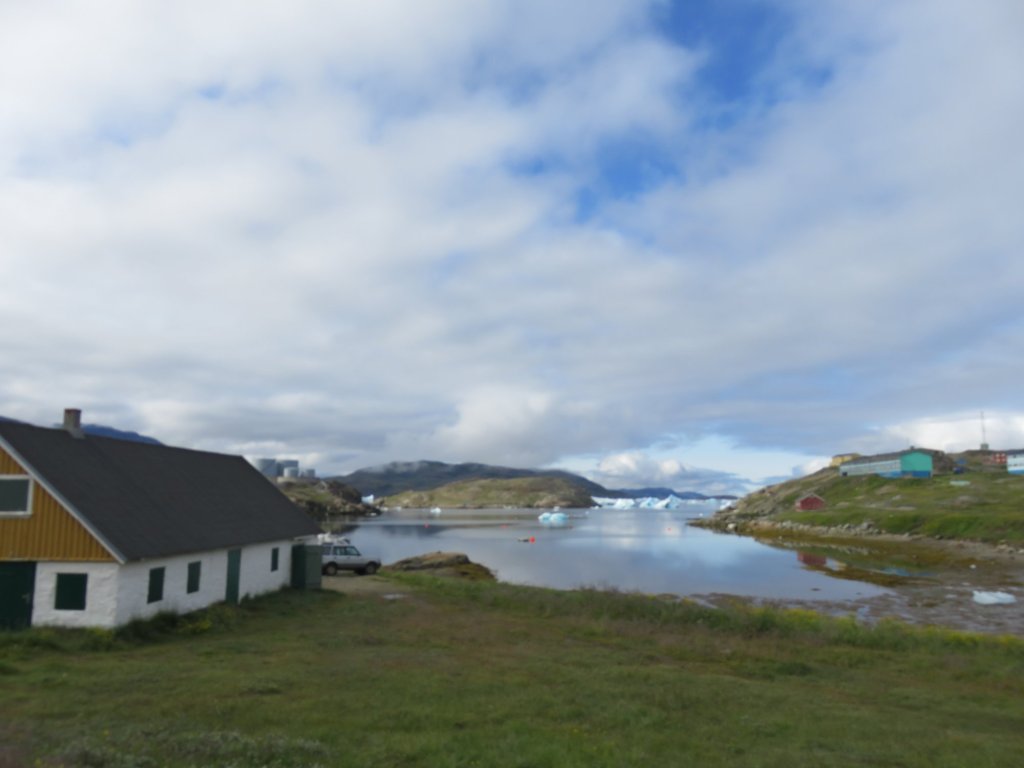
Erik the Red settled ‘next to a mountain’. However, in Bratthalid there is no – explicit – mention of that. In Narsaq there is – at two locations where the – inconspicuous, almost concealed – remains of Norse settlements have been found directly next to a mountain – and have not yet been fully investigated. The location in the photo above looks out over the bay at the beginning of Tunuliarfik – Erik’s fjord. The stone remains lie directly next to a mountain, where – how atmospheric do you want it to be – at least 125 ravens retreated for the night towards dusk. In the far northwest of the Narsaq peninsula, there are – if possible even more inconspicuous – remains of Norse settlements. Here again: right next to a mountain.
Be that as it may, I was actually quite surprised that the Greenlanders – and I don’t mean the ubiquitous Danes of course, but the Inuit – are quite proud that these Vikings had found their country. Apparently the scale of the Vikings was of such a nature and behavior that the advantages were mainly seen: trade, first. One had something that the other needed, or at least: interesting from the point of view of secondary necessity (luxury).

Luxury
That luxury, and the need for it, for modern nostalgic reasons or not, still exists today. Although it is hardly visible on the street, skins and ivory are still exponents of these needs among the Greenlanders. The skins of seals, processed as bedspreads on beds in a 4-star hotel in Qaqortoq. A vast remnant of a polar bear, a beautifully worked tooth of a narwhal on the wall of the lobby.
Back to Erik the Red. Let me start by saying that Erik the Red did not discover Greenland, of course, just as Leif Eriksson did not discover America. But is it known that not Erik the Red, but the Norwegian Gunnbjörn Ulfson discovered the island in 900 A.D., by chance? More than three quarters of a century before Erik the Red comes into the picture. Did Erik the Red know what to look for? And not just in terms of area, but also what was lucrative about it?
Did people in Iceland know in the course of the 10th century that walruses and their ivory could become a lucrative source of income, apart from the necessary first necessities of life. Did a demand for, the movement to this inhospitable place create? And, if the demand could no longer be met, did this create the movement back to the – now called Scandinavian – countries?

Erik’s green Greenland
Erik the Red tempted his followers to come to Greenland ‘because it was green there’, as a lure, or so the story goes. But this was not far from the truth. In Erik’s time the climate was even warmer than what we experience now. Greenland does look… green. What would that have been like in an even warmer climate? Compared to the west fjords of Iceland and the fjords of Norway, it would not have looked unknown or ‘hostile’.
Many theories circulate about why the Norwegian population eventually left Greenland. The worse weather in the 14th and 15th centuries is cited. Storms could affect a large part of the population in a single day, if the men were at sea, as happened in Shetland up until the 19th century.
It is possible that the plague in Europe was a driving factor, and that more than enough – by then more comfortable – areas became available. I would like to add a theory to that. As much is a matter of follow the money, wasn’t the rise of the Hanseatic cities and the trade with them in the Baltic region also a driving factor in the gradual depopulation of the areas in Greenland involved? Trade could not only be conducted over a larger area, closer to home. The diversity of the trade goods was also of course greater than that which could be exchanged in and out of Greenland.
Given this new wealth that had been heard of elsewhere in the homelands, people were simply fed up with eating seals somewhere on the edge of the world? After all, supposed (even greater) luxury makes the grass greener on the other side.

Be that as it may, scarce, often not yet investigated archaeological traces from the Norse period, do not yet provide a conclusive answer. In Greenland today, with tourism on the rise, they are a very welcome addition to history for the Inuit. A history that is sometimes told even more than the – much older – own history, which in my opinion deserves to be explained and explained more broadly. The mythology of the Inuit alone is a very wonderful one, about which I will tell more in a next blog. Traveling north..
Sources/read more:
Seaver, K.A., The Last Vikings – the epic story of the great Norse voyagers
2010 Map of Sydgrønland Kalaalit Nunaata Kujataa South Greenland – Tema om nordboerne I Grønland – theme: Vikings in Greenland, Arctic Sun Maps –
www.arcticsunmaps.com – uniquely detailed map showing all known – even the most obscure – ruins the vikings respectively Norwegian population (and Inuit).
http://www.sciencemag.org/news/2016/11/why-did-greenland-s-vikings- disappear
December 8th 2017
A Viking or Anglo-Scandinavian strap end with wolf (?) and entwined snake in its jaws from England.


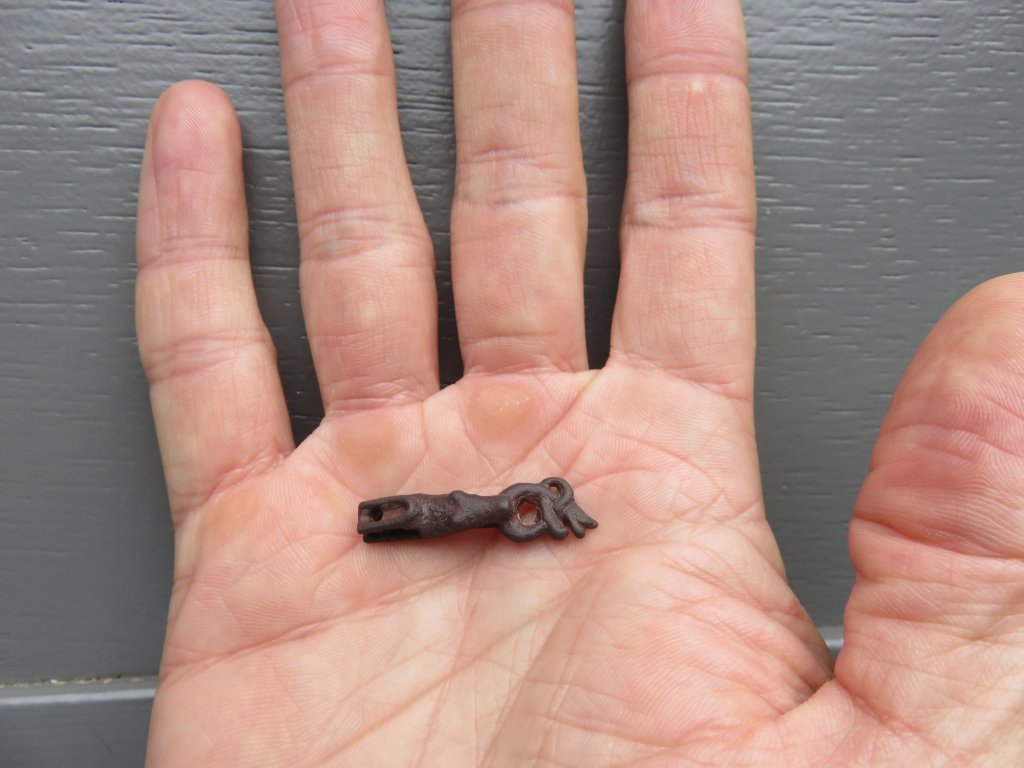
This remarkable tiny – 34mm x 10mm strap end from the Viking Age, found in England (Norfolk area) is a one-off. Decorated in the Urnes style with interlacing snake design, it can be addressed to the 11th century, the early 12th century the latest. The strap end seems to have attached on a small strap, considering its size. What kind of strap, or where the strap was part of, is unknown.
This artefact is once again witness to the fact to what great extent craftsman would go adorning all details of every day use objects like straps. The image depicted is that of a zoomorphic animal head (could be the head of a snake, could be another animal like a dog or wolf) holding a captured snake in its jaws. The pierced holes on the end of the strap end were for attachment on the leather.
The interwoven design of the curling snake is of great quality and is made by a very skilled craftsman within this tiny frame. The brown vaguely ‘reddish’ bronze is typical by artefacts from the Viking Age, made (and found) in England. Shown to Barry Ager, former curator in the British Museum, he reacted:
‘It does appear to be a strap-end in the form of some kind of canine, wether a dog or wolf, as you suggest, catching a snake in its jaws. Could it be Fenrir, up to his tricks, maybe? Viking examples of the type are usually decrated in the Urnes style, but this more is more naturalistic, so is presumably late in the series, later 11th centuries and stylisticaly in the Viking/Norman range’.
James Graham-Campbell adresses the design of the strap end as Anglo-Scandinavian. Shown to Kevin Leahy, Archaeological Finds Specialist and National Adviser at the Portable Antiques Scheme he responded that he would look for any parallels. Meanwhile, although the precise find spot won’t be given by the metal detectorist who found it, I have mailed the Find Liason Officers of the Norfolk area, and await their response. If new insights pop up, I will add them on this article.
In the Prose Edda, three books are mentioned: Gylfaginning, Skáldskaparmál and Háttatal.
There is an intriguing text in Gylfaginning on the relation between Fenrir and Jormungand. In chapter 34, High describes Loki, and says that Loki had three children with a female named Angrboða located in the land of Jötunheimr; Fenrisúlfr, the serpent Jörmungandr, and the female being Hel. High continues that, once the gods found that these three children were being brought up in the land of Jötunheimr, and when the gods “traced prophecies that from these siblings great mischief and disaster would arise for them” the gods expected a lot of trouble from the three children, partially due to the nature of the mother of the children, yet worse so due to the nature of their father.Gylfaginning, Skáldskaparmál and Háttatal.
In chapter 38, High says that there are many men in Valhalla, and many more who will arrive, yet they will “seem too few when the wolf comes.” In chapter 51, High foretells that as part of the events of Ragnarök, after Fenrir’s son Sköll has swallowed the sun and his other son Hati Hróðvitnisson has swallowed the moon, the stars will disappear from the sky. The earth will shake violently, trees will be uprooted, mountains will fall, and all binds will snap – Fenrisúlfr will be free. Fenrisúlfr will go forth with his mouth opened wide, his upper jaw touching the sky and his lower jaw the earth, and flames will burn from his eyes and nostrils. Later, Fenrisúlfr will arrive at the field Vígríðr with his sibling Jörmungandr. With the forces assembled there, an immense battle will take place. During this, Odin will ride to fight Fenrisúlfr. During the battle, Fenrisúlfr will eventually swallow Odin, killing him, and Odin’s son Víðarr will move forward and kick one foot into the lower jaw of the wolf. This foot will bear a legendary shoe “for which the material has been collected throughout all time.” With one hand, Víðarr will take hold of the wolf’s upper jaw and tear apart his mouth, killing Fenrisúlfr.
Could this strap end depict the arriving of the wolf Fenrir with its sibling Jörmungand?
November 27th 2017
Romanesque art in the Netherlands
Through progressive insight we see the beauty around us. Often in places where you don’t expect it..
Two trips along the way, which eventually ended at a church in Vries, in the province of Drenthe, in the northeast of the Netherlands..
In August 2015 we made a bike ride to the so-called Scandinavian Village – a holiday park – just below the city of Groningen on the lake at Paterswolde. During the bike ride there we came through a small town called Vries. We had a bite to eat, I saw the church, quickly took a picture and we continued..
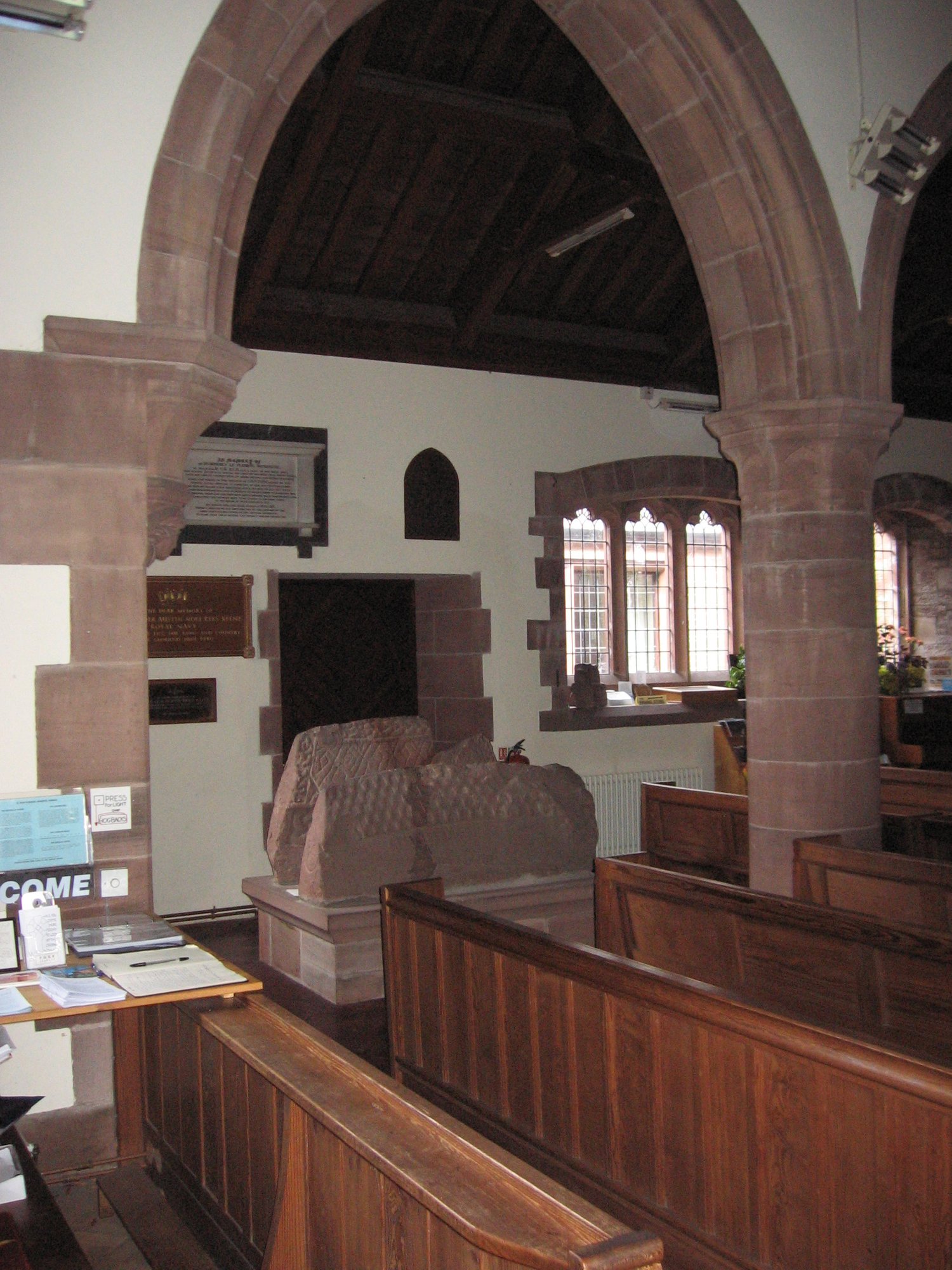
In 2015 we travelled to Cumbria in England to visit everything related to the Vikings and the early Middle Ages. But we also visited other churches from other periods and that is how we ended up at St. Bees Priory, an Anglo-Norman church with a Romanesque style entrance gate. I was immediately sold.
In terms of architecture and decoration style situated just after the Viking Age (1060 A.D.) and before the Gothic style (which makes its entrance around 1200/1250, it has the same, often very pure, non-bombastic art style that also attracts me in the art from the Viking Age. Often, and that is certainly the case in the early phase of Romanesque art, the depiction of animals, floral and plant motifs and the depiction of human-animal faces or animals are still stylistically connected to that Viking Age.
So.. Anglo-Norman churches, Romanesque art. But in the Netherlands? I had no idea, not at all.
In 2017 we moved from the west of the Netherlands to the east, to Zwolle. We were looking for some decoration for the wall of the living room and bedroom, and.. ended up in Vries again, this time in the workshop of Erik van Ommen, a nationally known painter and designer of bird watercolors and paintings. Again I was attracted by the church, which I now examined more thoroughly at the entrance of the church. I was astonished. I had never seen such a church in the Netherlands before. We went home with a painting and a drawing by Van Ommen, but I had to come back sometime to study the church up close.
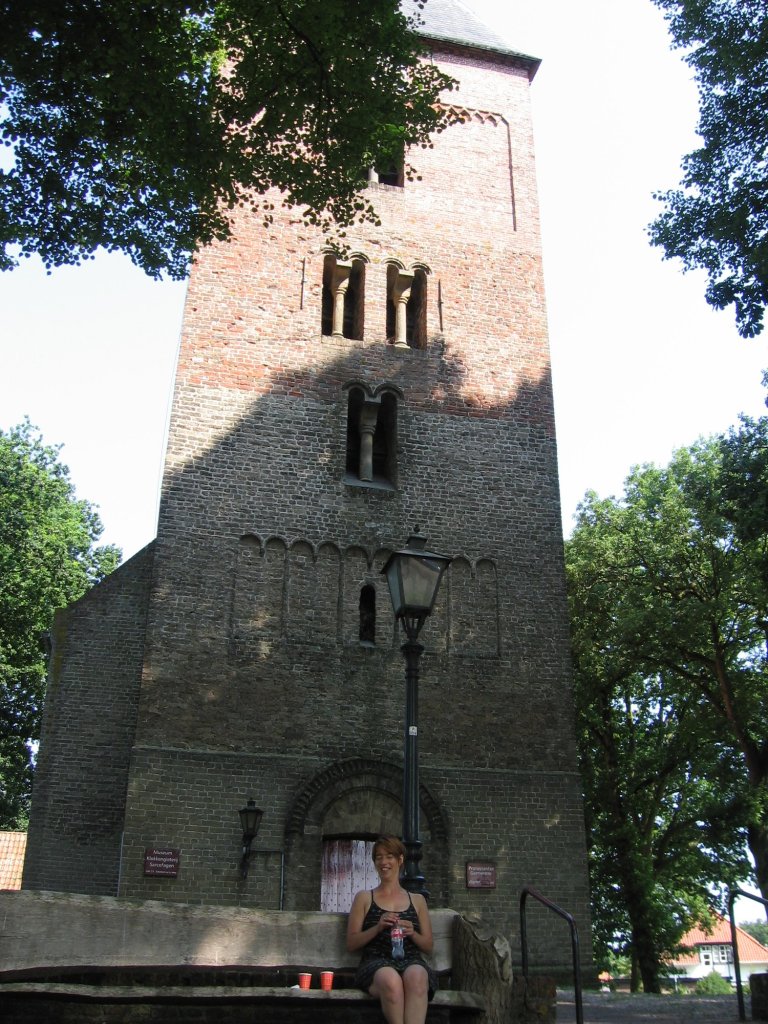
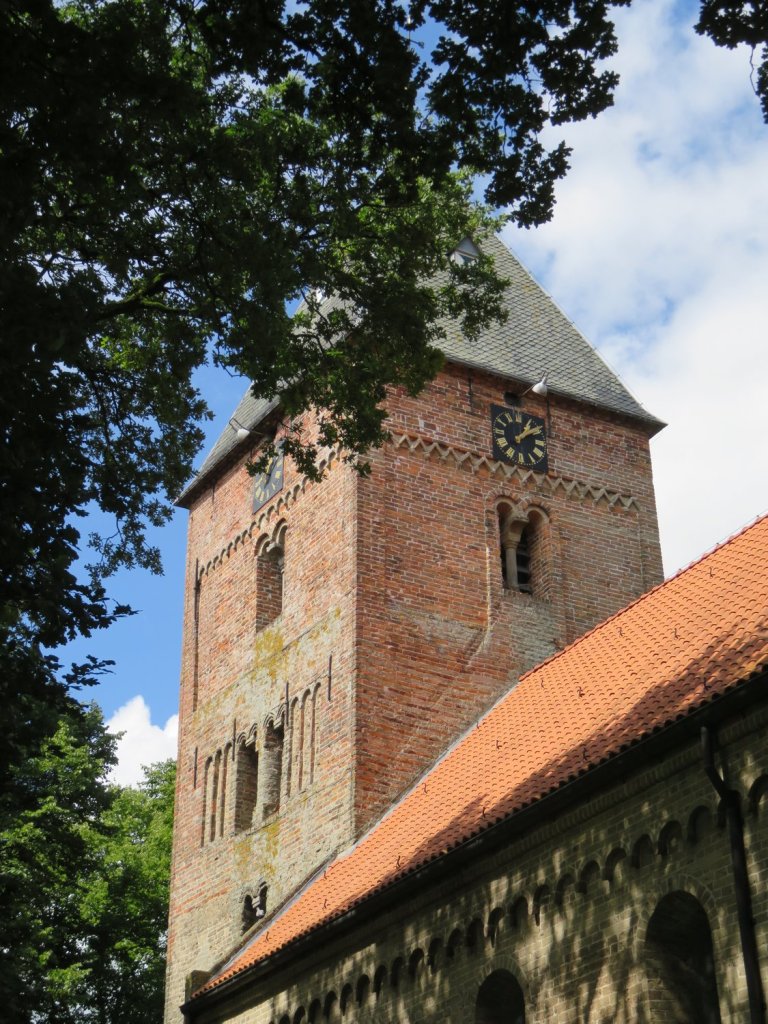
Without realizing it was Sunday, we drove to Vries again. In the picture below and below we see the 12th century tower, the oldest part of the St. Bonifatius church (built halfway through the 12th century). Although partly rebuilt in 1769 because of brittle walls, all ornaments and arcades with bell windows and blind arcades remained intact thanks to a conservator who must have had historical knowledge of the importance of this specific church.
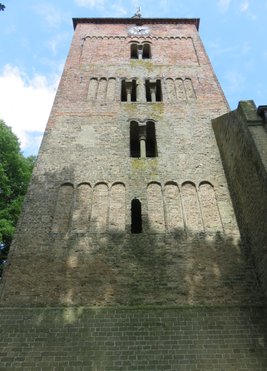
How lucky we were that it was Sunday and the church was open! But first I looked at the outer parts of the tower and the nave.

Imagine, look at the small open windows – still without glass in the 12th century, which would have been a novelty in the later Romanesque period, how dark the church must have been. Simply lit by candles, with a purpose of repentance, but also a sense of safety, silence.
The introduction of lancet windows into Western European church architecture from the twelfth century AD built on a tradition of arched windows placed between columns, and led not only to tracery and elaborate stained glass windows, but also to a long-standing motif of pointed or rounded window shapes in ecclesiastical buildings, which can still be seen in many churches.
Above the bell windows we see two more features of Romanesque art: the so-called chevron – zig-zag – ornament, and the pillar separation in the middle of the converging arched window, executed in an extremely simplistic way. Far removed from the rich ornamental Romanesque style. Perhaps deliberately executed in this way because there was not enough money to do it otherwise, or because a skilled – and therefore expensive – mason was lacking.
The same can be said about the doorway. Unmistakably executed in the Romanesque style, with features such as the chevron ornament and the stepped doorway. As a kind of inviting feature. One of the well-known experts in Romanesque decorative style and ornamentation, Rita Wood, saw the doorway designed in this way – as a tunnel-like tapering opening – deliberately designed in this way to create an inviting appearance for the churchgoer (or: in spe). One entered a protected shell, a protected space.
A rich ornamentation with human or human-animal figures and heads/little heads – the so-called tronies – is (still) missing here – although the term tronie refers to painting. The portal is simple, but unmistakably decorated in the Romanesque style. The so-called tympanum is also missing. This is the semicircular or triangular decorative wall surface above an entrance, door or window, which is bounded by a lintel and an arch. It often contains pediment sculptures or other statues or ornaments. In the church in Vries this part above the door entrance is filled with stones without any form of decoration.
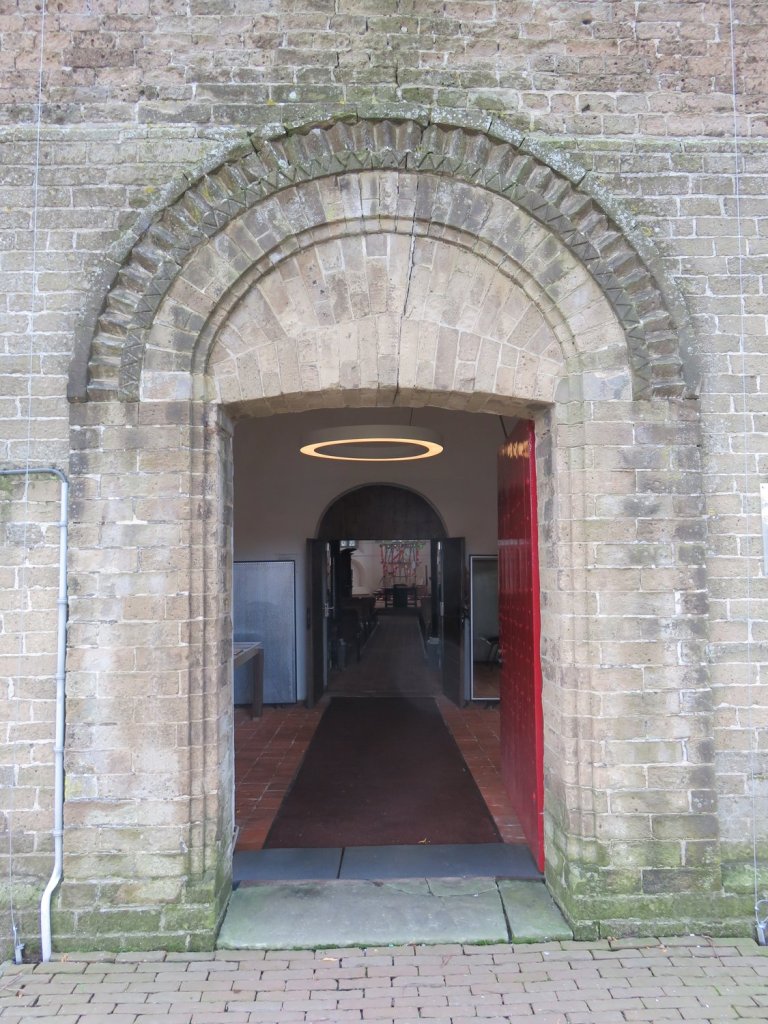
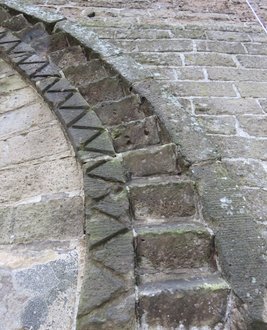
People will always investigate things and it is thanks to Reverend Klumper that he noticed and asked himself why there were thirty-seven teeth above the doorway. Why specifically the number thirty-seven, he asked himself. This is no coincidence. In our minds we have to travel back to the time when this structure was built. When these thick Romanesque church walls were built, it was not only to support the vaults. At the same time they expressed the defense against the evil outside world. Literally and spiritually. Note the loopholes/windows on the first floor of the bell tower. They were built for that purpose and were meant to function in this way. In Romanesque art, the evil outside world was depicted with rich ornaments and anthropomorphic – half human half animal – details under the capitals. Floral motifs and (interwoven) snakes were all part of this image.
Due to a lack of money in the small village of Vries, these ornamental and bombastic features are missing here. To depict an alternative element of defense against evil, numerical symbolism was used that the congregation could and would understand.
In addition to the thirty-seven serrations, there are eighteen arcades on the south wall and nineteen on the north wall. Both form the same number of thirty-seven. The eighteen arcades are symbolic of light, life, the sun and good, and to the right of the entrance. The right side is the so-called Good Side, because from the right side of Christ flowed his redeeming blood. The nineteen arches symbolize the Bad Side: darkness, death, the moon and evil. Not much good came from the north, as the preceding Viking Age had shown.
The highlight of the journey of discovery in the church revealed itself when we entered the church and walked through the nave to the rear.

Allow me to consider this as a Holy Grail of an unexpected example of Romanesque art in the Netherlands. Where was this magnificent baptismal font actually made? A brochure in the church provided clarity. In the early Middle Ages, there was a sandstone quarry just across the border in nearby Bentheim in Germany. These baptismal fonts were made at the same location and sold to Hanseatic cities such as Zwolle and Deventer. But of course, these cities were not yet called that at the time of production. So a minister from Vries bought this baptismal font, transported it, as far as Meppel, over water, but after that it must have been transported by horse and cart..
Bentheim produced many baptismal fonts, the twenty-six baptismal fonts that have been found in the Netherlands testify to this. Seventy-five baptismal fonts are known from East Frisia, Schleswig-Holstein, Oldenburg and Westphalia. Most of them are still in their original location and are used for baptisms..

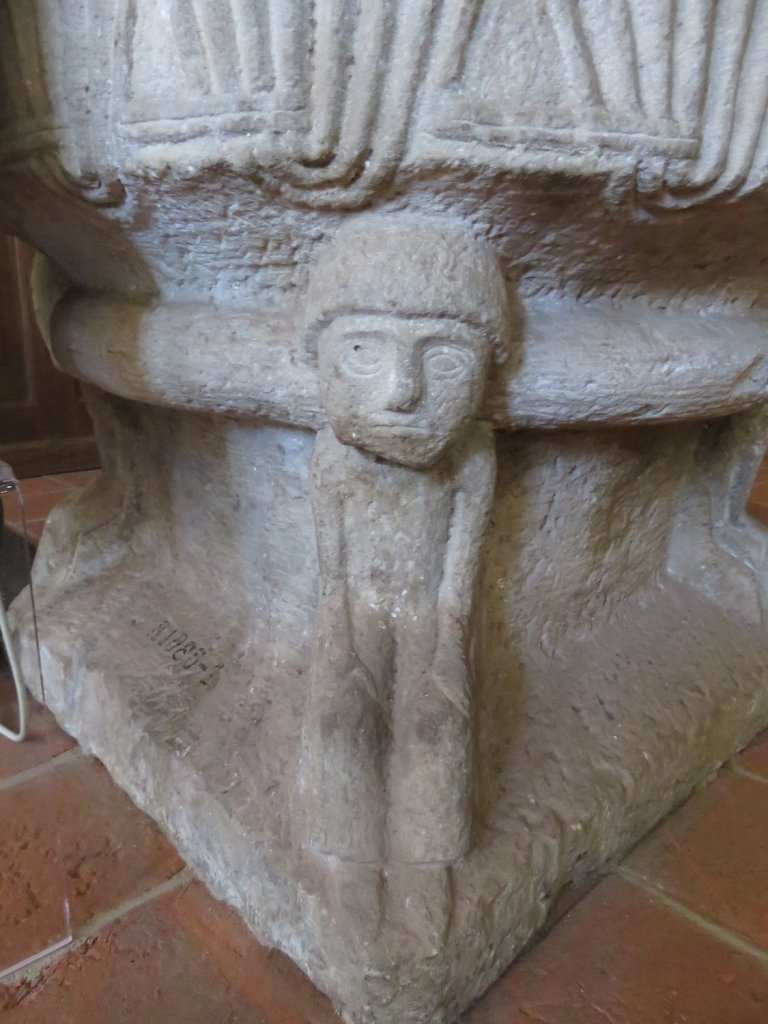


The baptismal font in the church of Vries is typically Romanesque: not highly ornamental, but ‘honest’ in its execution. Like all ornaments in the Romanesque parts of the church. The cupa – the bowl – has various ornaments in a so-called rope motif, a band of vines, grapes and leaves. The execution is highly stylised but cleverly executed. In addition to the band below, stylised Acanthus leaf ornaments can be seen. This is a Greco-Roman type of motif. The fruit-bearing wine grape is symbolic of life flourishing through faith in God, which begins with Christianisation at the baptismal font. The four human figures at the feet of the baptismal font are not specific figures. Their hands resting on their thighs carry and support the baptismal font. Note the same type of eyes on the so-called Lewis chessmen – a set of chess pieces from the 12th century found on the Scottish island of Lewis. The baptismal font can be dated to the beginning – or possibly a little later – of the 12th century. The baptismal font in the church in Vries was loaned free of charge by the Drents Museum and that is why we can admire it in its original place ‘in situ’. In the museum of Assen there are still six Romanesque baptismal fonts to be viewed.
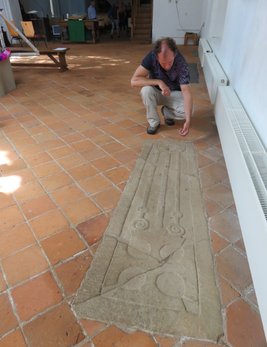
At the back of the church in the choir there are two sarcophagi, sunk into the pavement. They date from the 12th/13th century. These sarcophagi were used to decompose the body of a person. Sarca phagein = eating meat. After the body had decomposed it was placed elsewhere. These sarcophagi were originally outside the church with the lid facing upwards.


Finally, take a look at the exceptionally old and shaped lime trees on the square in front of the church.

April 20th 2017
A Viking myth and a belt mount
This week’s blog is a guest blog written by David Mullaly, wich I thank him for greatly.
One of the most widely known Norse myths, which provided a cornerstone for the Vikings’ beliefs about their origins, involves the story of Sigurd, a famous hero, and Fafnir, a fearsome dragon which guarded a great treasure. Making a long story very short, Sigurd digs a pit, and when the dragon falls into it, Sigurd stabs it with his well-tested sword Gram, and kills the beast.

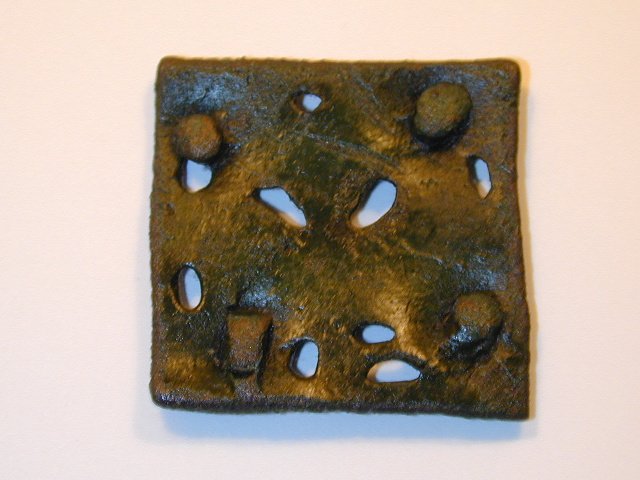
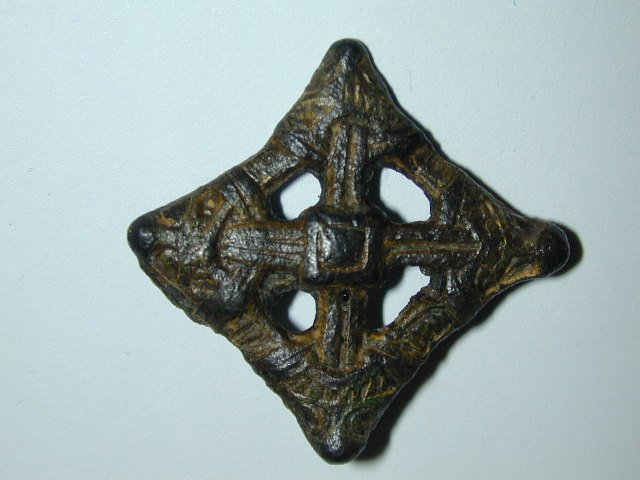
The two pictures provide a clear image of a square bronze belt mount, found in the Kievan Rus area of Eastern Europe, which shows clear traces of gilding, and the remains of four fastening posts on the reverse. Almost all of the openwork mount is filled with the body and central head of a beast, presumably a variety of serpent or dragon. The head is identical to heads of beasts which are associated with the Borre style of Norse decoration.
In fact, the Borre style is probably the most commonly Viking style found on clearly Scandinavian items in Eastern Europe, since the Swedish Vikings who travelled east to both explore and in some cases settle did so primarily in the 9th and early 10th centuries, when the Borre style was predominant in Sweden and the rest of Scandinavia.

However, if you look closely at the bottom left of the square, you can see an almost circular swirl of lines surrounding what may be a human figure. Note that there are hatching lines or similar etched details covering the dragon, and the swirling lines in the corner are different. Also, if you look to the right of the figure, you see a thin horizontal element, highlighted by the open areas around it. That element is unlike anything else in the scene, and seems to connect the human figure with a leg or foot of the beast.
I would suggest that the mount portrays the killing of the dragon Fafnir by the hero Sigurd using his named sword Gram. The horizontal element is likely the sword, and Sigurd is shown stabbing the beast with it. Although other theories are possible, this one seems to be the best fit for what we see here.
Isn’t it remarkable that a craftsman devoted so much time to the decoration on a small bronze mount like this? What may be more remarkable is that there are very few known representations from the Viking period of Sigurd and Fafnir, one of the truly seminal myths of that culture. As far as I am aware, this is the only known example of this fascinating mount.
November 20th 2016
An Anglo-Scandinavian horse harness pendant in Ringerike style
This blog I like to show you an interesting horse harness pendant from England from the Viking Age.
But first a short prequel. On a regular basis I am writing about my artefacts in the magazine of the so called ‘Viking Genootschap’ in Belgium, The Ravenbanier. I was writing the article for the magazine for January 2017 about another horse harness pendant I have – see here – as I started to Google on ‘Viking horse harness pendant’. Googling on ‘Viking’ and adding words to that, have costed me a lot of money the last ten years but gave me the joy of the world also..
Googling so, I stumbled on this horse harness pendant on an auction website Ebid, where I was surprised to be able to buy this one for a fixed prize. Of course I was tempted and seduced once more..
The horse harness pendant is one stylistically to be addressed as Anglo-Scandinavian in a – derived – Ringerike style. The overall execution of the pendant is ‘crude but charming’. A true Scandinavian craftsman would have made a far more clever, symmetrical and well executed piece. As here, this isn’t the case I would suggest that this horse harness pendant very possibly was made by or a Anglo-Saxon smith making the pendant in a deliberate Scandinavian stylish way to appeal to the taste of the Scandinavian settlers in England or was made by a successor of one of the Scandinavian settlers in England. Not being familiar in a direct way with the Scandinavian way of art, he might have attempt to imitate the Ringerike styleform.
(the candle in the photograph: I kept it this way, as everyone can use some extra light in these dark weeks to come..).
Interestingly if we turn the pendant 180 degrees upsidedown, we can distinguish also a ‘fleur the lis’ – clumsy executed as it might be – symbol. Now, being addressed to the 10th-11th century I like to argue even for a transverse/hybrid Anglo-Scandinavian / (Anglo-) Norman art style as by the use of this symbol. Also if one is considering one of the ‘fleur the lis’ variants as can be seen underneath this blog, one could easily see the horseheads as the form of the outward curlings of the fleur the lis, adding to the crude symbol on top (if turned 180 degrees) of the horse harness pendant. But – again – any remarks or alterations are welcome.

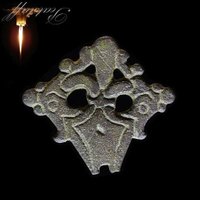
On a regular basis we can find the ‘fleur the lis’ symbol on horse harness pendants from the later Midde Ages. This is one of the symbols of France. A lot of English nobelty were originating from France and Normandy and encountered England via William the Conqueror. William the Conqueror encountering England in 1066 A.D., it is very well possible (also) that this horse harness pendant was made in the very late 11th century and stylistically being influenced by these Normans. But that is just a suggestion from me, wich – as always – is open for any discussion or debate.
This horse harness pendant was found in the late eighties of the 20th century by Peter Haworth approximately 1km south east of a small village called Fridaythorpe.
The area didn’t produce a great deal, a few Roman items and a few later Medieval finds. But no other Saxon or Viking finds.
It wasn’t recorded it with PAS as the scheme wasn’t introduced until the mid 90’s. Of course I will try to do yet – as I consider it as an important piece of art and such a detailled provenance is present.
Hores harness pendants were hung as ornaments on the horse harness and being used to demonstrate the social status of the rider involved. During the Middle Ages horse harness pendants were one of the objects used to demonstrate the importance or aspirations of the owner (i.e. rider). As wel as (arm)rings and brooches they were visible for individuals the owner met – or to make an impression otherwise to remember to the social standing of the owner. In the late Middle Ages, horse harness pendants are being decorated even richer by the use of enamel. Though this might have just have been pure decorational, it might as well have a so called ‘heraldic’ function. In that purpose it had shown that the rider was ‘in service’ of the person owning the horse harness pendant. The ‘upper class’ would have made an impressive show out of it, by accompanying their heraldic achievements, showing their horse harness pendant(s) on the great cloth covering their horse or by wearing it, embroidered on their cloths.
–> if you like to see this artefact live.. there will be an opportunity! Among many other objects, this horse harness pendant will go on display from March onwards (an exact date to be confirmed) as I am preparing (with the curator of museum Dorestad in Wijk bij Duurstede, Holland) an exhibition on Early Medieval art styles, decoration and design. This exhibition will include artefacts from the Franks, the Carolingians, the Frisians, The Balts, Finno-Ugrians, (nowadays) Rus, and.. of course.. the Viking Age (Scandinavian ietms and Anglo-Scandinavian and Hiberno-Norse items as well).
Keep a close eye on the News page in the forthcoming months!
An example of a later Middle Ages horse harness pendant with ‘fleur the lis’ motif you can find here:
http://www.tulliehouse.co.uk/thecollection/horse-harness-pendant-medieval
Further information:
http://www.treasuretrovescotland.co.uk/Gallery/harness_pendant.html
Clark,J. The medieval horse and its equipment c. 1150 – c. 1450 A.D.
The Finds Research Group AD700-1700 Datasheet 39 by David Williams; Anglo-Scandinavian Horse Harness Fittings, p. 6, figure 7.
When consulted FLO officers, Vanessa Oakden pointed out to me that the style of the pendant made her think about the style used in a dress hook from the late 10th, early 11 th century, wich can be seen here:
https://finds.org.uk/database/artefacts/record/id/634162
but in my opinion the dress hook is of a far more refined and detailled design and excution and can be dated somewhat earlier than the horse harness pendant here discussed.
A similar horse harness pendant was on auction at Timeline Auctions, february 2015 – see image attached of the catalogue.
Dear Tony Brady.. this one’s is specifically for you – giving me a mild kick under the butt writing a blog again after some absence! It truly is people like you who give me the joy in writing and interacting on these artefacts.
So.. A high five to you.

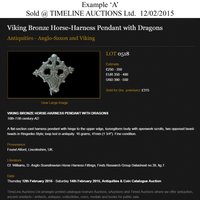
June 22th 2016
The Odin mount revisited – the converting element.
In this guest blog, David Mullaly is giving his view on the Odin mount type, of wich I have one, see image right below – discussed previously on this page I am thankful to him giving his view and hereby share it with you.
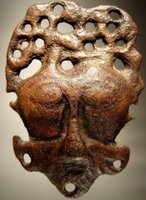
In recent years, a very small number of examples of a distinctive bronze mount have emerged from English soil and history which merit our attention. All of them display a triangular human face with large lentoid eyes and a sort of moustache and side whiskers feature. However, the most recognizable aspect of these large mounts is a sort of lattice-looking headpiece at the top. Should this properly be called Scandinavian, or perhaps Anglo-Scandinavian, or perhaps even Hiberno-Norse? More on that later.
An incomplete example of this type is included on the Portable Antiquities site (ID YORYM-5CO4B6), and has been designated as being of “national importance” because of its rarity. The provided findsite is Brantingham, in Yorkshire. Only a small area of the headpiece remains, but this is clearly an example of this type.
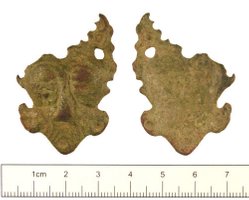
Another example was pictured in the July 1996 issue of The Searcher (p.44). According to the publication, the item “appears to be a mount in the form of a human head. Again of bronze, the style suggests strongly that this is of Scandinavian origin, and would date to the 10th century AD. It could have arrived with a Viking, but may equally be an example of Anglo-Scandinavian metalwork produced in Britain.” No findsite is provided.
(PDF to be added)
An almost identical example is illustrated in the March 2005 issue of The Searcher (p.21). My thanks to Harry Bain and John Winter of the publication for providing a copy of the page. This is part of the description provided: “A cast, copper-alloy, openwork mount, in the form of a hollow backed human face with large eyes, a narrow pointed beard and a projecting moustache. The hair is represented by intertwined snakes.” The findsite provided is Northern Yorkshire.

A fourth example, provided by the UK Detector Finds Database (#36202), is described as follows: “An anthropomorphic mount moulded in the form of a stylised human face-mask of late Viking (Urnes style) inspiration. The face has protuberant lentoid eyes, long nose and an elaborate moustache. It is surmounted by a projecting feature or headdress, almost antler-like in appearance, in openwork Urnes style. There are three attachment points: a pierced circular lug on each side and a piercing through the chin, which retains a separate copper-alloy rivet….The mount is possibly a representation of the Norse deity Odin, from whom the mythical antlered Herne is believed to have evolved in old folklore. Its probable use was as a decorative element on leather, such as harness.” The findsite provided is Bedale, once again in Northern Yorkshire.
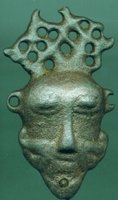
Finally, yet another example,which was found in the area of Malton, in Northern Yorkshire, is shown below. Once again, we see the large eyes, the prominent moustache, and the lattice-like headdress.


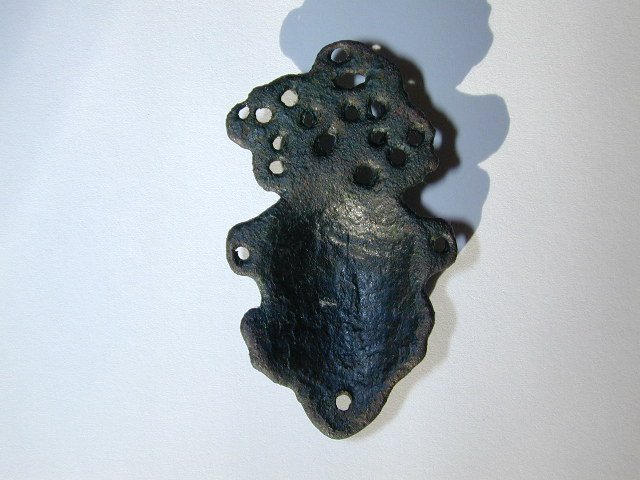

What has been said thus far? We have a small number of large bronze mounts, primarily found in Northern Yorkshire, displaying a strange, staring face with a strange headpiece on the top. One of the descriptions suggests that the style of the headpiece involves the Urnes style, indicating a late Viking dating. And that same description suggests that the face could be that of Odin.
Permit me to suggest that the writer of that description was probably correct about the Odin identification, but probably wrong about the Urnes style and dating. Let me explain.
The common features of the faces on the mount suggest something more than just a Viking visage. When I first saw an example of this type, I immediately guessed that Odin was being represented–but I was guessing. I do not think it’s a guess any more.
Very recently, I saw an ancient bronze mount found in Armagh, Northern Ireland, which had a startling image on it.

You can clearly see a representation of Odin with a very long beard, with his arms around his two raven companions. This is a familiar Odin image, which can be found on some Viking pendants, which have been found from Western Russia to the UK. Here is an example.

However, if you look at the Odin found in Northern Ireland, you also see what would best be described as a Christian-like halo above his head. It would appear that a Viking metalworker in Ireland borrowed an element of Christian iconography to emphasize the spiritual dimension of the Norse god Odin.
Now, let us consider what has been found in the UK, and primarily in Yorkshire. There are currently six known examples of a mount which may portray a Norse deity, and which include a headdress which could certainly be analogous to a halo.
What I would suggest is that these large bronze mounts, either belt mounts or horse harness mounts, were in fact either made in Ireland by the Hiberno-Norse, many of whom moved from Ireland to Yorkshire in the early 10th century, or were more likely made by those same Hiberno-Norse after they moved to Yorkshire. Instead of being influenced by the Urnes style, and being late Viking, these mounts represent a borrowing from Irish Christianity, and probably made by a number of different metalworkers in the early to mid-10th century.
May 26th 2016
A rare Viking Age artefact find in Holland – a silver ring.
And why Viking Age finds in Holland are so rare.
A very rare intact silver ring from the Viking Age recently had been found in the borough of Buren. Cees-Jan van de Pol detected the ring with his metal detector.
On the same location also a piece of melted silver in the form of a drop was found together with a silver coin from the 10th century in the clay ground of the Betuwe.
‘Its form and decoration are pure ‘Viking’
Unique example
According to archaeologist Nils Kerkhoven from Dreumel and Viking Age connaisseur Luit van der Tuuk, this ring is unique for the Netherlands. Kerkhoven: “This is a special ring. We do know a (in fact: a few, TK) golden ring from the Viking Age found in The Netherlands, its form and decoration are pure ‘Viking’. But according to me this is the first silver ring from the Viking Age found in the Dutch soil wich is almost complete. Its form and decoration are pure ‘Viking’. You do not see that often.”


Viking Age artefacts are rarely being found in the Netherlands. Compared with – by example – England the discoveries are rather bleak. In Holland the Vikings ecountered, but never stayed for a longer period of time. There are theories about the existence of a long staying (few years) Viking army in or near the village of Asselt in the provence of Limburg, but that still is to be proven satisfactionally by archaeological research to be undertaken in future.
Another thing is our history of ever changing coast lines and river walks. For example the Viking ‘pirate post’ on Walcheren had dissapeared into the sea over the centuries. Rivers inland have changed also in the course of centuries, making the exact original spot where an artefact originally was left behind sometimes fuzzy. In Domburg, Sealand (Holland) a Viking Age buckle was found in 2010.
Vikings must have raided Holland and maybe traded, but their remains can be very elusive.
What we do have are finds from the area of Dorestad, a great golden armring of unmistakingly Viking interlace and knotted nature. Also from Dorestad there are two silver cloathing pins with filigrain decoration. They date from the first half of the 10th century. De decorated top of such pins have been found as beads on a necklace (see also my golden beads from Gotland). From some graves in Birka, Sweden, exact parallels are known.
Another Viking Age jewel, also from Dorestad, is a so called ‘needle buckle’ with knotted decoration. Such a buckle is categorized to the penannular brooches. These pennanular brooches were worn with the needle pointing to above. They have been found in many places in England.
Some years ago a silver armring with five rings hanging on it was being found in the sea by Callantsoog.
Such composed artefacts probably were made in the south of Sweden. The most south Swedish examples date from the second half of the 10th century. Another possible area of origin is Sjaeland in Denmark. Bij comparable armrings from Scandinavian findspots, the number of attached rings can increase to fifteen. Some rings are decorated with folded coins around them, making the jewel and the findspot where it originally came from, being dated accurately.
From the river Maas near Wessem, Limburg, the so called ‘sword from Wessem’ is famous, being the only one – more or less – distinguishly Scandinavian in its decoration, sword is known. At the moment it can be seen at the Streekmuseum in Asselt, Limburg in the Netherlands.
Finally, two silver hoards from the Viking Age are known from Westerklief on Wieringen, the one being found in 1996, containing 1.6 kilogram of silver treasure. The other smaller one, just being found a few years apart from the first one. The one can be seen in the Rijksmuseum voor Oudheden in Leiden, the other one in the Informatiecentrum Vikingen op Wieringen.
In the Fries Museum finally a small golden ring from the Viking Age can be seen. In the museum of Dorestad several early medieval and some artefacts with a Scandinavian decoration can be seen.
So.. we do not have a lot, but our collection is growing still, due to the ever increasing popularity of metaldetecting !
Attached I have the links to the artefacts mentioned and musea where you can see them.
So a bit Viking Age Holland promotion here !
Hope you enjoy..
See also:
http://www.rmo.nl/onderwijs/museumkennis/verhalen/vikingschat-van-wieringen
http://www.rmo.nl/onderwijs/museumkennis/verhalen/vikingsieraden
http://www.vikingen.nl/pg-28219-7-84399/pagina/welkom.html
http://www.pzc.nl/regio/zeeuws-nieuws/deskundigen-bevestigen-vondst-vikinggesp-in-domburg-1.4054837
http://archeologieonline.nl/nieuws/vikingring-gevonden-in-friesland-0
http://www.hartvannederland.nl/nederland/friesland/2009/fries-vindt-bijzondere-vikingring/
http://www.rtvnh.nl/nieuws/126007/bussumer-doet-vondst-van-zijn-leven
Addition June 7th: the curator of museum Dorestad pointed me to this link about another silver ring being found in Holland, Frisia, near Tirns in 2011:
http://www.sneekernieuwsblad.nl/nieuws/1359/zilveren-viking-ring-gevonden-bij-tirns/
April 11th 2016
A Viking Age Anglo Scandinavian drinking horn finial.
From status symbol to symbol for vanity and luxury – showing the temptation of Christ.
In this blog I like to take you on a trip alongside one of the distinct Viking Age attributes of noble descent, the drinking horn.
Being very rare, and within itself, being of a very rare type, I was extremely happy to be able to add this drinking horn finial to my collection. Just known to have been found in England, the salesman addressed it stylistically to the 11th century. The use of the kind of zoomorphic head in the finial resembles the casting of zoomorphic heads on stirrup finials of the 11th century.
The best and/or safest way to address this finial is Anglo Scandinavian from the (late) Viking Age. The long ‘snout’ resembles the Urnes like style of the snouts used and casted in that particular late Viking art style, but the crudiness of the way of casting makes this a hybrid Anglo Scandinavian form, as also can be recognised in other Anglo Scandinavian artefacts found in England from the 11th century (like stirrup terminals – see link). Other experts consider it (much) earlier, being of the 8th centuries.
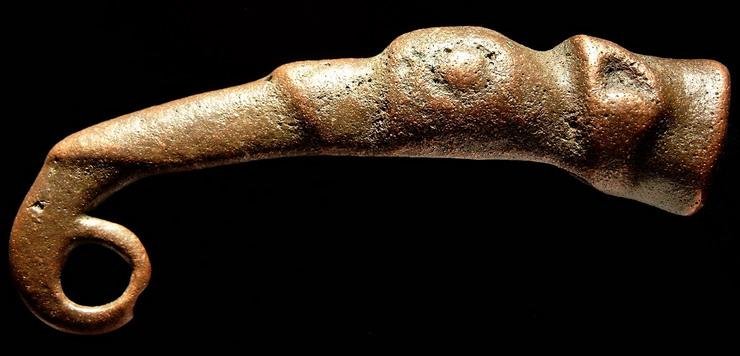
The salesman thought the zoomorphic head to be depicting a wolf. Stephen Pollington thought of it of being a canin. Carol de Neuman Vegvar considered it a hound. So.. zoomorphic indeed, as everybody sees something else in it. Only a few complete drinking horns of the Viking Age did survive. Some more rim mounts and terminals survived but all in all these are very rare items within the Viking Age artefacts segment.
The form of this drinking horn finial is definitely to be recognised already in the Anglo-Saxon period. A magnificant pair of horns was excavated from the pagan burial mount of Taplow in England, dating from the 6th century. The horn found at the excavation at Sutton Hoo in 1939 adding to these early treasures of Anglo-Saxon art.
A symbol of certain status..
The organisation of the symbel, based partly on the first party feasting scene in Beowulf also recalls the usage of the horn. The drink should be offered in a splendid drinking horn, rather than a normal cup or beaker: horns were a status symbol at public events. Furthermore during the symbel, the circulation of the horn cannot end until the horn comes to rest. While individuals may excuse themselves and leave when they have had enough to drink, it is an act of great disrespect for any participant to lay down the drinking horn.
Viking Age mythology and tales from the sagas have lots of references to drinking horns. Often included in the descriptions of large banquets, they also have a symbolic value as an official gesture of welcome. Think about the Valkyries, welcoming the fallen warriors with a drinking horn to Walhalla.
The famous ‘Fyrkat woman‘ grave, contained two drinking horns. Neil S. Price has suggested that it might be the grave of a Viking sorceress, a so called völve, similar to graves in Sweden. As her grave was the richest burial in the cemetery, she must have been of considerable social standing. In Scandinavia six horns have been found in Birka in Sweden and tenty-six horns – some of them in pairs – have been found in Norway.
Two remarkable dragonheads of bronze, probably decorating the tips of two drinking horns are in the National Museum of Denmark. Both can be dated around 1050 A.D. one in very distinct Urnes style with a long elegant head.
Also in present day Ukrain a pair of (complete) drinking horns was found in the so called ‘Black Grave‘ in the area of the Kievan-Rus.
The Bayeux tapestry depicts a banquet at Bosham with King Harold and his Anglo-Saxon peers. Two large drinking horns with mounts at rim and elobarate tips are also tokens of the high status posession and use. Finally, the great Norman font in St. Mary’s church in Burnham Deepdale is decorated with reliefs showing symbols of the farming calendar. January is symbolized by a man sitting in a chair and drinking from a large drinking horn.
Perhaps the scene is somehow reflected in the wooden calendar sticks – known from the later medieval Scandinavia – on wich the Adoration of the Magi (the 6th January) was marked with a drinking horn.
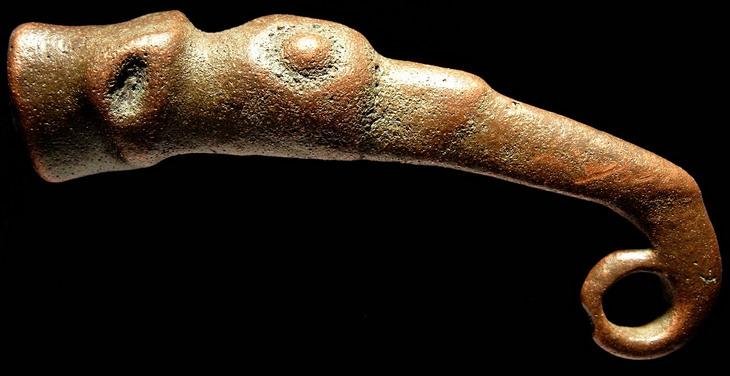
‘From this horn it is thought to be well drunk if it is emptied in one drought, some men empty it in two draughts, but there is no drinker so wretched that he cannot exhaust it in three..’
– the testing by Thor of the evil giant Utgard-Loke of Jotunheim –
From Ireland a horn terminal excavated at Carraig Aille – see images beneath – has openwork jaws wich enclose a stout ring (like mine) probably for a suspension strap. Being from the 8th century, it is from the presumably same age as my example depicted above. Another horn terminal from Ireland has blue inlay garnets and an – unprovenanced – drinking horn terminal decorated in the Irish/Ringerike style of Viking art with remaining glass settings and remains of silver wire inlay pays tribute to the luxurious nature of several horn terminals. The article, written by James Graham-Campbell I have attached the reference at the end of this blog.
To my knowledge, no other similar example or similarlike type of my drinking horn is known, but please correct me if I am wrong!


So, what went wrong for the drinking horn during the (early medieval) centuries ?
It seems to be that Christianisation was guilty of this. As these days – speaking in 2016 – Islamic State has some very determinated ideas – to put it utterly mildly – of what is to be and what isn’t to be anymore, the Anglo-Saxon church had their very own ideas..
Already in 787 A.D. a synod of the Englisch church met at Chelsea, and the proceedings included a special canon about the proper behaviour of priests celebrating mass. ‘We have also ruled that neither the chalice nor the paten for the offering of God should be made of oxhorn, because they are bloody‘. Of course, this was double-Dutch for stigmatising the drinking horn for being of evil sin.
Drinking horns were used to illustrate a wasteful living by the church, gradually becaming a symbol of vanity and lust. An illustration in a manuscript from the end of the 9th century shows Luxuria, personified by a young woman, who is offered drinking horns by three men. The Latin text states: “Now Luxuria defeats sobriety“.
The image is getting worse, though. In an Anglo-Saxon manuscript from the 11th century – the so-called Tiberius Psalter – shows a picture of the third temptation of Christ. (how many times can Christ have been tempted anyway ? whas it that tempting, and for who ? The tempter or Christ ? 😉
Just beside the figure of Satan is a drinking horn among other items, which evidently all symblozes earthly wealth and vanity.
One of the last items reflecting the high culture at court use of the drinking horn can be seen in one of the 12th century dating figures of the Lewis chessmen.
During the next 100 years the old traditions for the use of drinking horns dissapeared, but at the end of the 13th century the use was rediscovered. After all… who doens’t like a drinking horn as one sees nowadays the often reproduction of early medieval drinking horns on the internet.
So, finally, what for the Anglo-Scandinavian (or: Irish) drinking horn finial mount..
Who had been using it ? It wouldn’t have been someone of lower social status.
When was it finally lost or gotten out of use ? And if gotten out of use, for what reason ?
These tantalizing questions remain in the mist…
References:
Etting, V., The story of the drinking horn – drinking culture in Scandinavia during the Middle Ages (2013);
Graham-Campbell, J., An eleventh-century Irish Drinking-horn Terminal, Tapir Academic Press (2008)
Pollington, S., The Mead-Hall – Feasting in Anglo-Saxon England (2003);
Youngs, S., The work of angels – Masterpieces of Celtic Metalwork, 6th-9th centuries A.D. (1989).
February 16th 2016
The Sjellebro stone in Denmark – what is his face telling us ?
In 2008 I visited Denmark and followed the so called Viking Trail. One of the less obvious – and not very easy to find – monuments is the so called Sjellebro stone. It stands just in front of what appears to be an old river bedding, wich – at least at the time in summer as I was – almost was dry.
The mysterious stone of Sjellebro lay unnoticed for centuries on a meadow but hit the national headlines in 1951. The owner of the meadow, Åge Sørensen, noticed some carvings on it and called in the National Museum of Denmark. The stone was examined and gave up its secret: it had been decorated with a mask in about the year 1000 – the Viking era. The mask has big empty eyes, a pointed chin and plaited beard, and might depict a troll or bogeyman. The Sjellebro stone still stands in a grassy field on the north side of the stream and is visible from the road.
Again, the attractiviness of this monument is, that it still is ‘in place’ as it was erected a thousand years ago. Several ideas excist about what the face represents. But, I am always asking myself ‘Why ?’ as is stated ‘might depict a troll or bogeyman’.
Maria Paanum Baastup states: “The mask stone triggered an archaeological excavation that revealed it stood by a total of four prehistoric roads on top of each other, and the remains of a bridge. The roads were never in use at the same time, but replaced each other. The bottom two roads were covered with stones, whereas the subsequent roads were surfaced with planks. The mask stone probably dates back to the youngest road on top. It stood on the verge where travellers could see it. Perhaps it was meant to remind them of the “bogeyman” who according to a fairly recent legend is said to have lived in the stream. This bogeyman demanded a new human sacrifice every few years. Or perhaps the Vikings already knew this bogeyman way back and erected the stone to scare him away?”
I like to ask her about her theory, and whereupon it is based. (is there anything in the written record or Norse mythology wich points this way ?). If I can get additional info on this, I will add it to this blog of course.
I remember having read that it also might have been a ‘safeguard’ man for travellers crossing the stream (or river as it might have been once). Archaeologic findings show that “Alling steam” has been crossed here by humans through thousands of years. Around year 752 a solid road was built of timber and around year 1.000 the road was improved.
The “Mask” stone should have had magic powers and protect the travellers against evil.We will never know for sure. The stone lacks – unlike other face mask stones as the Mask Stone from Aarhus – runic inscriptions.
An also interesting theory for being the face possibly depicting a merman had been expressed in another blog about this stone here. ‘At Sjellebro it was in the old days important to beware that there was a merman in the river – and he claimed an annual human sacrifice. Sometimes it took years before accidents happened; once it took 6 years, but in the 7th year a waggon with 7 people crashed and they all perished in the river. The merman had got what belonged to him on back payment.
Various legends and sinister stories went from mouth to mouth through generations. An old woman told in the 1950s what her parents and grandparents had told her, about a married couple, who drowned in the crossing point on their way home from market in Randers. She knew their graves on the church yard in the village Lime.
Today the country croad at Sjellebro is broad and safe, and the merman has died – or at least disappeared, but both the legends and the finds from the excavations remind about the traffic of the past in the meadow downside Sjellebro Inn, west of the present Randers- Ebeltoft road. The place is quiet. Cars are quickly passing upon the road without noticing the ancient stone in the meadow or the pretty river valley, but the Merman is still waiting down there, speaking his old words: “Time has come – but the man has not yet come…..”

A drawing of the Sjellebro stone face reveals more of the detail. Few runic stones can be found where they were raised many hundred years ago. Most stones were moved and used when building churches and dikes.
The inscription is dated as having been carved between 850-1050 C.E. based on the style of the mask, which is classified as being in the Mammen style. My personal opnion is that the curly tendrils are showing us distinct Ringerike style elements, so I am not so sure to adress this to the – earlier – Mammen style.
Marie Stoklund had written in her book Runes and Their Secrets: Studies in Runology she recorded 21 stones decorated with a total of 23 masks. Stylistically they run through various Viking Age art styles, as the Mammen style, Ringerike style, Urnes style and even the motif continued into the Romanesque period. She refers to ‘picture stones find in Scandinavia’ so I do not know if this includes the Danish mask stones. I will ask her this.
Also she is stating about she recorded 21 stones that ‘The masks always show males in a state of sublime peace, with strong features, but showing no sign of aggression. They do not, for instance, bare their teeth. This is of great importance, since the showing of teeth is the most aggressive feature of man’s and lion’s body language’.
This notion would argue against the theory of the face depicting a troll or bogeyman. Within itself having the goal to scare people (or other spirits) of. Or an not so friendly merman even so..
Any additional ideas on the image ? Contact me on : vikingsandartefacts@yahoo.com

One of my artefacts in my collection has a – somewhat similar long lenghty – face within it.
It is a horse fitting. I have never seen such a face on this sort of equestrian equipment item before, and again the mystery of what it might represent or why it was depicted on this specific part of equestrian equipment. It was found in England.
References:
Stoklund, M. Runes and Their Secrets: Studies in Runology, p. 45-46
http://www.kulturarv.dk/1001fortaellinger/en_GB/the-sjellebro-stone/stories
http://www.europe-today.com/denmark/viking11.html
http://thyra2005.blogspot.nl/2012/07/the-mask-in-stone.html

January 22th 2016
Borre National Park in Norway – and the Borre style on a lozenge brooch.
A few years ago I was travelling in Norway, more specific the area around Oslo, in search of the Viking Age monuments to be seen there. One of the things we visited was Borre National Park. We were also in a rush to be able to see the museum near the entrance of the park, to take a view o Viking Age artefacts, excavated in the park area. Sadly, we couldn’t make it before 5 PM, and as it was at the turn to March, it wasn’t the summer season and the museum was closed already.
The mounds on Borre National Park dates from the Iron Age up to the Viking Age, 600 AD – 900 AD. Surprisingly just only one of the major mounds on the Borre site has been completely excavated, and this happened in 1852. From this excavation hail the marvellous Borre finds. But because of the unskilled excavation of the Ship Mound at Borre a lot of knowledge was lost. It is likely that the Borre finds were originally on a par with the ship graves at Tune and Gokstad. In the 19th century excavations often weren’t of the present day standards. As far as my current knowledge goes, finds from Borre can be seen at the Viking Ship House at Bygdøy in Oslo. But.. you have to check that out ..
The majority of the artefacts exhibited stem from the Ship Mound, which was excavated in 1852. In the mound they found an imprint of a ship about 17 to 20 meters long, but no organic traces of the boat remained. The most spectacular finds in the mound consisted of gilded fittings, which would have sat on a horse’s harness, and a horse collar.
Entering Borre Park, I could just be quiet. What the pyramids must be for the Egypts, the mounds has their equal in this park. What a serene place this is.
This environment is so pure. Knowing that most of the mounds had remained untouched adds to the experience. Altough just one mound had been excavated, an attempt was also made by two other mounds by examining via smaller shafts. Charcoal and burnt bones were discovered. Theory is that excisting mounds were used too, by installing new graves in the 10th century.
At the time we entered the park, we were the only ones.
In Viking Age art, the Borre style is derived from the art style first recognised in a group of gilt-bronze harness mounts recovered from a ship grave in Borre mound cemetery near the village of Borre, Vestfold, Norway. Borre Style prevailed in Scandinavia from the late 9th through to the late 10th century, a timeframe supported by dendrochronological data supplied from sites with characteristically Borre Style artefacts.

The Borre style has three main elements, the most obvious being the ring-chain motif: a two-stranded plait whose intersections are bound by a ring. Secondly there is a type of gripping beast with a ribbon body whose claws clasp the frame in which it is placed, and finally a backward-looking quadruped with spirals on its hips and a pigtail.
The Borre style is found on jewellery throughout Scandinavia and even as far away as Russia. In England, artefacts have been found with elements of the Borre style. In the so called lozenge brooch (see underlined the link to the blog – 20 januari nog corrigeren) I wrote about them specifically) it can be found in the four arms wich are terminating in moulded Borre style animal heads.
But not only in England, I have to say: also in England .. These types of brooches are known from Scandinavian also. Found in England, and being not sure if they were moulded in England or were brought in from Scandinavia, Jane Kershaw describes them as Scandinavian-style. The example hereunder was found in Lincolnshire, UK and was purchased by me at the end of last year. As it wasn’t incorporated within the earlier blog (20 januari nog corrigeren) on lozenge brooches I show it to you here.
Also see for the blog about the Borre style sword chape here.(20 mei 2015 nog corrigeren)
Underneath the image of the lozenge brooch an image with a brief overview of the Viking art styles within a timeline.
References:
Fitzhugh & Ward, The North Atlantic Saga, see image;
Graham-Campbell J. Viking Art p. 63 – 70 especially image on p. 64 wich shows an image of the gilt bronze mounts from a horse harness found in the ship-burial from Borre;
http://www.visual-arts-cork.com/ancient-art/viking.htm#carvers
http://midgardsenteret.no/en/ – website to Midgard Historical Centre in Borre

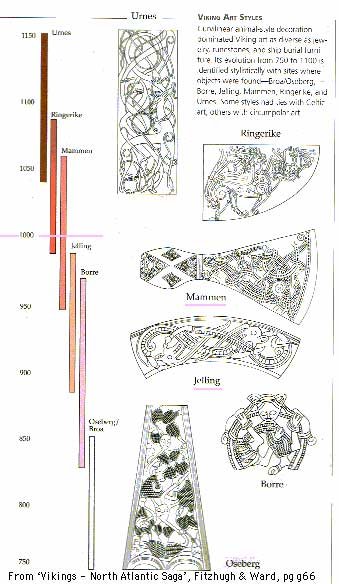
January 7th 2016
The Irton Cross, a pre-Norse marriage of Celtic and Irish style decoration.
As the last part of my journey to Cumbria, I like to take you to the – unusual for Cumbria – pre-Norse cross in Irton. It is located in the graveyard of St Paul’s Church, Irton with Santon, Cumbria. With exclusively Celtic Irish-style interlace decoration, it dates from before the Norse occupation. So.. strictly seen, not a Viking Age blog this time, but I hope interesting enough..
Dating from before the Norse occupation, this is an Anglo-Saxon cross and dates from the early 9th century. The west face has two panels of interlace, between which is a panel which once contained three lines of runes, all of which is surrounded by a border of knotwork.
The east face also has two panels with a diagonal key pattern, and two with chequers, which are in fact small sunken crosses.
There is fine scroll work on the narrow north and south sides, with leaves stem and fruit, possibly indicating a vine. In the middle of the west side is a blank panel which may have borne a runic inscription. In 1863 a mould of an inscription was interpreted by Professor George Stevens:
GEBDAETH FORAE (Pray for…)
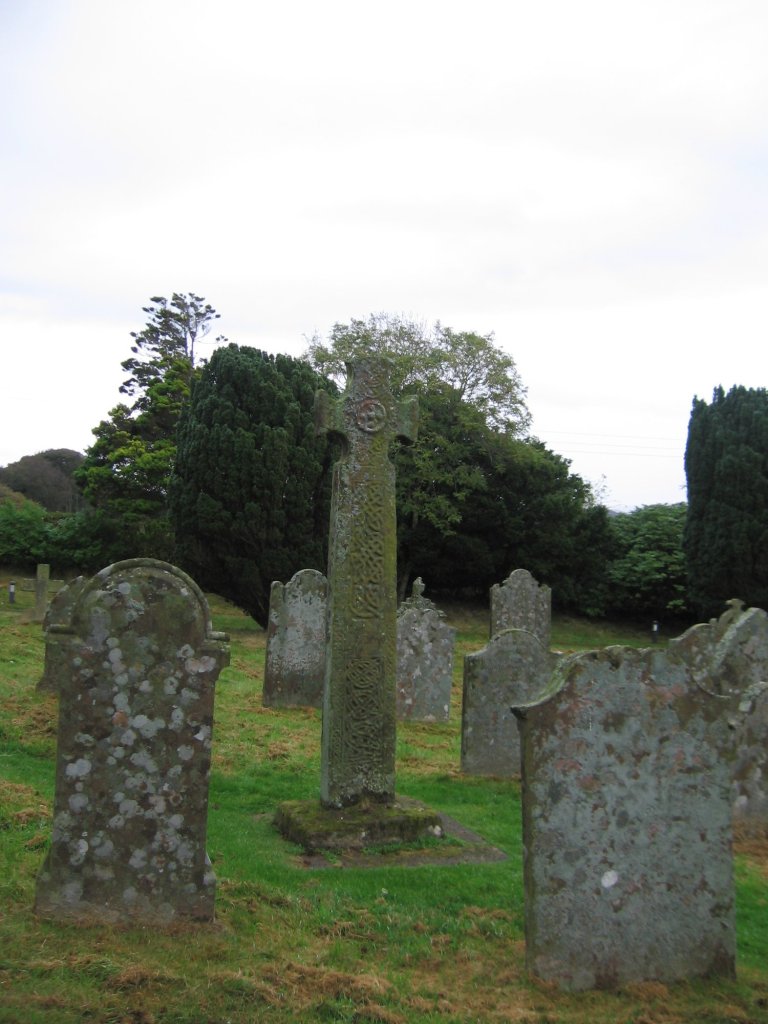
Stylistically, it dates chronologically between the Bewcastle Cross and the Gosforth cross and has greater affinity with the earlier Anglo-Roman style of Bewcastle. The Irton Cross is app. 10 feet high and carved from red sandstone and rests in its original socketing stone. It is one of the oldest in Cumbria and is decorated with Celtic spiral patterns and key patterns found in the book of Kells and other early Celtic Christian manuscripts and carvings. The cross is said to mark an ancient crossing of four tracks, places often associated with strange folklore and enchantment.
It is is one of the most important crosses in Cumbria, and unlike the one at Gosforth, bears no figures either human or animal. Altough pre-Norse, for strictly Vikingolists still very interesting for a visit. And it is all for free and in the (original) wild..
So, readers, so much for now about my visit to Cumbria. In the forthcoming blogs I will present a mixture of ‘new’ artefacts or share some monuments visited on earlier occasions, visiting the North.


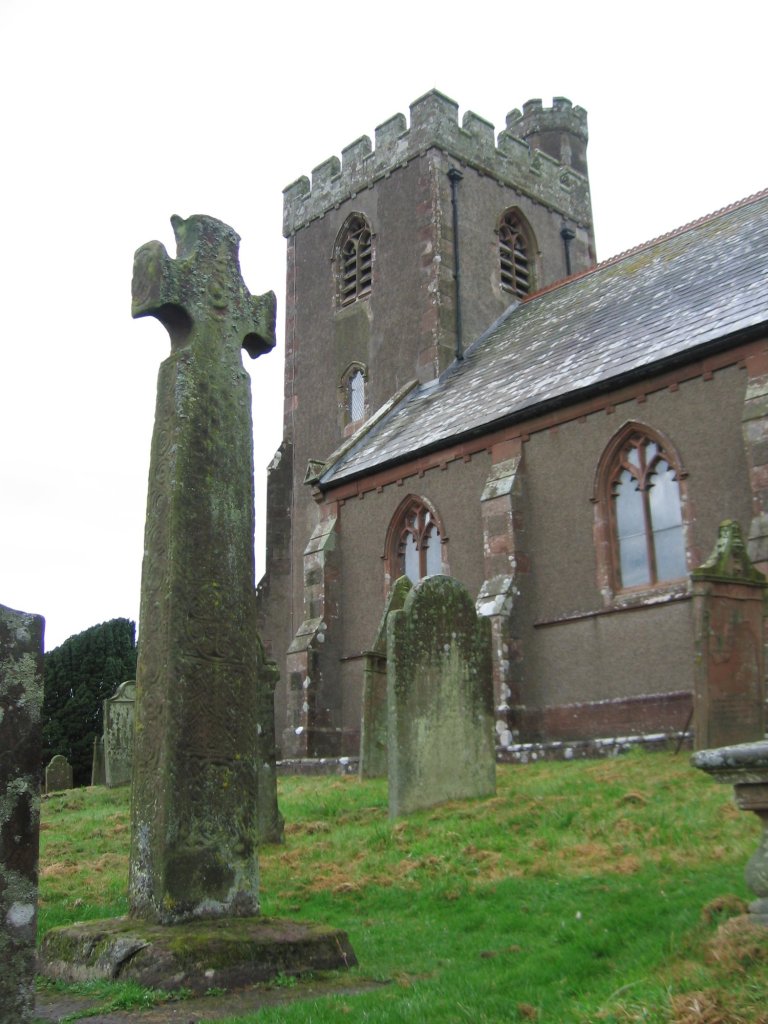
References:
Holder, G. The Guide to the mysterious Lake District
https://en.wikipedia.org/wiki/Irton_Cross
http://www.visitcumbria.com/wc/irton-st-pauls-church/
http://www.mysteriousbritain.co.uk/england/cumbria/ancient-sites/irton-cross-and-church.html
http://www.megalithic.co.uk/article.php?sid=7742
http://www.davidhalllakedistrictwalks.co.uk/pages/DIRECTORY/CHURCH_IRTON.html
Image beneath: the scenic surroundings of Irton..

December 28th 2015
The ancient rune-inscribed “Tunwinni Cross” in St. Mary’s and St. Michael’s Church, Great Urswick.
Another interesting stone dating back to the Anglo-Saxon period is the so called “Tunwinni Cross” in Great Urswick, Cumbria. Dating app. 850 A.D. it has Ango-Saxon runes inscribed on it. It says as much as: ‘This cross Tunwinni erected in memory of Torkbred (or Torkhtred) a monument to his son. Pray for his soul. Lyl wrought this’. The runes suggest that there was a literate early Christian community at the time.
Beneath the runes is a panel displaying two clerks, one holding a cross.
There is an argument that Urswick had been the site of a hitherto unidentified Roman fort. Following the departure of the Romans their monastry was re-used by local people. By the late sixth century it was the site of a monastry based on the model of that in use on Iona – a community of Celtic Christian monks.
Despite the dodgy light – it was late October – by enlargening the photos, some more detail might be revealed. Cumbrian churches are worthwile visiting, as this and prior blogs have shown.


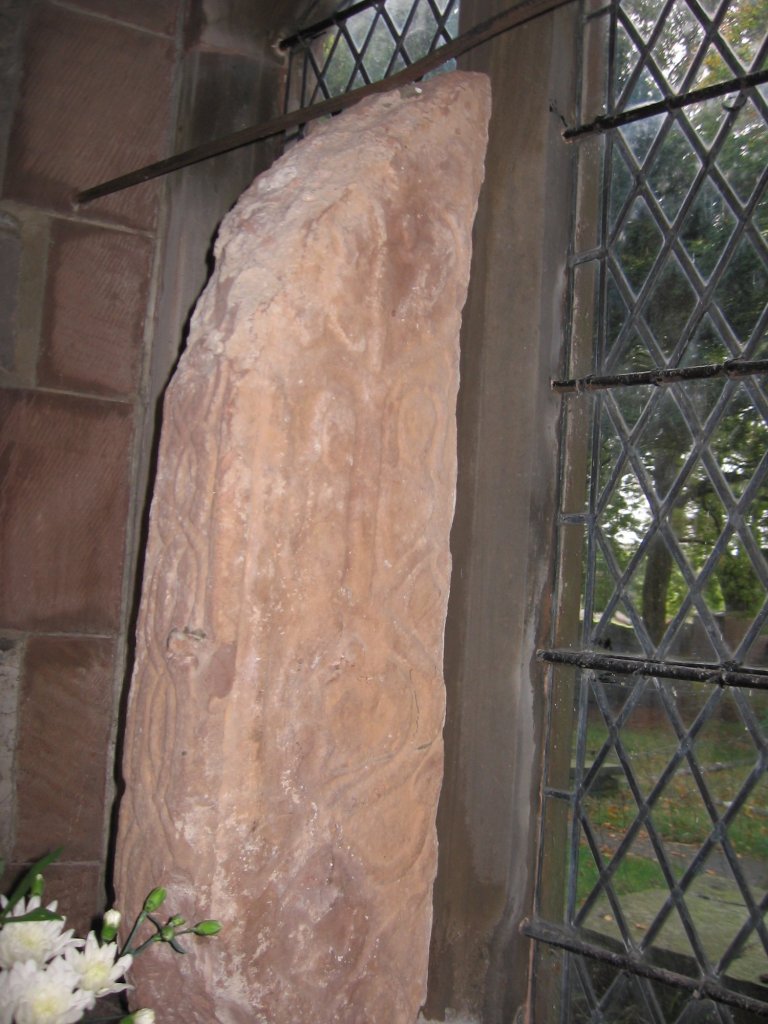

Having avoided the maybe too obvious Gosforth Cross, I hope to have given an interesting insight in the Viking Age (and Anglo-Saxon) monuments of Cumbria.
One more for the road ? Well.. then I will take you to another astonishing cross in the New Year. The Irton Cross. From here and now dear readers:
I wish you a spheric Sylvester and Happy, Healthy & Historical 2016 !
December 18th 2015
A Norman church – St. Bees priory in Cumbria. The Norman Age connection with The Viking Age.
Interested in the Viking Age, – understatement of the year – lately I cannot help myself felling in love with the Norman period. I am surprised by the beauty of architecture involved, and one cannot help asking himself why ‘The Viking Age’ is addressed to have terminated at 1066 A.D. architectally wise.
For example, as one sees the Norman church in Kelpick, Herefordshire – wich is high on my list for a next journey to visit.
Is it that strange to see very similar forms of ornamentation to the (also 12th century) as ‘Urnes art style’ as latest phase of art style in the Viking Age of Urnes stave church ? (the link leads to a lovely blog of Ru Smith lately having visited that church in Norway) compared with the outspoken Norman architecture involved at Norman period churches, as those in Kelpick or, in this article, St. Bees priory in Cumbria ?
So, is ‘the end of the Viking Age in 1066 in England’ a too rigid dated ? In my opinion, Scandinavian art style ecorational imagery / influence continued well into the late 11th and even 12th century. It were Scandinavians (though from France) who brought the Norman architecture and decorational style to England and other countries as well.
Interesting – in that respect – is the foreword of Patrick F. Wallace in the just published book Viking Dublin – The Wood Quay Excavations.
In the introduction and aknowledgements he states:
‘There are problems for an archaeologist wishing to use the word ‘Norse’. The inhabitants of Dublin (note: of course he is addressing Ireland here, but the architectural art style involved also, wich occurred in England as the Norman style also) and the other towns were probably of mixed Norse and local stock from early on and descriptions of both place and people should reflect this. Further, the extent of intermixed nature of so many aspects of the material remains, including decoration, means this culture should be termed ‘Hiberno-Scandinavian’from the mid-to-late tenth century onwards. (In Ireland) That mixed culture was well established by the time of the battle of Tara in 980. For convenience, the material culture up to about 980 may be termed ‘Viking’, whilst ‘Viking age’ describes the whole period from the 840’s to the arrival of the English or Anglo-Normans in 1169.’
He adds further on: ‘A difficulty for the archaeologist is how to recognize the evidence we have for the continuity of so many influences from the late Hiberno-Scandinavian phase into the late twelfth century. This is why from an archaeological point of view, I am recommending that the material remains of the 1100-1200 period to be termed ‘Hiberno-Norman’.
In Cumbria, we have visited a nice Norman period church, founded sometime between 1120 and 1135. The front door is of a distinct Norman/romanesque style and in the opposite of the main door there is a romanesque lintel of ca. 1120 A.D. showing St Michael fighting a dragon. Some distinct Celtic like influences are also to be recognised – see the sculpture sign just left of the tail of the dragon.
There is even a 10th century cross in the graveyard – where else ? , but we apparantly have missed that.. gotten spoiled as it seems of all the crosses we had seen already, presumably..
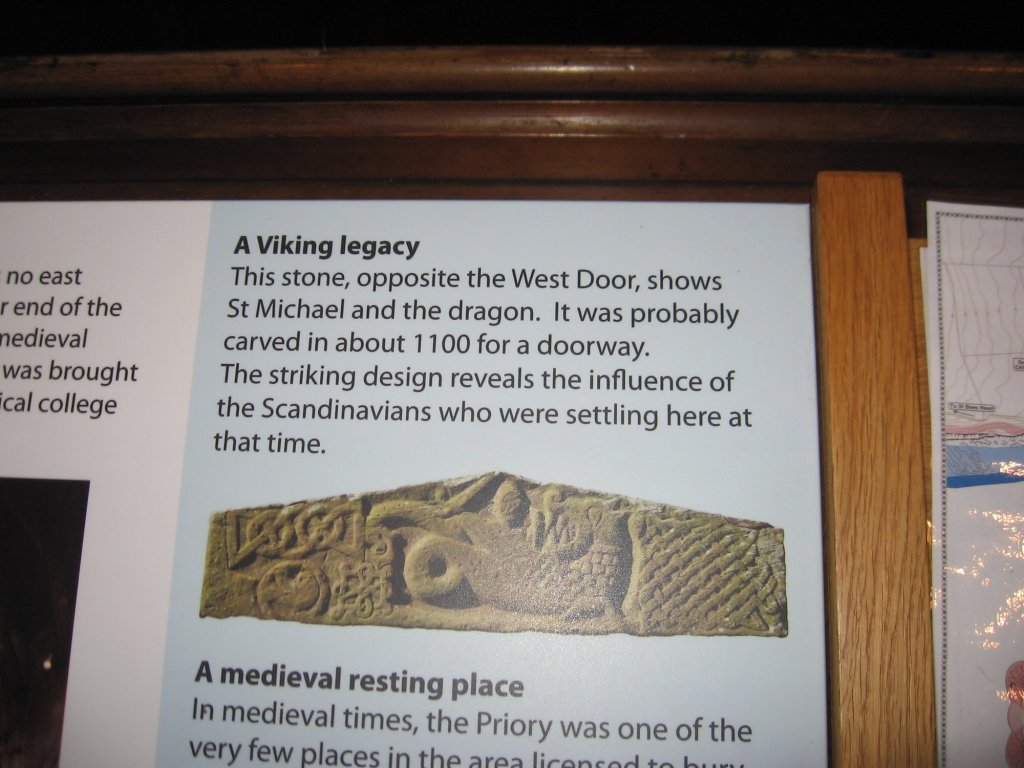

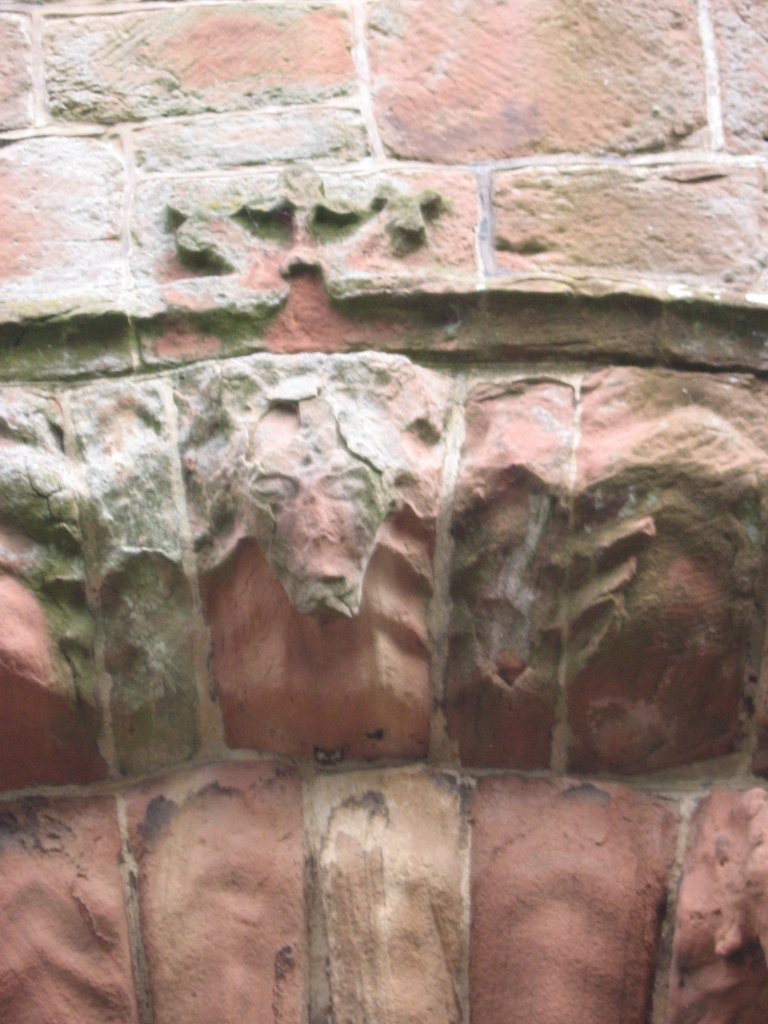
For more reading on Norman architecture in England I recommend the book (expensive, in Dutch we say ‘a rib out of the body – but truly worthwile !)
Fernie E. , The Architecture of Norman England (2002)
Oh yes.. a short visit back to my prior blog on the Viking section in the Kendal Museum in Cumbria.
The stone head figure – where I had expected the Sheela-na-nig to be exhibited, is of non Viking Age date. The Museum commented when asked:
‘This is our 14th century stone head. It was found at a barn in Borrowdale, on land previously owned by Furness Abbey. ‘
Next question I will address is why a 14th century stone had been incorporated in the Viking Age section and not the Sheela-na-nig. Maybe it was found ‘more appropiate’ ?
Certainly to be continued dear readers..
the characteristic front door with outspoken Norman/Romanesque architecture

December 5th 2015
The mysteries in the Viking section of the Kendal museum in Cumbria..
The last day of the visit in Cumbria I was ‘desperate’ to visit the museum in Kendal, being no less intruiged because of the book I have bought during our stay in Cumbria of Geoff Holder – The guide to the mysterious Lake District – Ghosts – Lake monsters – Big cats – UFO’s – Miracles – Magic.
On page 113 and 114 I stumbled upon a section dedicated to the Kendal Museum in Kendal. ‘A wonderful tenth-century Hiberno-Norse stone carving of the Crucifixion, unique in England’, ‘a viking sword and bowl mount decorated with a tiny head’ and something of a ‘Sheela-na-nig’ ..
Now here I got really intriguid..
Entering the museum we were a bit annoyed by the announcement that some re-enactors were walking through the museum who were students and practising a certain role.. So, the visit turned out to be a very quick one. Dear Kendal Museum: spare us the theatre, we are visiting a museum because of the objects..
Of course I wanted to see the Viking section, wich turned out to be a small one, almost a bit hidden inbetween the other display vitrines with items from virtually anything else from literally anywhere..
The Hiberno-Norse stone carving turned out to be worth the visit alone. But, no specific info on this object. The disturbing fact is, that some items were described properly, others were lacking any. Take care of your Viking children, Kendal Museum !
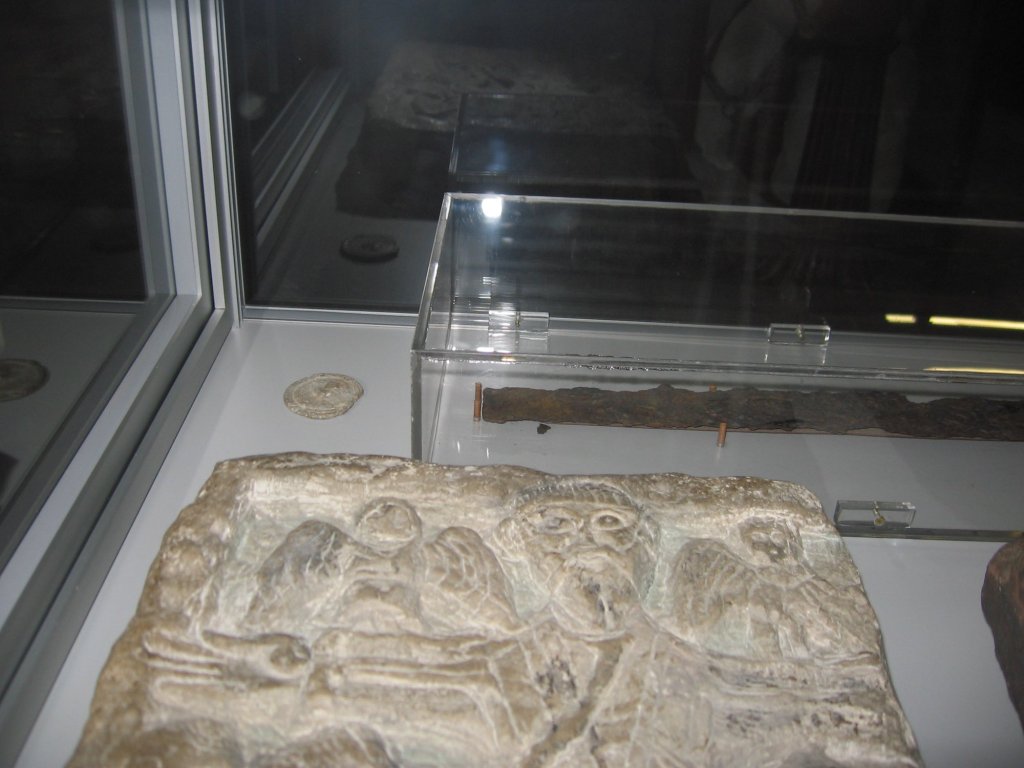
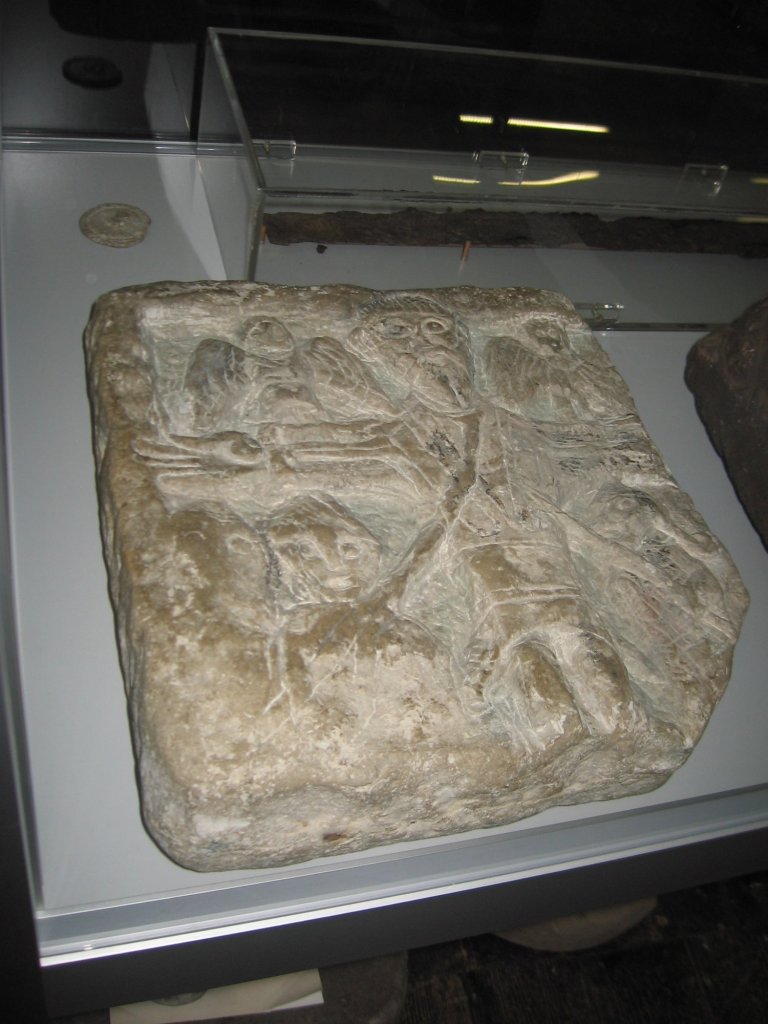
As it was the end of October and the light far from ideal, I couldn’t photograph everything proper. The viking bowl mount was truly worth the visit also and described properly. A link to that object I attach here. The viking sword well.. we have seen more impressive ones..
Then we moved over to an intriguing figure head.. no description at all.. I have informed what this is.. so, I hope to be able to add this later on.. and please let us hope it isn’t a beheaded member of the famous Chinese terracotta army..
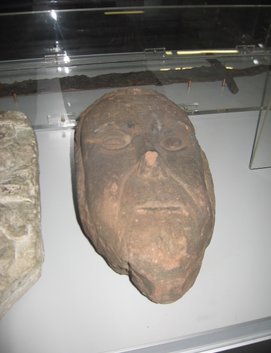
One thing is for sure.. this wasn’t the Sheela na gig where I was intriguied about by Geoff Holder’s little story.. As I had never had heard of something like Sheela na nigs and you tickle my curiousity about almost anything ancient easily I was dissapointed it wasn’t on display. Or did I imagined Sheila a bit to much ‘Sheilaish’ and had I looked at her above ?
No.. I quote here the intriguing story of the Sheela na gig who you can see here (link).
As Geoff Holder is describing:
‘Another interesting item on display is a Sheela-na-nig found in Pennington church. Crude in both senses of the term, the Sheela has pointed ears, a masculine-looking face, bared teeth, and angled arms pointing to a well marked vulva. Barbara Freitag’s 1994 Sheela-na-gigs: Unravelling the mystery traces its history. In 1925 workmen repairing the church found it on the hidden side of a stone used for a quoin (an angle-stone). They were so shocked at the sight of it they amost destroyed the carving, but a foreman intervened. In December 1925 Canon Kenworthy reported the find in the Pennington Parish Magazine, and an account was published in A Furness Manor: Pennington and its church (1929) by A. Fell, and in the Barrow News for 14 September 1929, the latter also by Kenworthy. Kenworthy surmised that the stone had been reversed in 1826, when the church had been almost entirely rebuilt with much re-use of the original medieval stones. Freitag dug up an account by Andy Roberts, who visited Pennington in the late 1920’s and was told by an old resident that the local people had always called the sculpture Freya, a Norse godess (in a deliciously accidentally link, Freitag’s surname is German for Friday, the day of the week named after Freya). The implication was that the Norse settlers in the area had been ambivalent about Christianity, and had inserted the figure of a pagan earth mother goddess into the church ‘just to make sure’. This notion of Norse cultural survival is supported by an inscription in the church’s tympanum, wich is written in Scandinavian runes and dated to the mid twelfth century, a period by wich most religious inscriptions elsewhere were written in Latin. In a 1983 article in the journal Folklore Richard Bailey noted that in 1979 he too was told by a resident that the local name for the carving was Freya. Bailey also discovered that despite the CWAAS having made a field-trip to Pennington, there was no mention of the Sheela in the Society’s official account of the visit, or even in the comprehensive inventory of Westmorland antiquities. It was as if the respectable members of the CWAAS were embarassed by the figure and wished to forget about it. Freitag says that the sculpture was allegedly removed from the church to the museum because the Pennington parson thought that the pagan image ‘might put a curse on people’. Freya was associated with fertility, and the Sheela’s vulva may show signs of rubbing in; in the Earth Godess (1991) Cheryl Straffon records that at some point before 1991 the sheela was taken out and exhibited at a village festival, after wich several local woman became pregnant, including the vicar’s wife.’
A lovely book by Geoff Holder and in my opinion not only phantasy and hearsay involved…
Read it on a windy evening in Autumn or Winter and you will see what I mean..
The Kendal Museum itself describes the Sheela na nig as follows:
‘The carving shown below depicts a female figure with a pronounced genital area. Other figures have been discovered throughout the British Isles but their exact function is unknown, although they are thought to ward off evil.
They appear to have originated in Western France in the early 12th century as carvings of naked acrobats. The idea spread to the British Isles from the late 12th to the 15th century.’
Personally I have a bit trouble with the warding of evil issue, let alone the origin having been found in ‘naked acrobats’. Why on earth would acrobats be naked in the first place .. figure.. and in the very very first place: why would naked figures be.. acrobats ? ….
‘Originated in the early 12th century’, would make this a very late outing of Norse sculpturing in my opinion also.
But.. I haven’t studyed all the books wich appear to excist on this sheela’s .. so..
‘All the books ?’ yes, beloved readers.. áll the books, see and be surprised..:
http://www.sheelanagig.org/wordpress/books-and-resources/
another intruiging blog, among other interesting blogs about English Buildings and architecture by Philip Wilkinson, on another Sheela na nig and her ‘shame and blame’ story, in a hidden place in a Norman church at Kilpeck, Herefordshire, can be read here:
http://englishbuildings.blogspot.nl/2009/12/kilpeck-herefordshire.html
The final puzzling issue remains why the Sheela Na Nig at Kendal Museum is not on display, ‘due to refurbishment’ and a nameless stone head is..
Still some superstition involved in our modern 21th century.. ?
We must therefore turn our head to the curator and make an appointment..
November 27th 2015
Dacre church – two intruiging stone cross fragments.The lion and the naughty snake..
In this blog we move from the outside graveyard of Dacre’s church to the inside..
One might easily oversee gems within churches in Cumbria. Unless one had done his research and knows where to look..
There are two reminders of the Viking period within the church. These are two beautifully carved cross shafts, one dating from the 9th century, the other, larger, dating from the 10th or 11th century. The smaller, older cross fragment is carved on four sides. The best preserved of the carvings represents a lionlike figure with plants surrounding them.

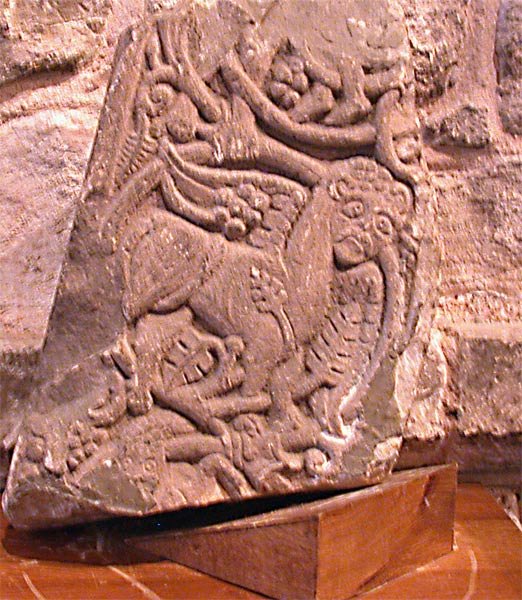
The larger stone was discovered amongst the rubble when the east wall was being restored in 1875 and is thought to be a thousand years old.
The larger cross is a fascinating piece of 10th century art. It stands, propped against the wall of the church, exposing a narrow set of panels, each carved with intriguing characters. The topmost panel shows a beast above two figures clasping hands. Beneath the hands is a small table. It is suggested that the figures are a reference to the Biblical story of Abraham and Isaac. Below this panel is one showing a stag with a hound on its back. This hunting theme was a common motif in the Viking period, and may also have had religious intent.

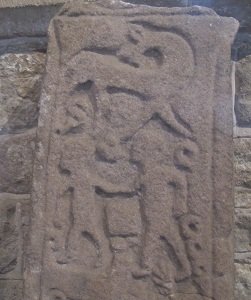
The lowest panel is quite beautifully sharp and clear. It shows a large tree, with two figures beneath it. One figure is reaching up to the tree. This has been suggested as a depiction of Adam and Eve in the Garden of Eden. Whilst Adam is without clothes, Eve wears a very fetching skirt! Who wouldn’t approach her..
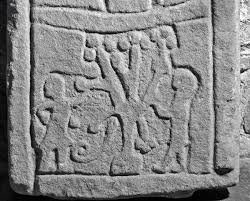
See the Ringerike style spiral form of the snake approaching the skirt of Eve and also the Ringerike style depiction of the branches with leaves. Compare with the stone in Ringerike style found in churchyard of St. Paul’s Cathedral, London.. The depiction on the stone with Adam and Eve may be of a cruder Anglo-Scandinavian form, but it is still recognisable as so.

In the forthcoming blog I take you to a visit to Kendal Museum in Kendal, Cumbria with among other interesting things, an intriguing female who is pointing out quite explicitally…
November 7th 2015
The Dacre ‘bear’ statues of St. Andrew’s Church, Cumbria – a case of ‘luctor et emergo’ in retrospective ?
In this blog we turn our heads to another type of mysterious stone sculptures, where is much debate about from wich period they are dating. Their symbolism is even more mysterious – but I have a daring theory about them, inspired on the weapon (flag) of the Dutch provence of Zeeland.
The weapon depict a struggling lion who overcomes the water, as a symbolism of Holland’s ongoing struggling against the water. ‘I struggle and I will rise above the water’ is my somewhat ‘stonecoalish’ translation of the line ‘luctor et emergo’. But why on earth would I relate this to the four mysterious stone figurines on a graveyard in Dacre, Cumbria, England ?
I address that a bit later on..

Of unknown origin the so called ‘Dacre Bears’ have been puzzling many for centuries. There is speculation that the bears are in fact lions, dating possibly from Roman times. Other theories have suggested they date from the medieval era. In my opinion the discussion if they depict bears or not I will engage, but lions.. ?
In 1890 Chancellor Ferguson thought that he had an answer and said – or better: had a theory – that the bears told a humorous story in four stages.
The first, the bear (now sadly missing its head) is seen holding a post with its front and rear paws. We see the bear missing its head, or was it deliberately casted without head ? Why I am suggesting that, I will address later on.
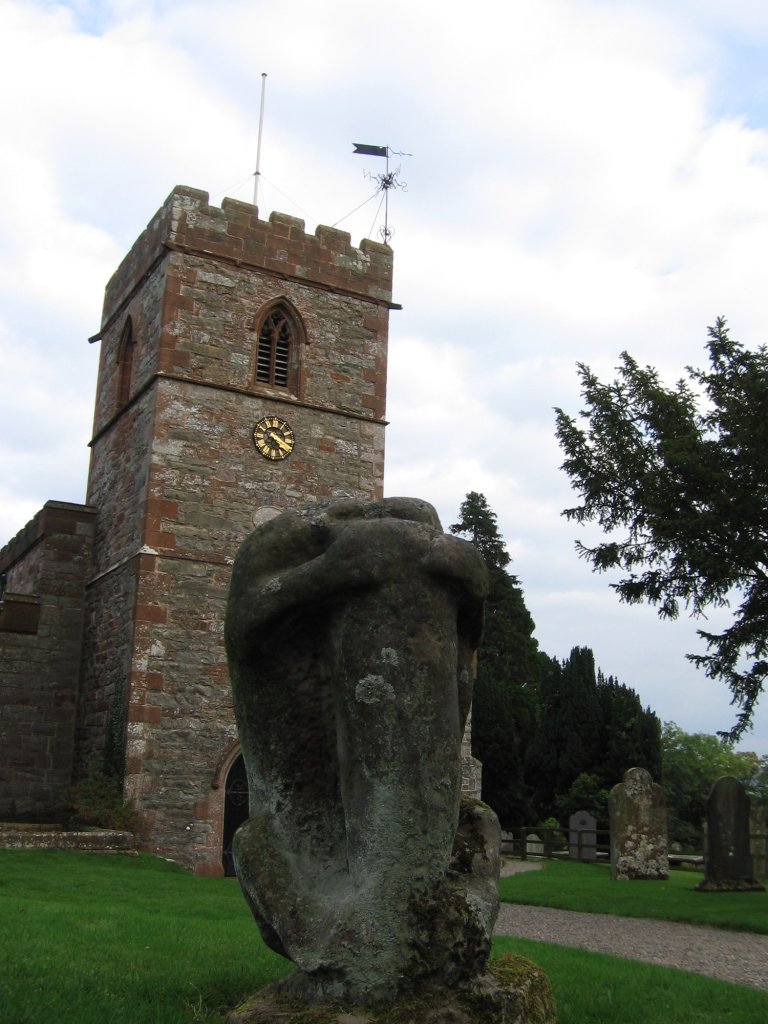
In the second, the bear has a small animal on its back – not very clear on the photo though – perhaps a cat or a lynx, and is turning its head to see what is there.
Ok. A.D. 2015, would we still consider it to be a cat or lynx attacking the lion, it would have been a courageous one, as they are considered by some to be lions. I leave that thoughts upon you..
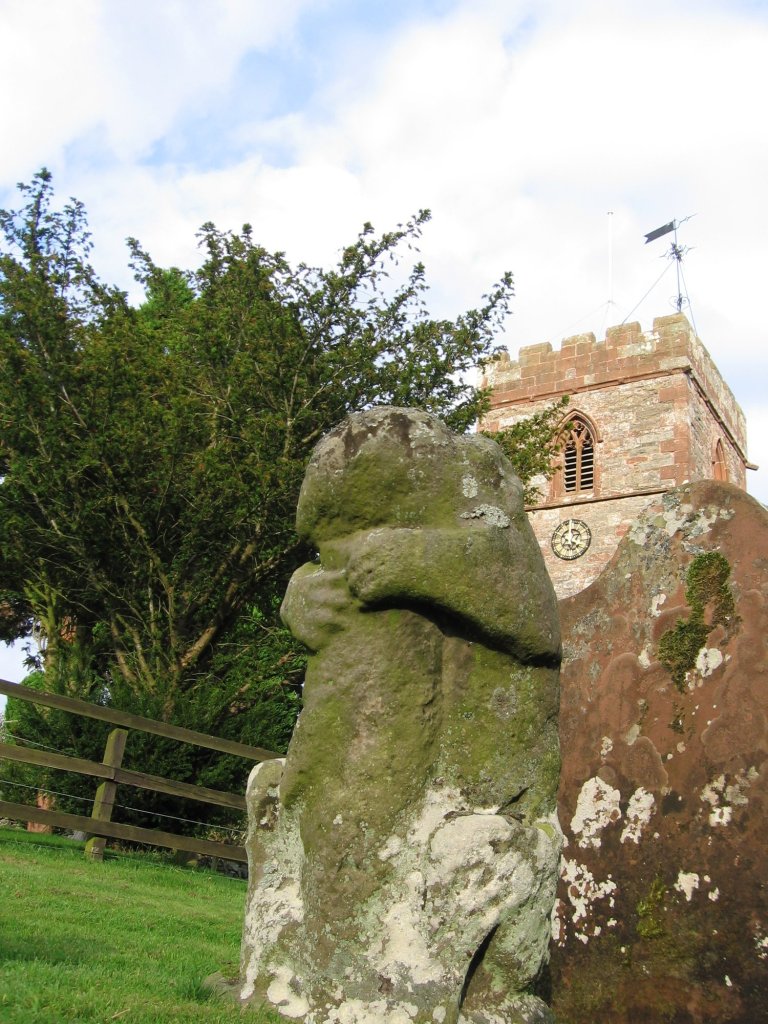
In the third, the bear has flexed its shoulder and is anxious to remove the animal. This is the most crudely worked of the pieces, perhaps because of its complexity.


Finally, the bear has a smug, satisfied look on the face, as if he has eaten the creature. (photo’s on the right beneath and thereunder).
This carving is the best preserved and with a clear mane and tail, suggesting the bear is indeed a lion. (as stated in the folder, available in St. Andrews’s church itself). Again.. if it is a lion, wich animal would have the nerve to crawl upon its back ?…
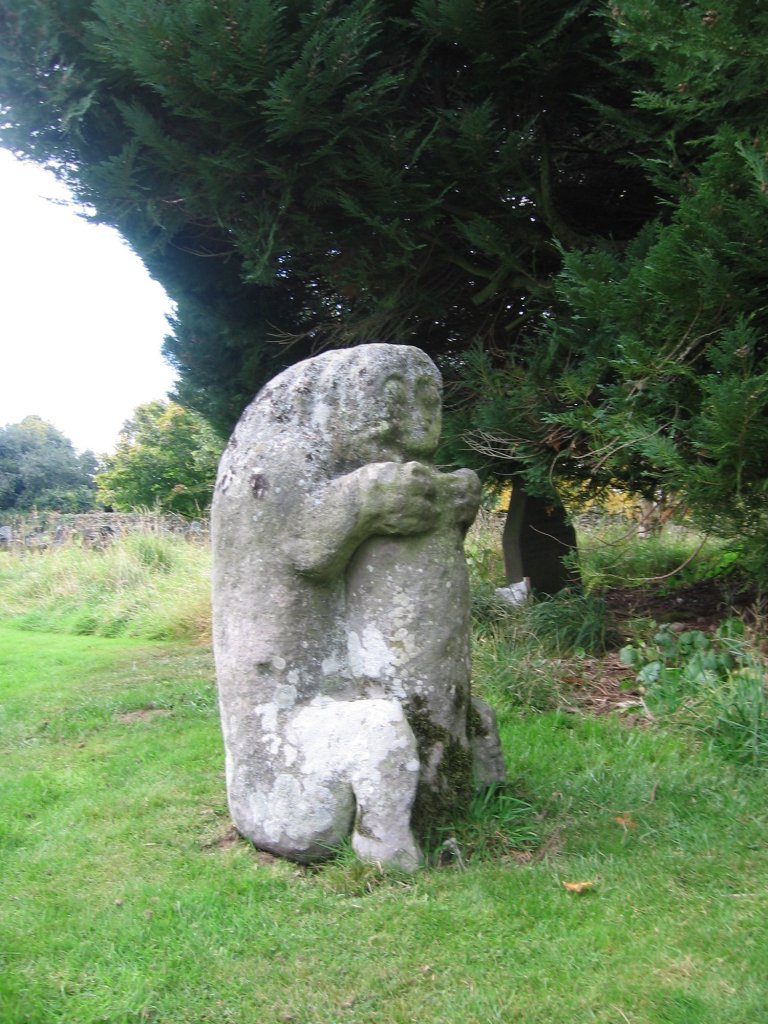
When I was examing the ‘last’ statue, I was mentioning a half holemark on the head. Also I had the strange feeling that what I was watching as well could be very old, or almost could be extraterristial, as strange as it may sound..
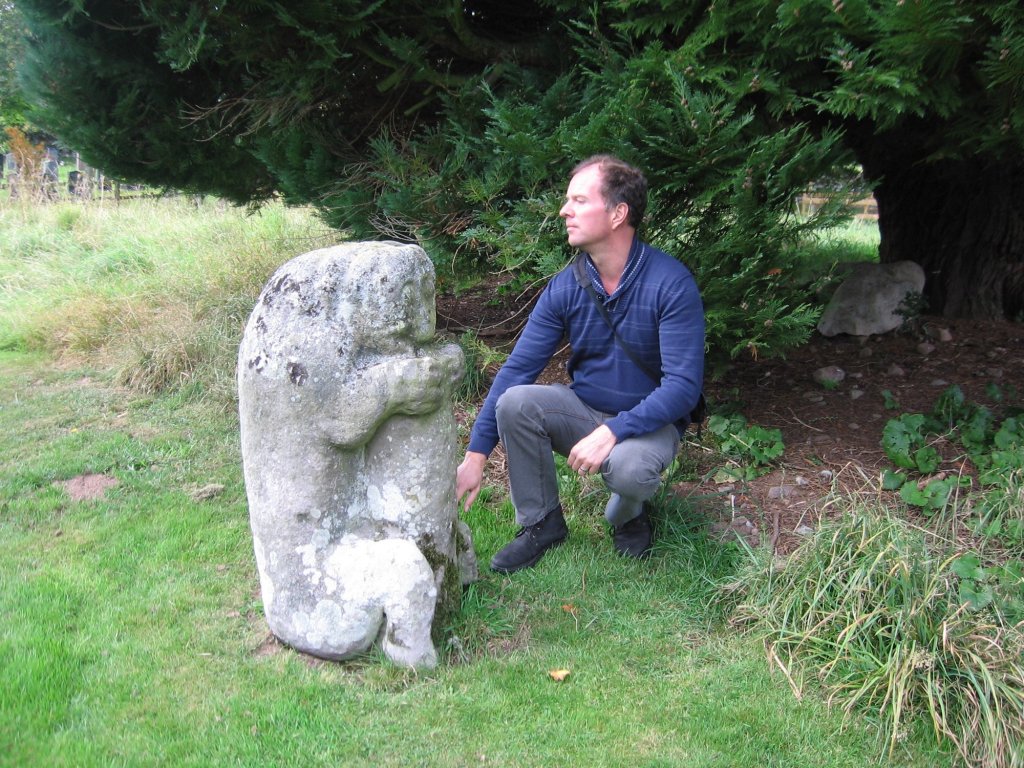

The bears were first recoreded in 1704, but are clearly much older. No one knows their original locations – suggestions include on the church tower, or on the battlements or a gateway of Dacre Castle. Each of the four creatures has a depression on top – too swallow for a flaghole, but just the right size for a candle or a wick floating in oil.
My theory then, – at last for the symbolism – is Good overcoming the force of Evil. If Good is starting losing its head, it is getting unaware of the Evil and is attacked by it. Waking up just in time, one refinds his head (sense) and fights its way back.. luctor et emergo.
Any suggestions can be mailed to me, vikingsandartefacts@yahoo.com or can be addressed to the church itself at: admin@dacrechurch.com
Addition October 2024:
To add to the mystery, Gordon Emery published about the Dacre bears in his magnificent book Curious Cumbria – The Lake District and beyond (2023).
Herein the unanswered questions of dating arise again: ‘Where they Roman? Where they from the Celtic monastry that may have stood here in the eight century, or are they Anglo-Saxon, Norse Norman carvings from the castle or from a later age?’
TC Bell is mentioned having another theory, pointing towards the lion character of the statues. ‘A long tasselled tail behind the animal’s back and mains on their heads point to the Roman lion – the only cat with a tasselled tail is a lion.’ Bell is stating that: ‘They come from ornamentation on a Roman road to a governor’s house where he has found evidence of a number of plinths with tops missing and says there may be more to be found. They represent damnatio ad bestias feeding criminals to lions in the arena, a warning to those who broke Roman law.’
Unclear, to me, remains if more of these kind of “tops” have been excavated.
My conclusion: It’s not a done deal yet !

October 26th 2015
Viking hogback stones in Cumbria- a mysterious part of the heritage of the Viking Age – let Halloween begin !
In the forthcoming blogs I would like to take you on a journey to Cumbria, England wich I visited last month. Several interesting Viking Age stone sculpture artefacts can be seen there. The attractiviness is, they can be seen ‘on the spot’ (or very nearby, sheltered in the churches !) where they have always stood. Almost no need to go to musea here – it is still there, in the wild..
In this part of the journey I will show you the so called hogback stones wich can be seen at – as far I have discovered – four places in Cumbria. These kind of grave-markers were created in the Scandinavian settlements in northern England. These characteristically long, relatively narrow blocks of stone have a curving apex. In its classic version it looks like a stone model of a longhouse with tegulated roof and schamtic wall posts.
Intriguing question maybe why they were having the form of a house.. as to depict a symbol of shelter in a new (after) world ?
Their distribution is focussed across northern England and southern Scotland, with only a few in the north Midlands, and one each in Cornwall, Wales and Ireland. There is a relatively late group to be found in the Orkneys. The most outstanding examples can be found in the church in Brompton, North Yorkshire.
Having visited the first hogback stones, it felt somewhat of a dissapointment. Well.. just a bit. It seemed that at this place the pagan remains found were tolerated, but only outside the church. In some cases the outside atmosphere is being considered as less hazardous to the stone material, as by example with the Gosforth Cross. Here or the soil where they were dug op from, or the air conditions did not much good for them. And then there were some very fanatic religious people back in the old days also – let us not forget..
When the old church was pulled down in 1720, the churchwardens ordered – among other monuments as the Giant’s Thumb – to be broken up for rubble. In a thankfull moment of reason, the locals forcibly interrupted the destruction, and the damaged parts were rivited together (concerning what is stated in Geoff Holder’s The guide to the mysterious Lake District – see: References). So, starting to be destroyed, they were saved from ultimate destroying. Thank you 18th century people of Penrith ! Remember those weren’t quite the ages of protecting history when it came to stones…
Read more upon the Giant’s Grave wich this monument of grabbed together Viking Age sculptures, including the two Anglian crosses at each side of the four hogback stones in the book of Geoff Holder. The ultimate book to read on a late Autumn night ! With gosts and all .. let Halloween begin..
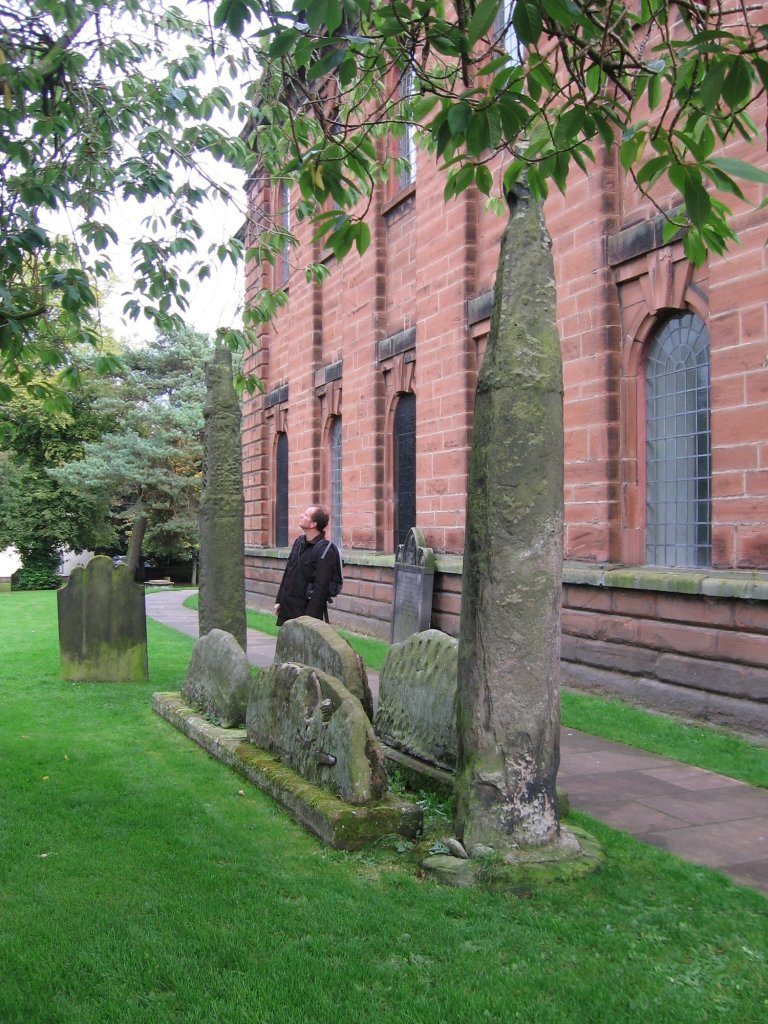
Back to the slight damp of dissapointment wich fell over me, watching the four hogback stones in St. Andrews Church in Penrith.. Spoiled with modern day expectations, at first sight I found them a bit ugly. Very worn and abraised by the hand of time. But, then again, as wich is with much in life, the glass appearing to be half empty, became half full as I took my time watching the remaining details..

On top the tegulated roof can be seen, and on the bottom what appears to be ‘rolling waves’. Symbolism to an ‘endless river’ as the ongoing circle of life in the afterworld ? Just a suggestion..
A sharper drawing of how they must have looked like, on the image beneath, with some details of the crosses on both sides.
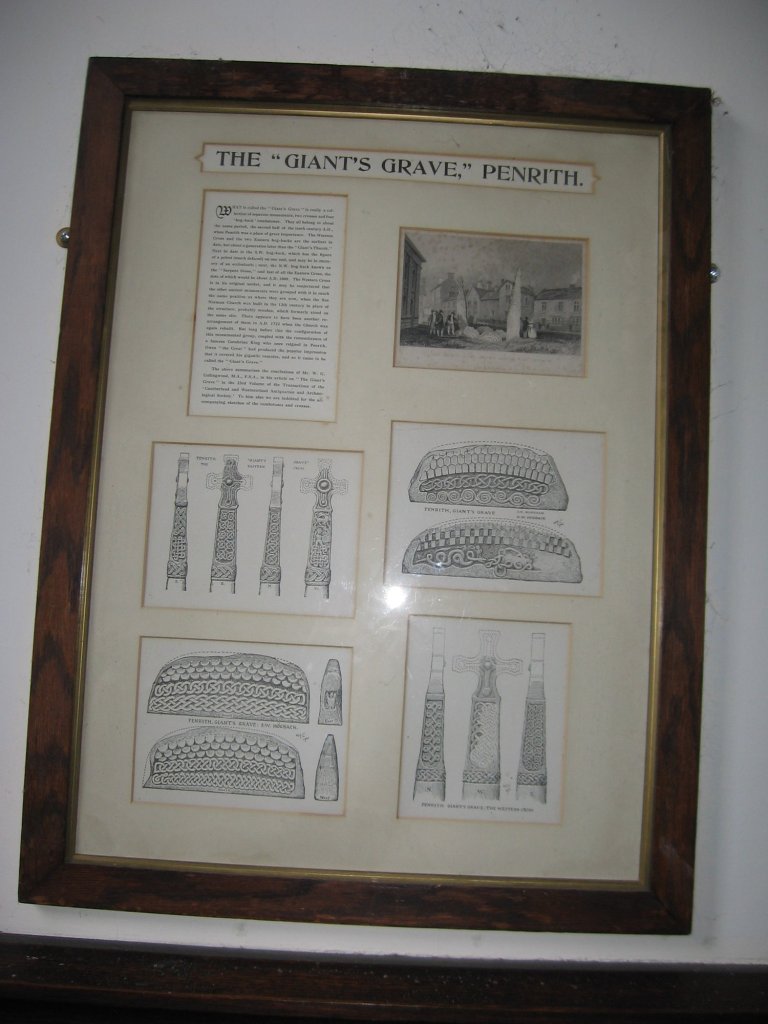
A little week later on – in the gloom light of late October – but how appropiate ! we headed to the Gosforth Cross in Gosforth. Inside the church – St. Mary’s church – itself, the hogback refugees had gotten asylum in a far more caring way. Here – luckily, a lot more detail can be seen. One features a pair of crucifixions (the so-called ‘saint’s thumb’), the other scenes of a battle (‘the warrior’s thumb’).

Having been found in 1896/1897 during restoration of the church foundations, they had a better fate and were encapsulated within the back of the church. I wonder if people realised what they have found. Where they aware of their historic and artistic value ? In Penrith, the locals did – and I think they did not knew from wich date and age it was. But they must have felt it was something special. It would be interesting to know how the people thought about these monuments at the time, and what they had known by then, and how they got to know at all in the first place ..
See on the photos the intwined snake images, the shield warriors on the bottom and the crucifixed figure on the side of one of the hogback stones. Pagan and Christ in a cultural clash.


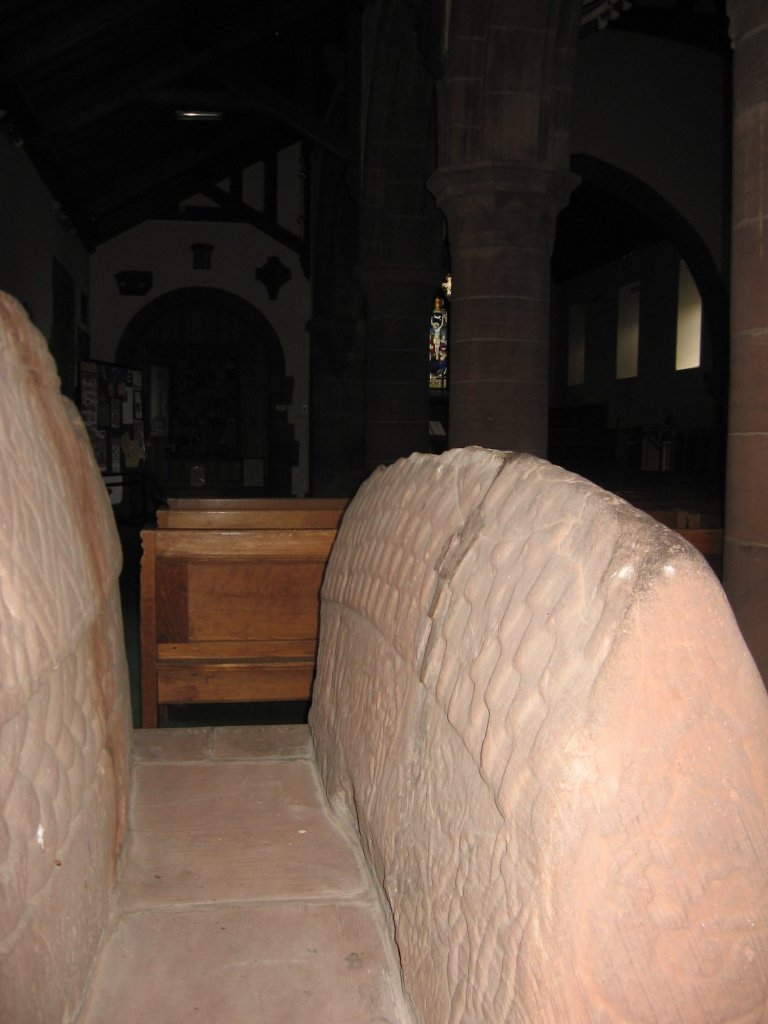


Well. I could have been with these stones until after dark, but as my wife wanted to travel on.. well.. I see you again, some day, hogback stones from Gosforth. And if you happen to be there one day, do not forget that monument on the outside…
Further on with the Cumbrian hogbacktour !
In – yes, luckily again in – St. Peter’s church in Heysham, there is a truly beautiful hogback stone. The guide told us, it had been studyied by Thor Ewing, a writer, in 2000. in ‘Understanding the Heysham hogback’ A tenth century sculpted stone monument and its context (link), Thor Ewing tells in detail what he dicovered on the both sides of this hogback stone.
Just being brought in the church as late as the 1970’s accompanied with some protest here and there among the church visitors, considered as being a token of old paganism, it had been remarkably nice preserved, and a lot of detail can be seen, still. Truly worthwile a visit.
I had a small debate with the guide in the church if the – zoomorphic, in my opinion – faces on the sides were lions (or hippo’s). The guide doubted if the vikings could have known about lions. Well I guess so, concerning the runes on the Ancient Greek lion statue at the Arsenal, Venice. For example. Vikings did travel south..
But when he told me he was doubting the vikings ‘discovered’ (as the native inhabitants were of course, in the first place) America before Columbus, I decided to rest my case..
One has to know when to start and to end a conversation ..
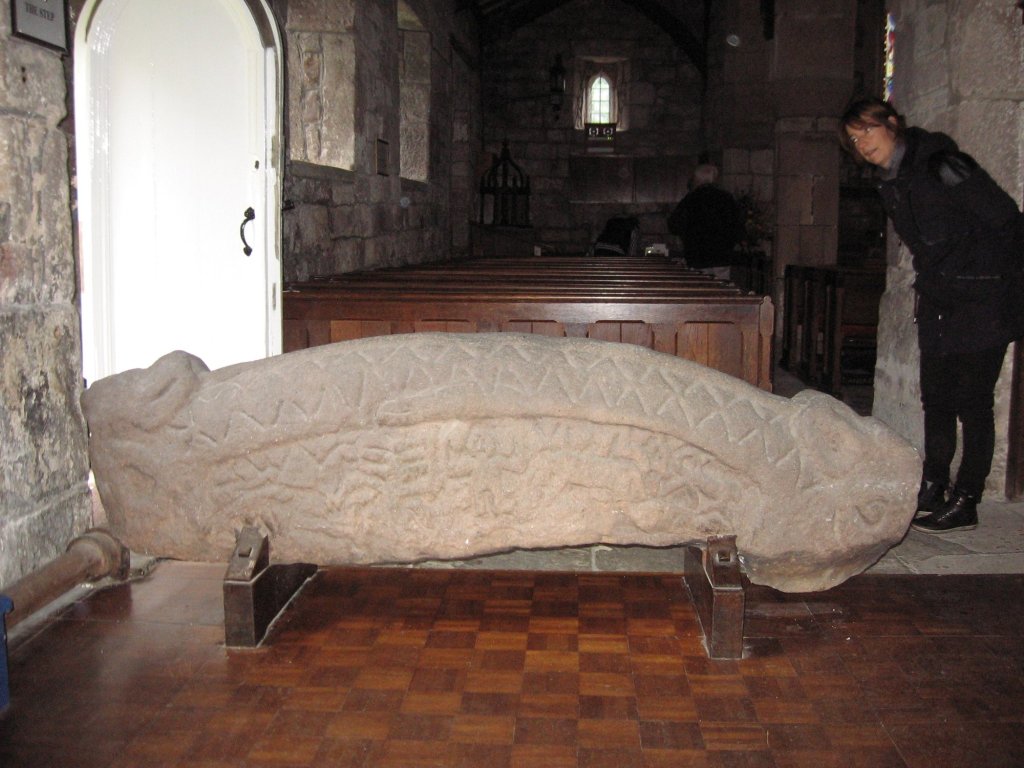


Just discovered the book in a bookstore written by Geoff Holder – The guide to the mysterious Lake District, I knew there had to be another hogback stone in Lowther, St. Micheal’s Church. With a promising image described in the text of ‘a naval and a land-based force of shield-bearing vikings above a fish and what might be a coiled sea serpent. On the reverse is a row of female figures with snakes, possibly a representation of the hideous hag Hel‘. Wow. If that did not sound as a true pagan promised land ..
Not complaing too much after all we have seen, this visit was the dissapointing one of them all. But if you wife states ‘I am happy to have seen them’ and I am answering ‘Measuring is knowing’ and the even more obligate verb ‘handling ‘if we did not see it at all, we wouldn’t have known anything at all of how they were looking‘ the glass was again half full, at the last day of our journey..
The hogback stone appeared to be just being tolerated within the entrance segment part of the church. As something you never use anymore but you do not throw away – entirely. That sort of feeling emerged when seeing this hogback asylum seekers.. Bed, bath and bread, ás we say in Dutch, but no luxury at all and standing on some outcuts of wood, you would balance the table with at home..
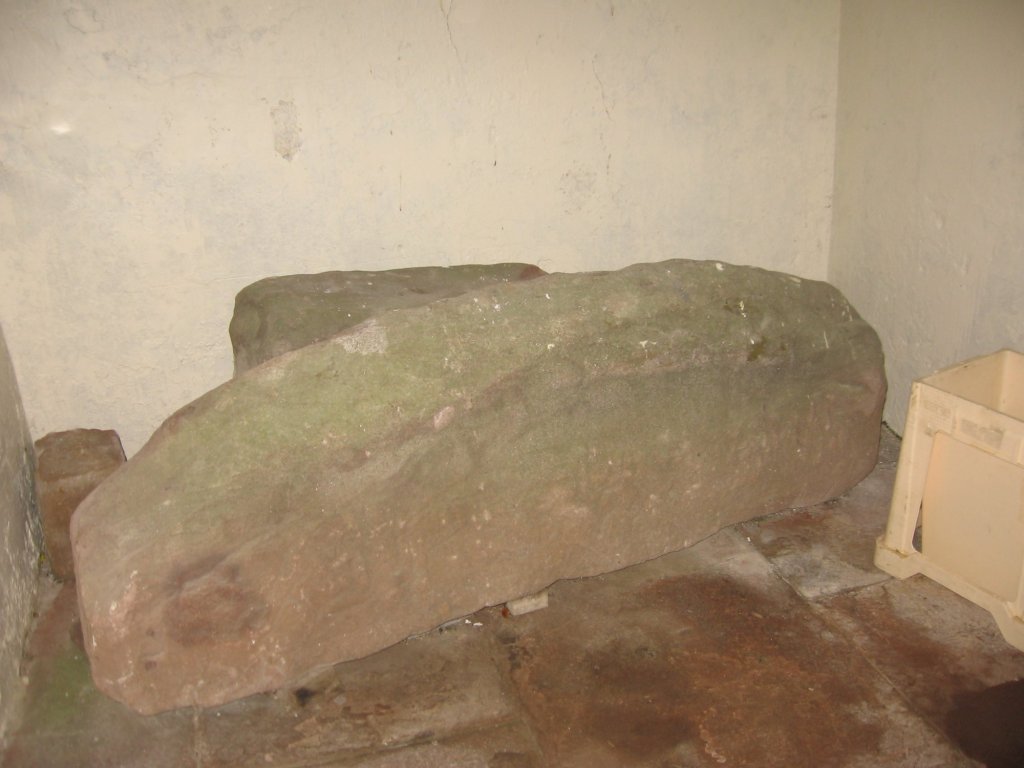

Come on, St. Michael’s Church.. care a bit more of your ‘children’ !
This hogback stone was moved in the church in 1907. Hogback stones layed partially buried in the churchyard before it was dug up and moved into the church.
The promising depiction of a longship – as certainly can be seen after some studying – see http://vikingminds.co.uk/pages/longship we have missed !
The stone itself is (157 x 50 x 30 cm) and very worn.
The hogback stones in Cumbria – very diverse in quality, but everyone worth a visit ! Especially on a gloomy day in late October …
The churches to visit – see photos of resp. St. Andrew’s church in Penrith, St. Mary’s church in Gosforth, St. Peter’s church in Heysham and St. Micheal’s church in Lowther.
Did I miss out on another one in Cumbria ? Let me know !
Addition October 2024:
Reading Gordon Emery’s Curious Cumbria – The Lake District & beyond (2023) some more hogback stones are depicted. Furthermore, Gordon Emery refers to the almost uniqueness of hogback stones to Britain put against the the theory of Bjorn Vernhardsson about norsemen/northmen, considering them not be Scandinavian, but from England, Cumbria and Northumbria ‘people of the north.’ (see also p. 75 of Curious Cumbria) A very interesting theory and therefore added to this blog about hogback stones.
In a next blog I will take you to four – still remaining utterly mysterious- statues ‘guarding’ the graveyard of St. Andrew’s church in Dacre..


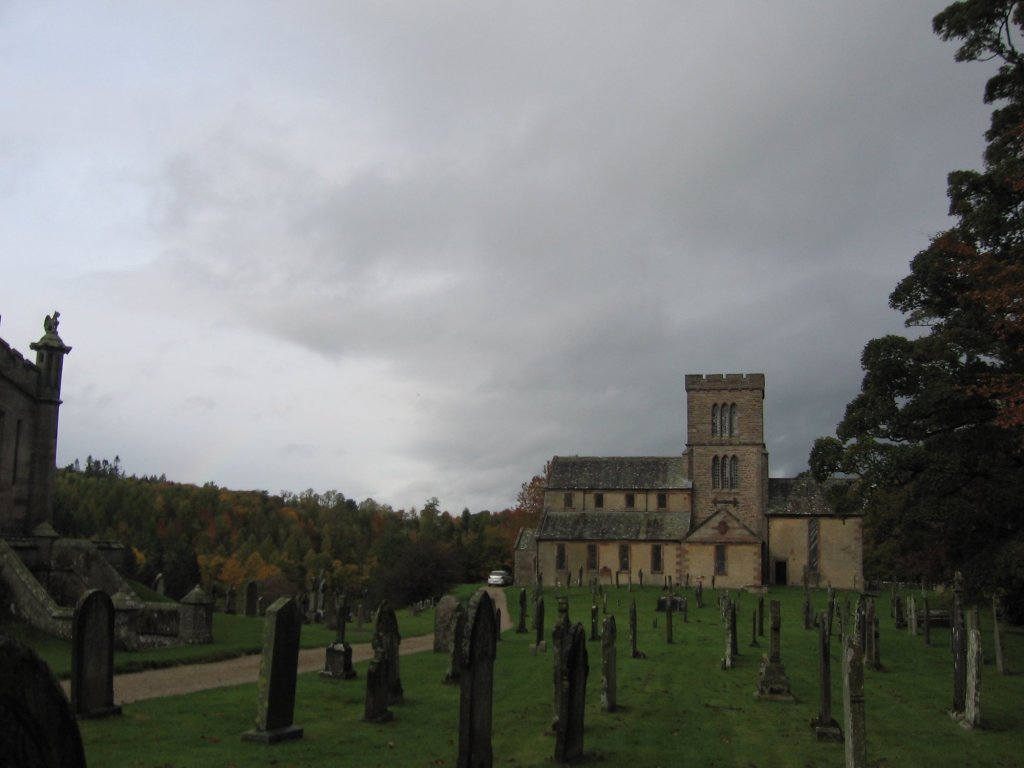
September 14th 2015
The most ‘vikingish’ coin of all viking coinage – the raven penny of Anlaf Guthfrithsson
On Coinage of the Viking period I took you along the Hiberno-Norse coinage of Ireland and showed you the penny I have of the Hiberno-Norse Kings of Dublin, Sihtric Anlafsson ‘Silkenbeard’.
This week I am a bit of proud to present you my latest acquisition ! It is the best part of a true, so called, Raven penny !
Vikingolists know why I am thrilled 😉 It seems that I have followed the same strategy as in 2004 when I acquired the hiberno-norse penny. It was only affordable to me because it was an example wich was split in two parts.
Choosing your battles..
The raven penny was very high on my list on ‘most wanted’, but seemingly totally unaffordable, having been sold on auctions for as much as over 20.000 pounds… (see the link for the though exquisite example being sold for £21,500/ $33,000 not including buyer’s fees..
Being witness to the ever exceeding crazyness collecting the true interesting Viking Age artefacts among collectors…
Another example was sold for $ 27.500. More examples you can find easily googling on ‘viking raven penny sold’.
Always having feeled somewhat of a sort of annoyed missing out on the example wich was on sale on Mike R Vosper coins see link I counted my blessings when this example came along on Timeline Auctions and gave it a try. After all.. for the true Viking Age artefacts collector, the raven penny is in his absolute top 5 of main type of artefacts (I think ;).
This raven penny I was able to get my hands on was somewhat cheaper.. Yes, it misses a part, but I was immediately attracted to it, especially as a big part of the raven was visible and the overall execution of the coin was sharp. Even when enlarged – click on the image – the quality of the remaining part is unquestionable.
Of course one can get it even cheaper of course.. but here is the real thing ..
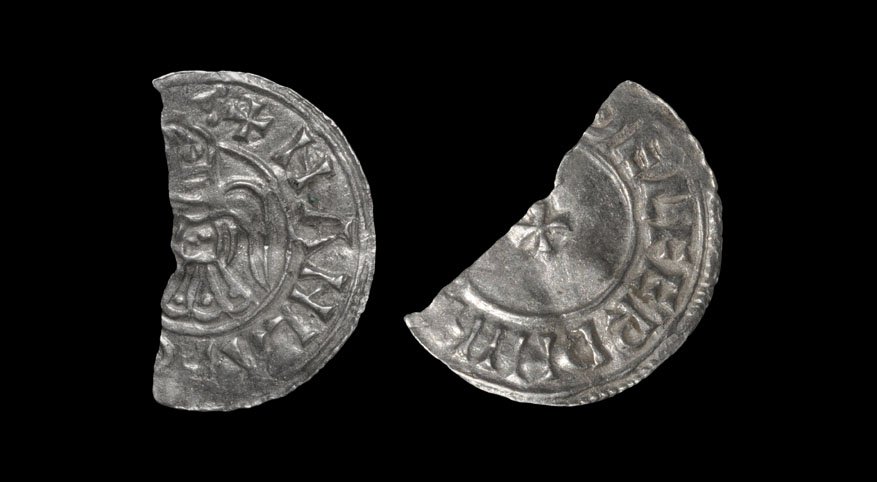
Back to the penny.. it is a true viking coin of Anlaf Guthfrithsson minted by the moneyer Aethelferd 939-941 AD.
Obv: raven with wings spread and +NANLAF C[VNVNC] legend. Rev: small cross with [+E]DELFERD MIN[ETRE] legend for the moneyer Aethelferd. 0.71 grams. Near as struck; a large fragment.
Olaf Guthfrithsson (Old Norse: Óláfr Guðfriðarson; Old English: Ánláf; rendered in Old Irish writings as Amlaíb mac Gofraid) (died 941) was a member of the Norse-Gael Uí Ímair dynasty and King of Dublin from 934 to 941.
This specific viking penny was struck in the name of the Viking King of Dublin, Anlaf Guthfrithsson who had created a kingdom around York in 939. At this time, at the end of the ninth century, much of northern and eastern central England was under the control of the Vikings. The Viking kingdom of York lasted around ten years. This archetypal Viking coin, the ‘Raven Penny’, was minted during his short rule, for he died two years later in 941.
A pagan or a Christian association – or maybe both ?
The obverse legend means ‘King Anlaf’ (Olaf) in Old Norse and is one of the earliest surviving texts in this language. It features the Viking war standard – what is believed to be a raven, or possibly an eagle as both birds were associated with the Norse god Odin. This type is one of the most remarkable coins of the Viking invaders, showing a raven or perhaps an eagle, birds associated with the god Odin. The eagle is also associated with St John the Evangelist, so there may be a pagan/Christian association that would relate to all the local population.
Anlaf Guthfrithsson was the Viking King of Dublin (Ireland) who fought in the Battle of Brunanburh in 937 alongside Constantine II and Owen I against Aethelstan, King of England. The infamous battle of the 10th Century was not a victorious campaign for Anlaf but he survived the conflict and successfully seized York and parts of the East Midlands in the aftermath of Aethelstan’s death in 939. The ‘Raven Penny’ was minted during this occupation.
The obverse legend means ‘King Anlaf’ in Old Norse and is one of the earliest surviving texts in this language. The use of Old Norse language instead of Latin coupled with the raven image, associated with the Norse god Odin, is a strong indication that the Vikings were declaring their independence in the British Isles.
Literature
S. 1019; N. 537.
August 21th 2015
A Viking Age firesteel – the razor’s edge ?
This week an artefact of the Viking Age, wich have been a case of heavy debate, still going on.
Sold as a viking firesteel with Odin and his raven, Hüginn and Muninn, depicted y Timeline Originals (now: Timeline Auctions) I was very curious about this object. First of all because the image of Odin and his companying birds is so outspoken clear. If it is the image of Odin with his raven is a matter of debate within itself. Apart of being a pagan image it could as well have been a Christian alike image of the Ressurrection of Christ.
Set aside that image, the artefact itself is matter to debate. Sold as a described, a man called ‘Sergei’ mailed me more than uptight, making me out for somewhat of a fool..
‘… firesteels (steel is a key word here) were all made out of iron of high carbon content during the entire history of mankind. The bronze and other copper alloys are not strong enough to serve the purpose. What you have is a decorative anthropomorphic (combining elements of a man and animals or birds simultaneously) pendant or a plague of Perm (Finno-Ugric tribes) animal style. Such decor pendants, plagues, clasps and belt ends served as amulets against evil spirits in medieval times..’
Addressed as being Permian animal style this would refer to the ancient history of Finno-Ugric peoples living west of the Urals – Zyrian Komis, Permian Komis and Udmurts – and their art, most frequently referred to as ‘the Permian animal style’.
It was at its prime from the 6th to the 8th and 9th c. and its end fell to the 14th c. Treating Permian art, we should bear in mind that the art of Ob-Ugrians is fairly similar to that of Permian peoples and that at the time there were also the Ob-Ugrians Mansis (or Voguls) living west of the Urals.
And indeed, as one searchs for ‘Perm animal style’ images, one stumbles upon an image (on the right beneath) wich depicts a similar artefact..
As one can see on the page on my website I also have some mysterious images out of a (antique ?) Russian book, addressing this kind of artefact. But not known to me until now, wich book this is.
So.. an amulet after all ?
The debate continued though, literally on the razor’s edge..
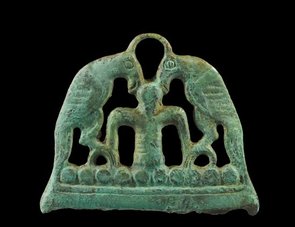

Being the curator of my own private collection of artefacts, one needs to protect his artefacts from bronze disease andsoforth. I got in contact with someone, priorly working at the Dutch National Archaeological Services, Johan Langelaar, who also made me out for something like a fool. Again..
Well.. one thing was for sure.. this amulet wasn’t going to protect me for being held for a fool ..
‘It is a shaving razor !‘ he cried out. ‘Do not let anyone tell you otherwise ! It is a shaving razor !’
‘Take a look at the iron on the bottom of the razor. That had detoriated, the iron part was the razor where wich one have shaved itself‘.
Ok.. a firesteel, an amulet and now a shaving razor..
Of course I did my own research then.
I came across a book, written by Spiro Svoronos, ‘Medieval firesteels’ wich addresses an openwork artefact as a shaving razor. Right at the same time, another artefact popped up at Timeline Originals, – see image beneath this article – wich had been addressed as a firesteel also, but looks very much the same as the type of openwork artefact on the image out of Spiro Svorono’s book about medieval firesteels. The reference given bij Timeline Originals happens to be a dissatisfying one too, as it refers to a quite different kind of firesteel type artefact (Cf. Lehtosalo-Hilander, P-L., Luistari II The Artefacts, Helsinki, 1982, fig.21.) A so called ‘horse and rider’ type of firesteel. (as a link to the image hereby attached).
A shaving razor also ? And of a much older date than being described as ‘viking’ ?
I try to get a copy of this ‘Medieval firesteels’ book. It seems unavailable right now.
And for one thing I have learned over the years.To be open for other opinions, and let newly discovered opinions from someone else or by myself alter as being ‘true’ presented opnions (from by example from someone sells the object in the first place).
Yes, we see a man with birds. But what followed as described is as intruiging as well..
The debate goes on…
Any thoughts on this both artefacts ? Share them with me on: vikingsandartefacts@yahoo.com
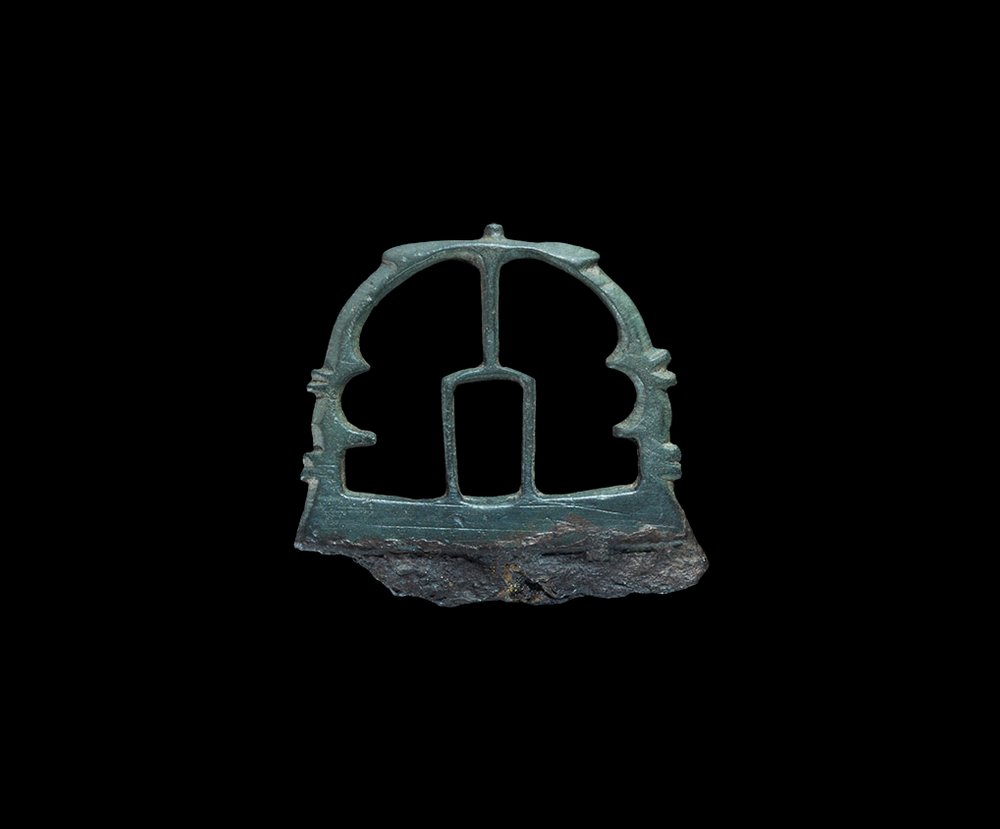
July 30th 2015
An Anglo-Scandinavian bronze mount in Mammen style – a bird dragon entangled within itself..
This week I like to take you on on a short trip to a so called ‘Anglo-Scandinavian‘ type of brooch. ‘Anglo-Scandinavian’ as this type of brooch only shows up in England. The brooch has the characteristics of a Scandinavian strong Viking style decoration, but a non-Scandinavian form.
Anglo-Scandinavian is an academic term referring to the archaeological and historical periods during the 8th to 13th centuries in which there was migration to – and occupation of – the British Isles by Scandinavian peoples generally known as Vikings. It is used in distinction from Anglo-Saxon.
It is an extremely rare type of brooch. There are just three other examples known. (‘Mammen style decoration is rare in Britain and this brooch is only one of three rectangular brooches known in England, two brooches are known from from West Stow Heath, Suffolk and Bergh Apton Norfolk’). These two similarlike brooches are on display in the Ashmolean Museum in Oxford. The third is in a private collection. The example shown here destines from Dirk Kennis. The exact findspot regrettably is unknown, but it was found in East-Anglia. This example is of the better quality than the examples of the Ashmolean Museum.
Executed in the Mammen style, it can be dated to the mid to late 10th century.
See for reference:
Viking Identities: Scandinavian Jewellry in England by Jane F. Kershaw, p. 116, 117 and 118 (Mammen-style brooches).
Quote:
‘Unique for Scandinavian-style ornamental metalwork in England, the brooches depict a Mammen-style bird…. the bird has an arched neck and forward-bent head with round eye and open jaw, together with a double-contoured head lappet; this arches downwards into interlace with its body and wings before terminating in an open-ended tendril. The wings, represented by a pair of double tendrils, extend diagonally downwards to the bottom left corner and pass behind a similarly constructed tail, extended diagonally upwards. The bird’s raised leg, with bent foot, is also visible. This treatment, particularly the movement and open-ended tendril terminal of the head lappet and the use of the tendril ornament to depict the bird’s wings and tail, identify the bird with the Mammen style.
Yet whereas the brooch motif is influenced by Scandinavian art styles, its rectangular shape is not Scandinavian in origin. The brooch shape would instead appear to relate to to rectangular and suare brooches found predominantly in northern Germany and the Netherlands: so-called Rechteckfibeln.
Square-headed brooches are dated on the Continent to the 10th century, a date wich accords with the appaerance of the Mammen style in Scandinavia’
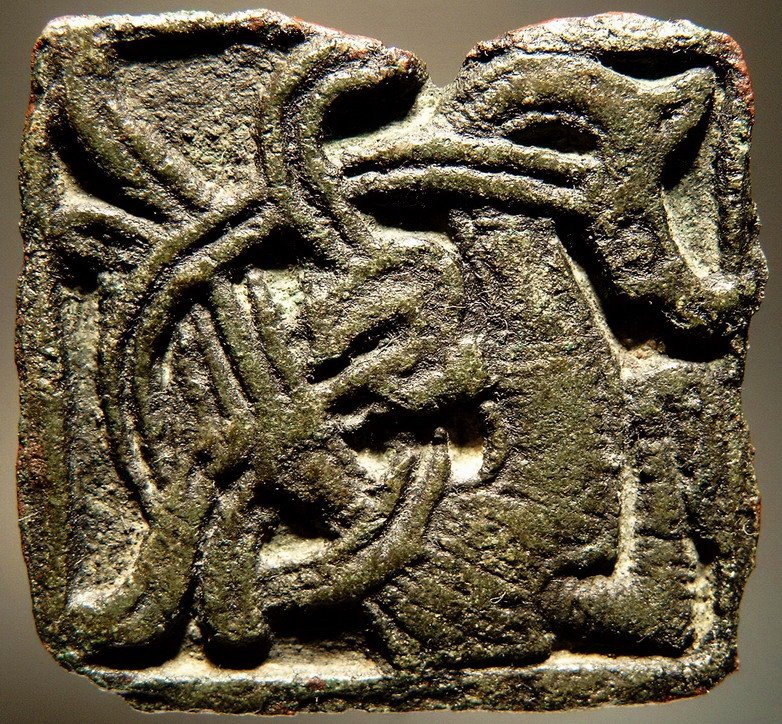

The best reference until now, I have found in the database of the Portable Antiques Scheme to a similar Anglo-Scandinavian bronze mount.
http://finds.org.uk/database/artefacts/record/id/466558
Also see the Viking-Age Scandinavian art styles and their appearance in the British Isles Part 2:
Late Viking-Age art styles datasheet from The Finds Research Group

See for expanded and updated information https://vikingartefacts.com/viking-brooch-in-mammen-style/
July 10th 2015
Viking Age weather vanes – looking for the stars ?
In this week’s blog I like to take you on a sea travel watching the stars..a sea travel, wich ultimately ends on the roof on a church..
Let us start with one of the most intruiging parts of this article. This is, that several of this Viking Age weather vanes actually were found .. on churches !
A pagan artefact for use on a religious building..
How on earth did they get there (presumebaly after use in prior century/centuries on ships) ? It is a question wich answers lays in the Mist of Mystery. Or isn’t it ?
As it is, several famous weather vanes were being found on the church spires.
First we have the gilt-broonze vane from Källunge church, Gotland. Designed in the Ringerike style with a so called ‘Great Beast‘ it is remarkably well preserved. As I could not find a photo of this specific weather vane, I added a drawing of it. The ‘Great beast’ – a distinct characteristic of the Ringerike art style, places it in the 11th century late(r) Viking Age.
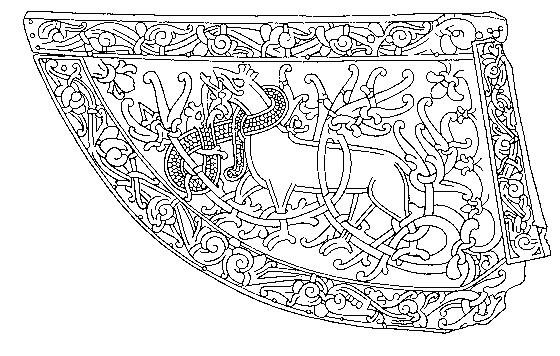
The second weather vane was found on Heggen church, Buskerud in Norway. Also cast in a fine Ringerike style, one wonders if some boy in more recent days had tried to shoot the vane of the churh-spire..
As our own Dutch poët Lucebert was saying: ‘Everything of value is defenceless‘…
The detail is showing us – again – a ‘great mythical beast’. A peacock ? One could see this with little phantasy..
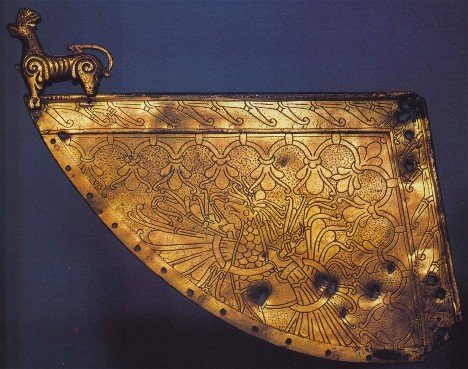

The third famous weather vane to be addressed here, is the weather vane from Söderala, Hälsingland in Sweden.
Once again this weather vane is representing state of the art Ringerike style, in a late form of this distinct style.

The common feature on these specific three weather vanes is, that they are remarkably well preserved. Could it be they were in use for just a short period of time at the end of the Viking Age ?
A weather vane from Tingelsted can be dated as late as from the 12th century in a distinct very late Urnes transferring to romanesque style execution. The more floral motifs and ‘lionesque’ lizard ? figures are addressing this weather vane to the (beginning) of the Romanesque style.

This so called ‘miniature weather vanes‘ were in use to determine a star’s height above the horizon.

The type of weather vanes as the one from Tingelsted contains marks wich were probably used for measurement of the height of the sun.
Apart from this practical and ingenious use in navigation, weather vanes probably were first and for all of social status. The bronze of which the weathervanes were made was so precious as to make the instruments extremely valuable to the Vikings. But their true importance lay in their usage. The Viking ship which could afford to carry one and an individual who could use it, was able to sail independently from most of the weather in open seas. This made it possible to approach the British Isles and the continent of Europe, and withdraw to the open sea when the situation so required.
Probably the ship carrying the instrument was leading a fleet, and because of its special status as a flag ship, the instrument functioned as a pennant when not used for navigation.
Blindheim (1982) perceived a change in the construction of the weathervanes after the 11th century.
The change could indicate the end of their primary use. Turning them in into an object of social status of …. Christian churches..
Gilded bronze weathervanes appear on the roofs of medieval churches in Sweden, Norway and Finland where they are often regarded as ornamental: symbols of access to resources and craftsmanship for the important families who endowed such buildings. So maybe that is how shiny things at the end turn up on church-spires, independently of what they represent..
They may have inspired the medieval Norman custom of attaching a gilded weathervane or cock to church roofs, which eventually spread to secular buildings such as castles in France and Italy where their use was restricted to certain ranks of nobility (Lindgrén, 1983).
See for references: – as always, I have attached a link to the publications/bookstore where the book can be bought !
Engström, J. New interpretations of Viking Age weathervanes 1996
Graham-Campbell, J. Viking Art p. 124-126, Ringerike-Style-Ship-Vanes, 2013
Lindgrén, S. Viking weather-vane practices in Medieval France in Fornvännen, vol.78, 1983.
Williams, G., Pentz, P. and Wemhoff, M. Vikings life an legend – The British Museum (2014). p. 219, fig. 15 and p. 220, fig. 16.
http://www.timelineauctions.com/lot/the-great-beast-weather-vane-finial/52839/
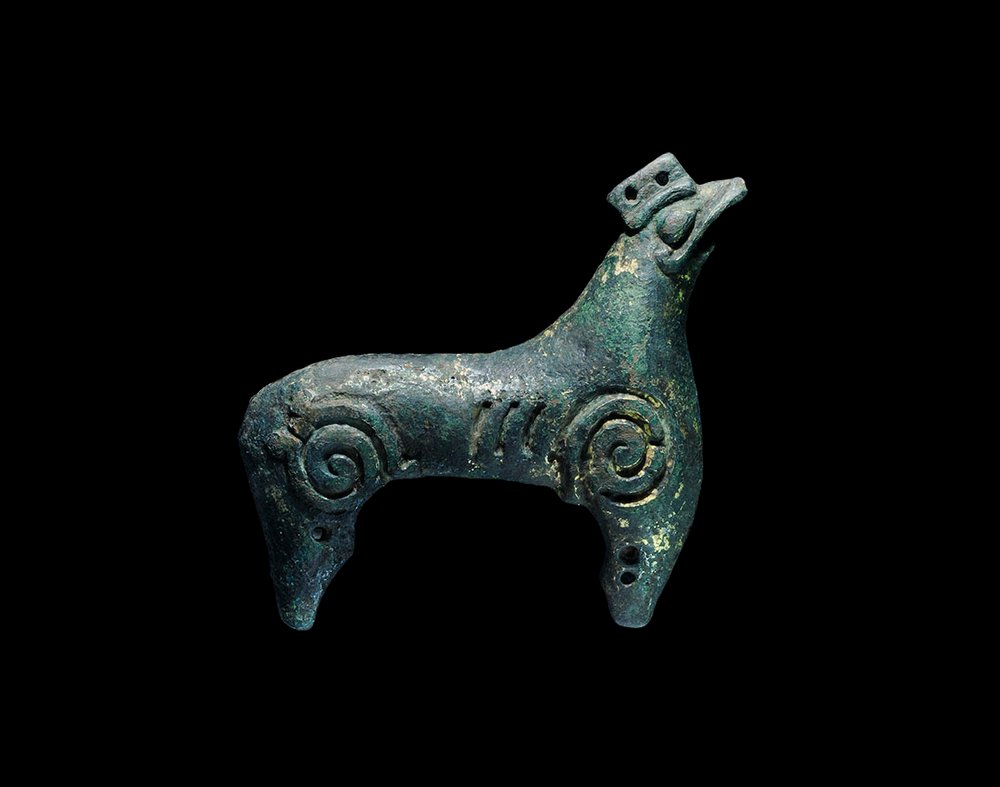

The two photos above: the first an animal shaped figure wich would have been on top of a weather vane (finial). the second an animal figure from a weather vane, Lolland, Denmark. Both in the Ringerike style, to be recognized at the spiral on the hip and shoulder of the animal.
June 22th 2015
Viking jewellry from the isle of Gotland – the animal head shaped brooch
This week’s blog I address one of the specific feautures in Viking Age Gotlandic jewellry. The animal head shaped brooch.
These specific kind of brooches are often described as ‘boar’ or ‘bear’ head brooches.
Consulting Lena Ideström, curator at the Gotlands Museum in Sweden about this issue, she responded:
‘If you translate the swedish word for these brooches “djurhuvudformade spännen” you get “animalhead shaped brooches”! I am afraid that I don´t know why the english speaking world has choosen boar and not bear. The type is very typical for Gotland and we have never had big game like bears here, maybe it has something to do with that.
If swedish people ask me what animal it is supposed to be I usually answer wild boar or bear, I would think both of them possible. And the fact that they look like animalheads to us does not necessarily mean that that was the meaning when they were made’.
Consulting Gunnar Andersson, senior curator at the The Swedish History Museum, he responded:
‘I have never heard that they are called boar- or bear head brooches. In Scandinavian literature these Gotlandic brooches are simply called animal head-shaped brooches’.
These kind of brooches may be addressed as ‘boar’ perhaps because of the significance of the boar in Norse religion as an associate to the god Frey. A man called Friedrich Kruze had once compared them even with a horse head..
As we even do not know if these kind of brooches in the old days actually were called ‘animal head shaped’ let alone ‘boar’ or ‘bear’ head brooches, the use of animal head shaped brooches is useful, but by no means exclusive in my opinion.
The animal head shaped brooches were an exclusively Gotlandic type, used in pairs as part of the female dress brooches. Often together with the round boxshaped brooch, also an exclusively Gotlandic type. They were worn in pairs on tunic straps. They were in continious use from the 8th century until about 1150 A.D.
The island of Gotland specialized in the creation of richly ornamented box-shaped and animal-head brooches. The jewellery found in Viking-period graves shows that the Gotlanders shared in a Norse material culture, but had their own very distinctive regional identity.
The form of animal head shaped brooch with a separately-cast backplate is introduced around 900 AD. Many examples have been pierced to accept an attachment chain from which utensils could be hung in an ostentatious manner.

Specific details on the animal head shaped brooch:
A bronze boar-head brooch with separate backplate; the body formed as a hollow-cast case with upstanding ears and raised bar to the muzzle separating two panels of three-strand interlace ornament; to the sides and top, panels of scrolled tendrils; backplate attached by five studs, with rectangular slot, pin-lugs, round-section pin and integral catchplate; hole to the brow between the ears to attach a chain, small casting flaw to nasal. 66 grams, 55mm (2 1/4″). Very fine condition.

References:
A very nice cd with images from Gotlandic Viking Age jewellry can be found and here:
http://arkeodok.com/viking-artifacts/viking-jewellery-cd/
Article from the British Museum:
http://www.britishmuseum.org/explore/highlights/articles/g/gotland.aspx
Other: (the underlined titles are linking to a book store where these books can be ordered).
Brown, Katharine Reynolds, Migration Art 300 A.D. – 800 A.D. The Metropolitan Museum of Art, New York, 1995;
Brown, Katharine Reynolds, From Attila to Charlemagne, Arts of the Early Medieval Period in the Metropolitan Museum of Art, 2000 – p. 317, Gotlandic brooches.
Carlsson, Anders Djurhuvudformiga spännen och gotländsk vikingatid: text och katalog. Stockholm. 1983
Kovárová Lenka, The Swine in Old Nordic Religion and Worldview
Wixom, William D., Mirror of the Medieval World. 1999
A lot of more images of animal head shaped brooches can be found in publications, books and on the internet, so this is a very select catalogue.
June 2nd 2015
The viking key as a symbol of female status and independancy.
This week’s blog I address one of the ‘key’ objects in the Viking Age, the key as a symbol of female status and independancy.
Keys were a symbol of a woman’s status in the home and in society. Women would run farms both in the presence of their husband or while he was away. Keys were symbolic of a woman’s power in the home.
The role of a woman and the symbolism of keys are even accounted in the Poetic Edda, in the Lay of Thyrm (Þrymskviða) where Thor disguises himself as Freya and goes to wed Thrym so that he will return Mjolnir, which was stolen. Heimdall says, “Busk we Thór then in bridal linen, and buckle on him the Brísings’ necklace. Let a housewife’s door keys dangle about him. Let woman’s weeds be worn by him. Let him bear on his breast bridal jewels, a hood on his head, as behooves a bride.” Then Thor answered, “A craven wretch may call me the gods if I busk me in bridal linen.”
Tough Thor thinks the wearing of keys is beneath his dignity, a woman would show her status by wearing her keys on her chains on the outside of her dress.
The big key is really one – or one of a very few, two ? – of a kind. The only similarlike example I came accross is published in Brett Hammond’s book British Artefacts, Volume 3 – Late Saxon, Late Viking & Norman. The example in the book was found in Denmark. Unfortunately not is known where the other key was found. Extremely well preserved, a spectacular piece to see !

The smaller key, of a somewhat more ‘common’ type. It was found near Norwich, Norfolk, England.

Viking and later Anglo-Saxon keys comprised a circular loop developing into a thick shank developing into a headplate. The present example includes the loop complete with two lateral horns, the round-section shank with collar on the upper surface, and the lower part of the head with its quadrangular void, terminal and delicate T-shaped finial. Keys of this type are brittle and easily damaged at the extremities due to the thin metal surrounding the voids; this is a complete example.
Both keys will be on display in an exhibition in museum Dorestad from June 7th on, from wich a press release can be read beneath.
Images: Luit van der Tuuk.
Press release exhibition of keys museum Dorestad:
‘Behind lock and door, exhibition on the development of the key.
An complete overview of early key types at Museum Dorestad.
As long as there have been possesions mankind has tried to keep them safe. Valuables could be hidden or stored in a closed chest or room. Valuable trading products had to be stored securely, preferably behind lock and door. It is therefore not at all suprising that so many keys have been found in the trading center of Dorestad.
This summer Museum Dorestad will be exhibiting a rare collection of keys dating from the Roman period through to the Middle Ages. The exhibition gives an unique view of the technical as well as the aesthetic development of the key. Not all keys were meant to be used, many had a symbolic function and a number of these special keys are also displayed. Never before in the Netherlands was such a complete overview of early key forms presented. Although there are keys and keys. Not all of them are used to open or close a lock. There were also many symbolic specimen in circulation, many extraordinary copies of which are exhibited.
Behind Lock and Door an exhibition on the development of the key from June 7, 2015 until January 6. 2016 at Museum Dorestad, Muntstraat 42 Wijk bij Duurstede, The Netherlands. See also http://www.museumdorestad.nl’.
References: (the titles of the books/publications have a link to where one can read the publication/buy the book).
Fitzhugh, W. and Ward, E. Vikings, The North Altlantic Saga, p. 84, images 4.18, 4.19;
Hammond, B. British Artefacts, Volume 3 – Late Saxon, Late Viking & Norman, p. 97, fig. 1.13-f.
Hynson, C. How people lived in Viking times , p. 15 (2009);
Stelle, R. Viking Age Keys and Locks, Symbolism in life and death, p. 5;
Tuuk van der, L. De Vikingtijd, Op zoek naar de Noormannen in Nederland en België, (2014) p. 16, 165;
Tuuk van der, L. Noormannen in de Lage Landen, Handelaren, huurlingen en heersers (2008) , p. 57 and image p. 58/59. Note: this book will be re-published in an updated new version under the title VIKINGEN, Noormannen in de Lage Landen Autumn 2015.
May 24th 2015
Odin’s self sacrifice as a protection for the Viking sword ?
As said some weeks ago I would return to a specific kind of sword chape.
My friend Ru Smith had aquired a similar viking sword chape last Autumn, and I think altogether our views on this sword chape, (Paulsen (1953) type B, 10th C) deserves an combined article.
As said before, Charlotte Hedenstierna-Johnson pointed out in her article, A group of Viking Age sword chapes reflecting the political geography of the time to a possible religious aspect of the image, the crucifixion.
Ru Smith is questioning that matter in his article about his example of this type of sword chape A Viking Sword Chape and the Hávamál Story of Odin’s Self-sacrifice. Examining my sword chape with the magnifier, I did somewhat of an not too much expected discovery. As in Viking Antiques markets and auctions a lot of storytelling and ‘Odinning‘ and depicting like Norse god This and That is going on, I was and am always cautious just believing what the seller is saying or believing himselve..
Especially when elves are being involved 😉
Then again, how could we be for sure 100%, as we have no connection with the Vikings afterlife ?
Back to the magnifier.. one noticed that one eye (left eye – that is the one on the right for you, watching the chape on the image 😉 is clearly to be seen as an eye on the metal .. the other eye .. just isn’t visible, not because it had abraised on the metal in some kind of way, no, because it seems to deliberately had been omitted.
On the place where you would suspect the other eye, a slightly hollow eye is visible as a well casted dent …
So… Odin after all ?
As said before: we cannot ‘prove’ images too quickly, it is very well possible that Ru Smith’s thoughts on the self sacrifice of Odin could make sence.
Then, let us just move ourselves in the heads and belief of our pagan ancestors.
Why nót depict Odin on a sword chape, to protect the carrier of the sword by giving him the wisdom of Odin in battle and remembering the sacrifice one needs in life to achieve its goals ?
The example published here was found about two years ago near the little town of Kreutburg, twenty miles south of Kaliningrad in that funny Russian-owned Kaliningrad Oblast area east of Poland.

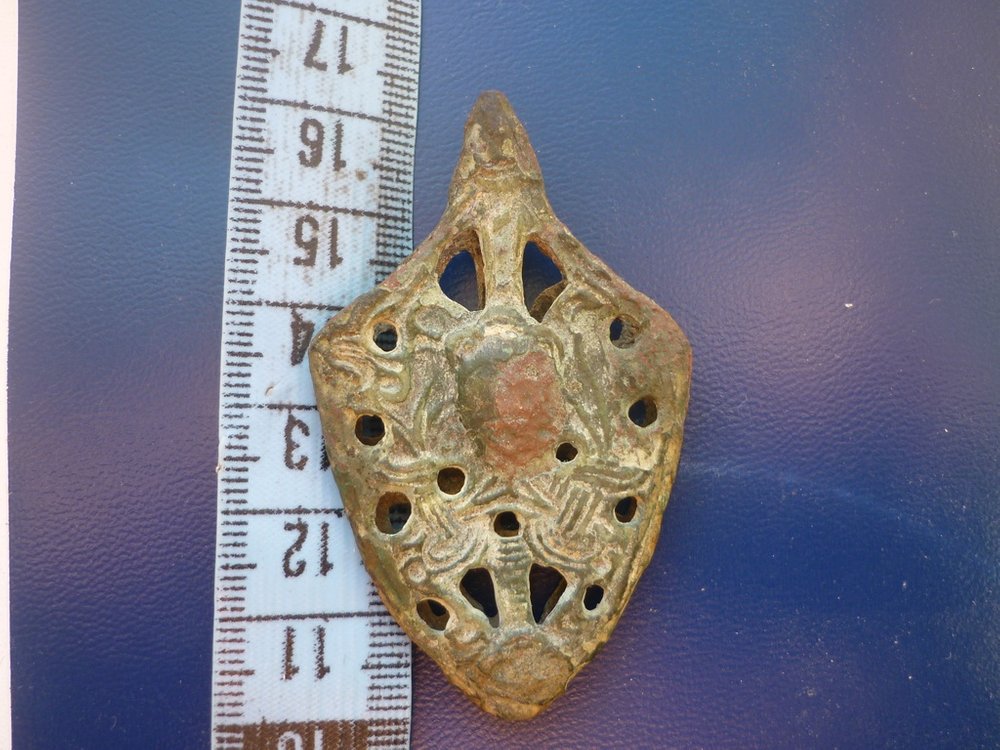
The images of the chape above shows the chape in ‘just cleaned’ situation.
The images of the chape beneath shows the chape, then coated by the metal detectorist with Paraloid B-72.
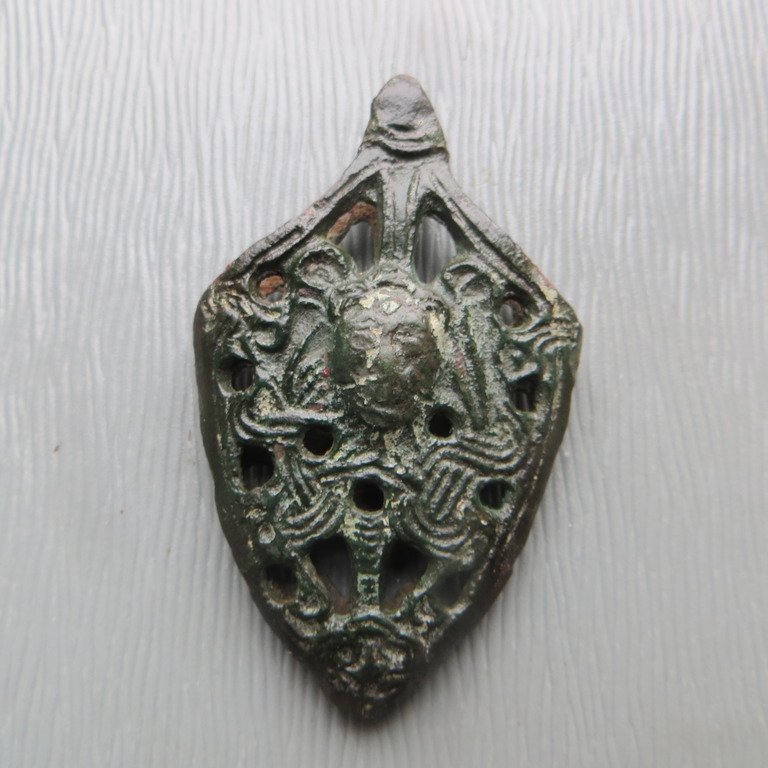
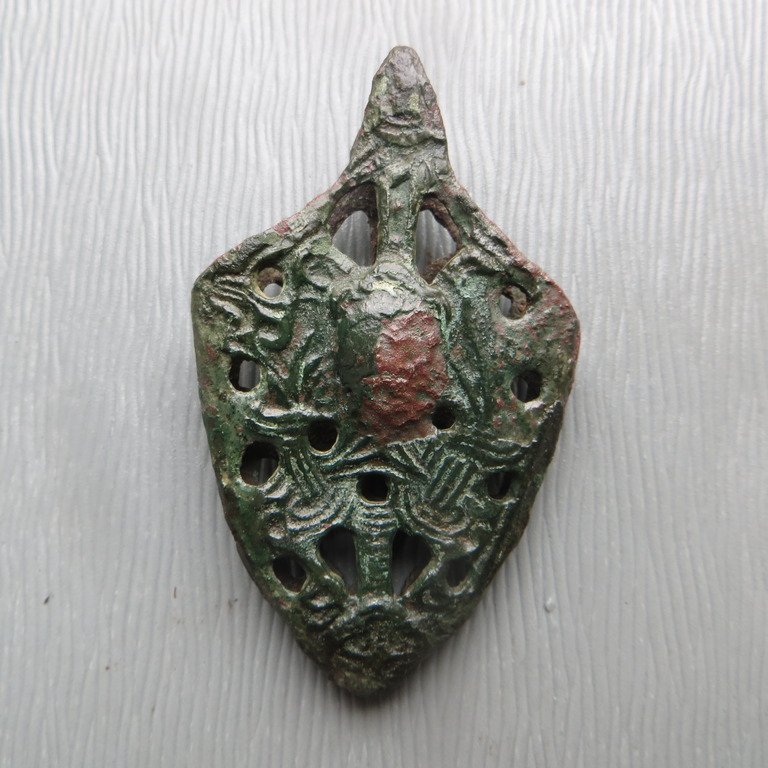
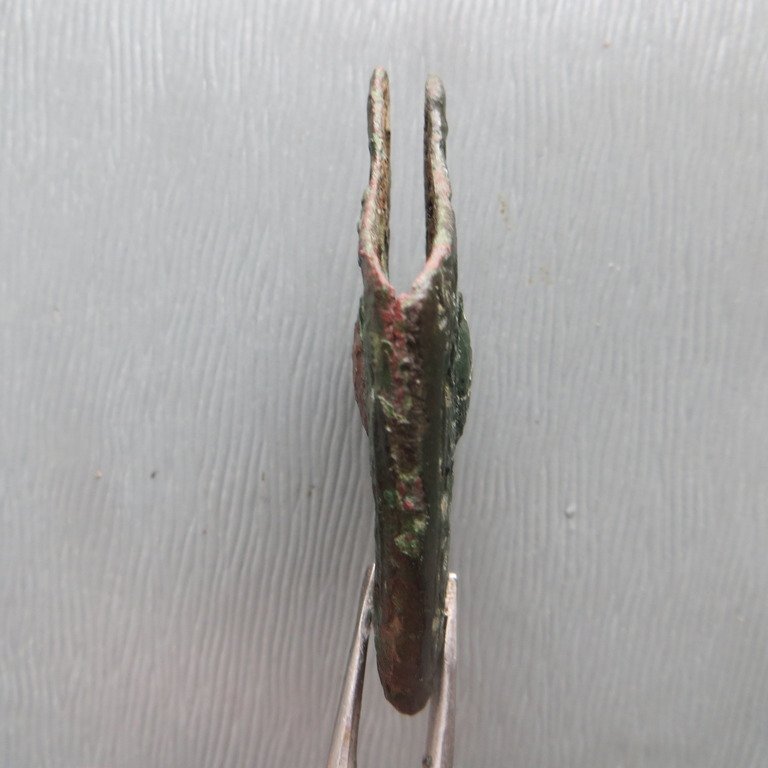
For further references to this stunning piece of Viking Art I point out to the ones given in Ru Smit’s blog above..
The map shows the area the sword chape was found (south of Kaliningrad).

I have shared our thoughts with Charlotte Hedenstierna-Johnson who responded: ‘Odin is Always a bit elusive, even as archaeological finds go…’.
And that, my Viking Age interestees and students and researchers, is the attractiviness of our part of field of research..
We do not, and cannot know everything for sure. That is the mystery, the ever during desire to investigate and deliberate ..
See for the general – very interesting – website of Ru Smith : http://www.pbase.com/hajar/viking_art
and the specific page on his sword chape : http://www.pbase.com/hajar/image/158520131
With thanks to Ru Smith
May 17th 2015
The viking tortoise brooch – undoubtly one of the jewel’s in the crown of Viking Age jewellry.
In this week’s blog I take you with me on a little journey to one of the most outstanding form of art within Viking Age jewellry: the tortoise brooch.
Some years ago I had the luck of my collecting life to be able to aquire one and it is still one of the cornerstones in the collection. At this moment, it is on display on the exhibition ‘The Norsemen were here‘ in the Historiehuis in Roermond (south of Holland) http://www.historiehuis.nl/
Although described in more detail here, I’d like to address this beauty piece of art also in this blog.
Viking tortoise brooches, more in specific, tortoise shell brooches in the beginning were domed and far more ‘flat’ (as ‘flat’ is a big word here). Later in the Viking period, the more elaborate and ‘outbuild’ the tortoises did get. The example I have is from the Petersen’s P52/P55 type, wich dates him in the second part of the 10th century.
For years I have thought it was gilded originally, as I have seen on several – the most bling-bling examples who had survived – in the National Museum of Norway in Oslo.
At one day the brooch developed a whitish surface and I consulted an archaeological expert in conserving and cleaning and treating artefacts. The developing white surface happened to be an early phase of bronze disease. Luckily I was just ‘in time’ treating this piece (see for some general advice to collectors on the page on the object where I have linked to above).
The archeaologist said that this viking tortoise brooch never was gilded. Obviously there were non-gilded and gilded types in the day. In my opinion the use of tortoise brooches may seem to have been widespread, it must have something in use with the more ‘upper class’ Viking Age woman. A few thousand have been excavated, in more or less complete state. Turning up in antique market just a few times in the last 10 years, addresses their rarity also.
On the images beneath in following order:
– an image of the tortoise, taken in 2009 when I aquired it;
– an image of the diverse types of tortoises brooches during the 9th and 10th century;
– images of the tortoise after treatment (mention the needle wich popped up when all the rust was cleaned away ! Being hollow on the inside and the remaing iron on the inside, it was filled up with a form of plastic to be able to preserve it).
– an image of how the tortoises were worn..
A select reference to books/publications here:
Hammond, Brett, British artefacts Volume 2 – Middle Saxon and Viking (2010) page 40/41, fig. 1.1.3-c.
Jansson, Ingmar, Oval brooches : a study of Viking period standard jewellery based on the finds from Björkö Sweden (1985).
Lonborg, Bjarne. “The method of production of Viking Age tortoise brooches.” Kuml 1991-1992. Arhus: I Kommission Hos Aarhus Universitetsforlag. 1991-1992, pp. 151-164.
Rundkvist, Martin, Domed oblong brooches of Vendel Period Scandinavia
Spirgis, Robert, 10th – 13th century Daugava Liv Pectoral Chain Ornaments with Tortoise Brooches (Riga, 2006) see link and image of the book here

A short overview of the types of tortoise brooches in 9th and 10th centuries..

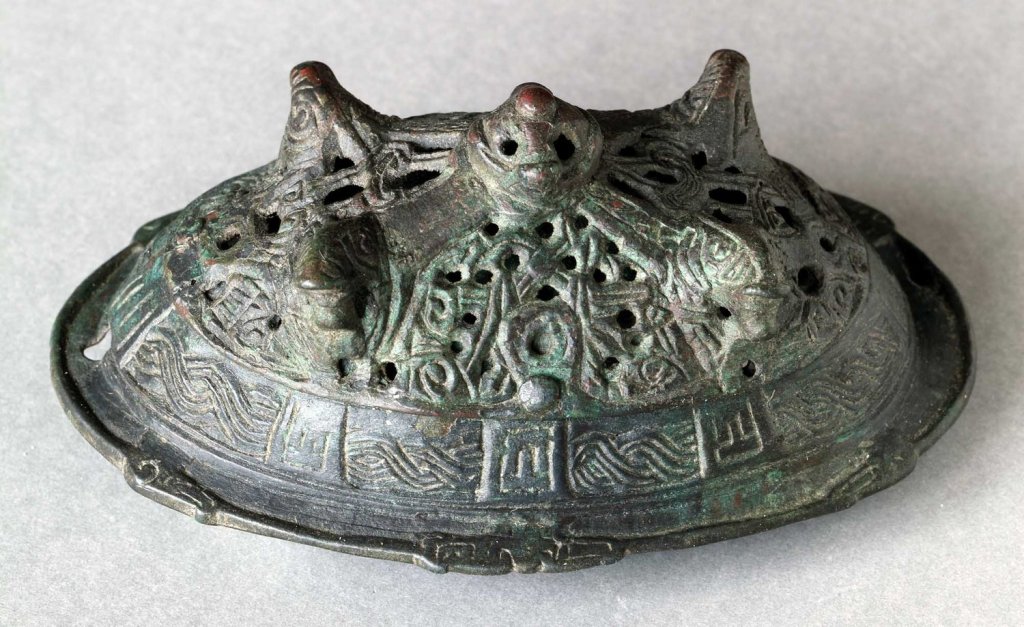
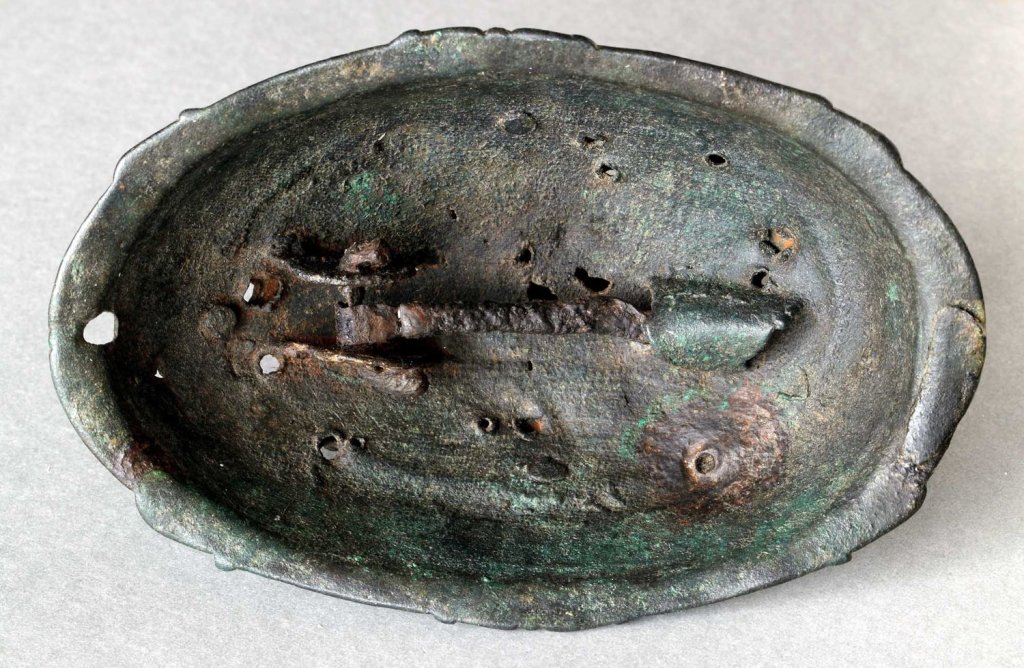
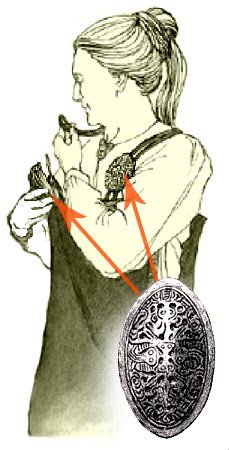
May 1th 2015
Viking Age sword chapes – always a bit of a mystery.
In this week’s blog I’d like to take you to the somewhat mysterious world of a part of the adornment of the viking sword, the sword chape.
Charlotte Hedenstierna-Jonsson published a very interesting article in 2002, called ‘A group of Viking Age sword chapes reflecting the political geography of the time‘ in wich she addresses this type of artefact as ‘scarce’. Written in 2002, I have asked her if – in her opinion – this is still the case nowadays.
This is the case, because there is a viral market on viking sword chapes wich hadn’t been documented at musea etc. The two sword chapes published here, are an example of that market. Of course, just for the sake of this overall overview of excisting sword chapes, I recommend each serious collector always to get the provenance of a sword chape. Generally, in my opinion, it doesn’t matter if an artefact is in private collection hands, but the private collector has to do his utmost efford to get to know and register the provenance of an artefact for future’s sake.
The viking sword chapes published here is a quick overview of some of the different types of them. Individually I will address them somewhat more in detail in one of the future blogs – as I did with the viking sword chape of Falcon Style – nog toevoegen link naar blog 24 april 2015 – and the viking sword chape of East-Prussian oriental motif style before.
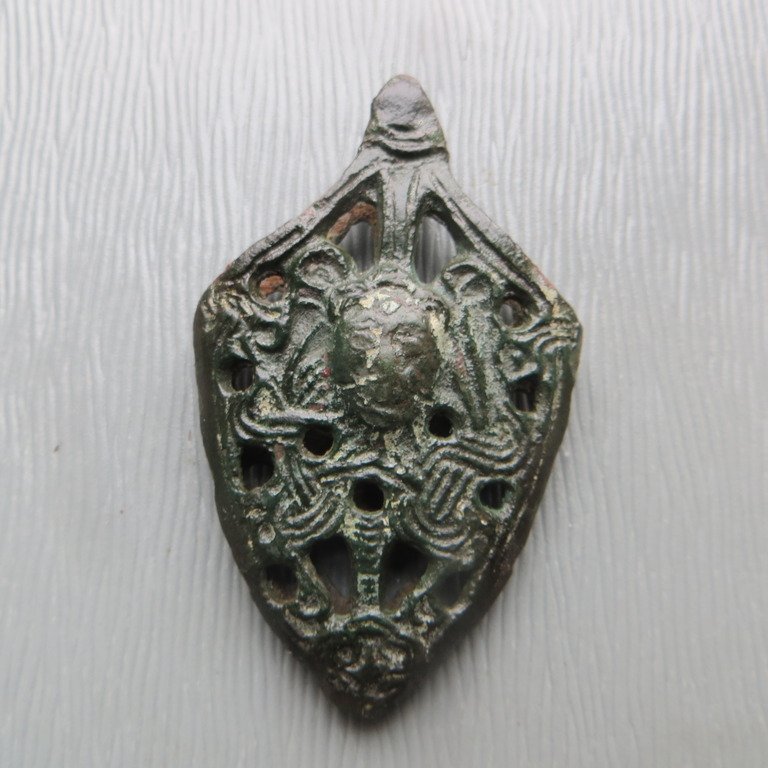
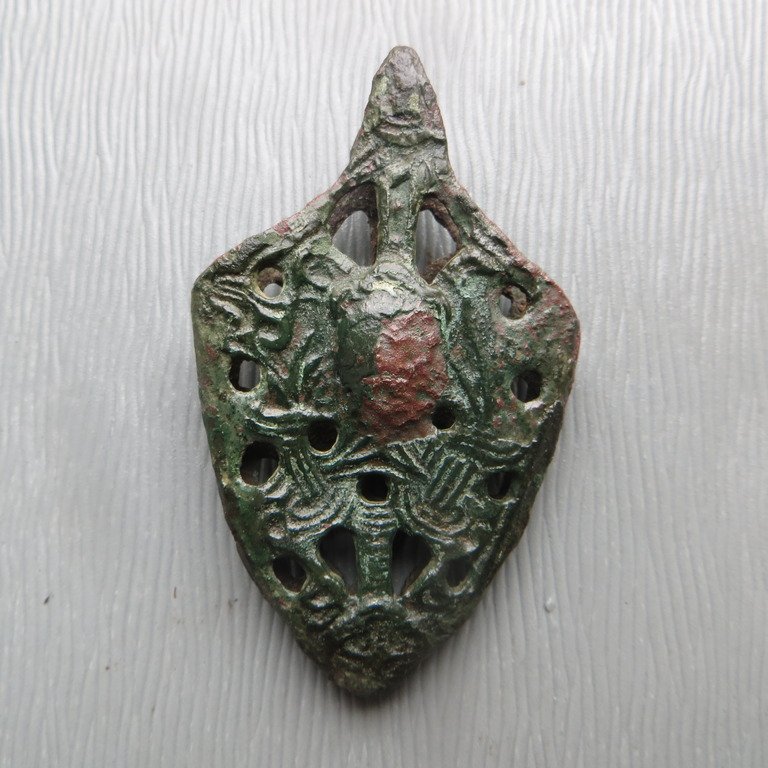
The sword chape above is one of a rare type, in Borre Style. This sword chape deserved to be addressed more indepth on itself, so keep an eye on forthcoming blogs..
Adressed in the mentioned article, there were – at that time – only 5 examples of this type belonging to the so called ‘Sub-group B’. Without stating that my example making that 6, it is clear this is a very rare type indeed. To be continued..
Viking sword chapes and their distribution
Locations of sword chape finds are spread over an extensive geographical area from Denmark, to the north of Sweden, going eastwards into present Eastern Europe as far south to the Black Sea. The mystery of this type of artefact lies within the fact, that some of the types – as the anthropomorphic figure types – were found in settlements, rather than in graves. Why were they seperated (accidentally or deliberately ?) from their swords ? Was their function a cufflink alike ? Worn at the sword adornment on special occasions ? A special occasion whereby it had its function as a horse pendant alike, impressing other people and making oneself distinctive from the other (people) ?
In the majority of cases – that is why the provenance and the circumstances how an artfact was being excavated or found by chance are so important for our knowledge – this is not certain.
The second viking sword chape – wich also be addressed in a future blog – is of a type called the ‘Valleberga type‘ by Peter Paulsen called ‘A Scandinavian group’. Wich adresses a problem in our up-to-date knowledge and overall present view on viking sword chapes. Being published already in 1953, our knowledge and interpretation since then had increased of course, and a new publication with an up to date overall summary is very much needed.
As Fedir Androshchuk published all 832 (!) known Scandinavian swords in Viking swords: Swords and social aspects of weaponry in Viking Age societies, I would recommend scholars to publish a similar publication on Viking Age sword chapes indeed. 832 known vikings swords alone in Scandinavia addresses the rarity of sword chapes regarding their far lesser known number in my opinion.
Though, I am curious what Charlotte Hedenstierna-Jonson has to say about this and will add it to this article when I receive a reply from her.
Scabbard chapes
Described here as ‘scabbard chapes’ some of the finds within Scandinavia are adressed in his book, but besides the very valuable publications of Charlotte Hedenstierna-Jonson and the Peter Paulsen’s book, no more up to date information I cannot share with you yet.
See for the publications Of Charlotte Hedenstierna-Jonson:
A group of Viking Age sword chapes reflecting the political geography of the time. Journal of Nordic Archaeological Science, 13, pp. 103-112 (2002) as well as
Rus’, Varangians and Birka Warriors from the same author adressing the eastern connection and showing us several images of viking sword chapes.
Diverse Russian books like Scandinavian Antiquities of Southern Rus, from Fedrir Androshchuk and Volodymyr Zotsenko (2012) are addressing viking sword chapes, but a course of Russian is sorely needed then 😉
S. Yu. Kainov 2009, Sword’s scabbard chapes from Gnezdovo
It would lead too far summing up all books where known or less known sword chapes are being published within, but if you know a reference to a book/publication not addressed here, let me know at vikingsandartefacts@yahoo.com.
April 24th 2015
Is It Viking ? The familiar and ever returning question among Viking-Age artefacts collectors.
This week’s blog – from yours truly himself this time – is putting the spot on the among Viking-Age artefacts collectors ever thrilling, amusing and tantalizing question when shown an artefact they cannot address: ‘Is It Real ?’
In fact dear Viking-Age artefacts belovers, one could write once a week a blog like this. But I will restrict myself to this weeks Mystery Object or described in other words: Loch Ness being bited by a cat like animal and biting it back.
Let us amuse ourselves, and at last get tantalized…
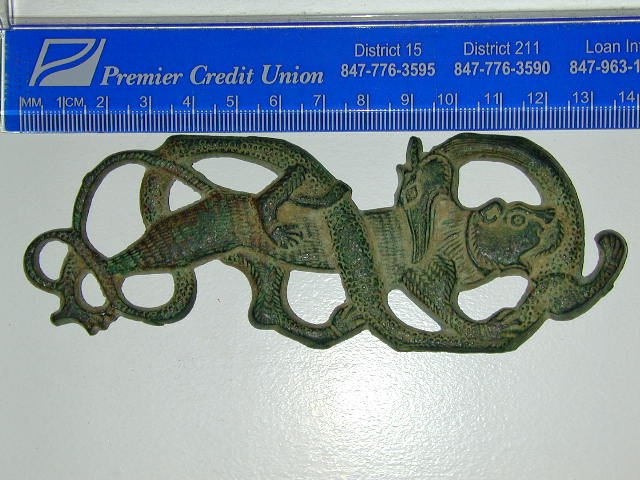
One fine day in the beginning of Spring, a good friend of mine on the other side of the ocean, sended me diverse pictures of this by him called ‘brooch’. Of course the kind of interlace triggered me to define this artistically vikingishwise as ‘Late Viking’, but I couldn’t put my hand on it..
The object, being found in England was rather too sharp in detail and execution to be really from the Viking Age, as many items found there suffers and suffered from the bad soil condition and debased metal quality used in Anglo-Scandinavian areas involved. The crispiness of the piece I found remarkable, and made me place it somewhat further in the Middle Ages.
After a day or two dubbing I came with the definition: ‘Late Urnes transverse romanesque Style’, 1150 – 1250 (more to 1250 than to 1150 A.D.) where James Graham-Campbell when consulted seemed to agree on. But the ever remaining question popped up..
“Where can I find a reference, is there a similar artefact to be found in literature ?”
Now: not always is this the case, and in defining an artefact as being Viking-Age one has to have the knowledge how an Viking-Age artefact should look like.
Sometimes the artefact is representing one of the distinct Viking art styles (like Borre, Urnes etc.). Sometimes it doesn’t, though one can define the distinct vikingness of the execution of the piece nevertheless.

The biting and interlacing curling of animals kan be found in romanesque churches, like the one I have visited in Münster, Germany last winter. These (phantasy) animals are biting into plant tendrils, or themselves. But always one direction, without being bitten backwards.. like the piece in this week’s blog involved.
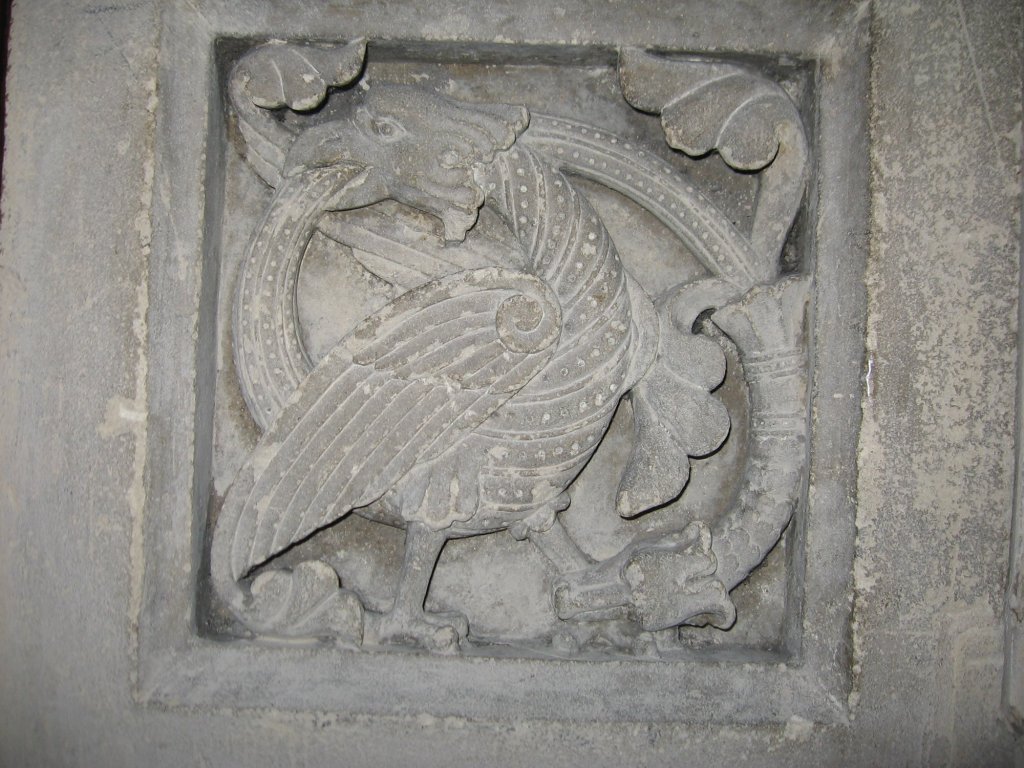

Then the idea popped up, after consulting my ‘Ring of Expertise’ (wich most of them rejecting the idea that this was viking), to put a call on Facebook on diverse metal detecting forums in Holland.
Now, and this is very dissatisfying, in Holland there seems to be very little or no people heavily experted on Viking-Age objects on social media or otherwise. So, after the good laughter and jokes around, someone even came up (very firmly) stating that this was a ‘Victorian age snake brooch‘.
As I was very surprised by this firmly addressed statement, I googled ‘Victorian snake brooches’ and simultaniously consulted Martijn Akkerman, a in Holland well known jewellry specialist from the tv-programme ‘Tussen Kunst en Kitsch’ (our own ‘Antiques Road Show’ in Holland).
http://web.avrotros.nl/tussenkunstenkitsch/experts/martijn_akkerman.aspx
The ‘Victorian snake brooches’ turned out to be an absolutely no go.
Being eloborate, in shiny silver and gold, often set with garnments and more or less precious stones, the snake and cat brooch just casted in bronze was a world away from this..
See link
Then I received the reply from Martijn Akkerman
‘The mount absolutely doesn’t has its origin in the 19th century en cannot be compared with the type of snakes casted on jewellry from that period of time. My first impression is of an earlier time, and possibly indeed Viking-Age. In my opinion, a 19th century age of the piece can be forgotten, wich might make it a little easier determing it’.
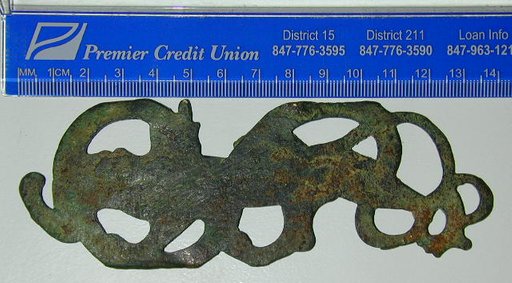
So, my dear beloved Viking-Age crazy researchers, collectors and lovers.. where does this all lead to ?
As always: Mystery. Some mystery, wich we cannot live without I guess. The answer lying in the dark Mist of Evermore. Or is it ‘Battle of Evermore’ ?
As it is..
If any thoughts on this piece of art (wich, old or newer, I think it is) please be invited to let me know !
Yours truly.
April 3th 2015
Aldeigjuborg – the first Russian capital.
The blog of this week is written by Valentin Sustov from Russia.
Aldeigjuborg, or, in Russian, Staraya Ladoga is probably the oldest city in the northern part of Russia. It was founded near 750 B.C by Scandinavians (perhaps by Vikings from the island of Gotland) and shortly afterwards became prosperous.


Dating of Aldeigjuborg
The first buildings in Aldeigjuborg, due to archaeological studies, were built at Zemlenoe settlement of the wood, which had been cut down before 753 B.C (according to tree-ring dating studies). That’s why the dating of Aldeigjuborg lies down within the limits of the middle of the 8th century B.C. The buildings were ship-repair workshops and forges. But in 2013, archaeologists found a Frankish comb of the 7th century B.C and some other founds which were dated before the year of 750 B.C. And nevertheless scholars believe, that the Aldeigjuborg was founded near 750 B.C, because these artifacts could be a simple Viking trophies, which were held in their families.
Short history
The first dwellers from Aldeigjuborg were Scandinavians – the colonists and Finns from nearby tribes. The Slavs begin to penetrate this territory in the end of 60th of the 8th century. They captured some territory from Finnish tribes and built some fortifications in the Ladoga region. These actions led to military conflict between Vikings, Slavs and Finns. In the end of 60th Slavs destroyed Aldeigjuborg and rebuilt the area in a Slavic way. The new “authorities” of Aldeigjuborg began to start up a large-scale trade. Archaeologists found the treasure of Arabic dirhams, which was dated 786 B.C.
In the beginning of the 30th of the ninth century Vikings reconquered the city and, due to controversial theory, established the state, which is customary called Rus’ Khaganate. This time period is characterized by a climax of trade. Nowadays archaeologists find beautiful Scandinavian jewelry, Greek beads, Finnish ceramics, Arab coins and rings, Khazar glass, Slavic crockery and more. But it had to end. Aldeigjuborg was destroyed again in 860-862 during the civil war between various ethnic groups, which lived in the Ladoga region.
In 862, the dwellers of Aldeigjuborg (due to chronicles they were Slavic and Finnish tribes) «invited» Rurik to rule them, because of large number of civil conflicts and decentralized authority. Rurik came to Rus’ with his brothers – Sineus and Truvor and with his own army. The future Russian ruler, Oleg (Helgi) was a member of Rurik’s inner circle. Sineus settled at Belo Ozero and Truvor at Izborsk (some archaeologists stands, that he settled in Pskov). After their deaths, Rurik became a supreme ruler of Rus’ and moved his residence to Holmgarðr (Novgorod) in 864.
On the following images some intruiging artefacts, found in this area..


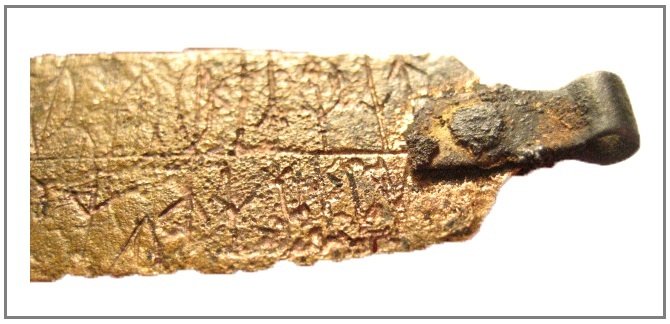


Sketch of runcic amulet made of copper IX-X century (see photos above). The interpretation of the inscription is missing and attempts to read it has not been done. We only know, that the amulet has these words on it: unþR (1–4), runaR (29–33), and probably þaR (14–16) and haki or hak (17–20).


The first side consists of 4 Elder Futhark runes and one cryptography sign. The others are short-branched runes. The second side consists of Younger Futhark runes and cryptography symbols. This amulet is probably of Icelandic origin and the interpretation of the inscription is derived from Old Icelandic – Varr í fárland — is being protected [on the road] in a dangerous land or varr í farland — protected during a sea voyage”, “protected” [on the road] to a distant land. Due to the last runes the owner of this amulet was “protected” by a god Týr. The second side of the amulet consist of one inscription – þarnisk þér eigi u (úrr), what it means – Yes, You will not be deprived of male power.


March 27th 2015
Sköll had our sun grabbed last Friday, but the sun had escaped the attack – a horse harness pendant depicting their story..

This week I’d like to show you a probably unique cast bronze Viking harness pendant of 11th century date, formed as two wolves chasing each other; probably representing the celestial wolves Sköll and Hati wo chase sun and moon.
It was found at Thetford in Norfolk.
Looking at it as a ‘Yin & Yang’ kind of symbolic way, the two wolves represent ‘good’ and ‘bad’. Black and white. Sometimes the light is in our lives, sometimes the dark part takes over.. They are chasing one another in an everlasting ‘circle of life’.
The legend of Sköll and Hati
In Norse mythology there is the intriguing legend of Sköll and Hati, wich goes as following:
“Long, long ago, at the beginning of time. The god Odin, the all-father put the sun and moon into magical chariots to fly across the sky. The god told sun and moon to take their chariots and travel across the sky once a day, but that wasn’t how it worked out.
Sun liked watching waves crash on the shore, so he would hold the sun for hours close to the earth. All of that heat turned the land into a desert, and left the rest of the world dark and cold. Moon liked the sight of the deep forests, where she would tie her horses for hours on end. What’s more, the animals and people, even the gods didn’t know when to wake and when to sleep.
The gods in Asgard sent messengers to Sun and Moon, they offered them gifts of gold and jewels, but the children just laughed.
“We shine more brightly than gold or jewels,” said Sun.
Odin even threatened them with his magic spear, but Sun and Moon knew that the gods needed them to travel across the sky. Now that they had the job, they were going to do it just the way that they wanted. Besides, if the gods attacked their chariots, they may destroy the sun and moon forever.
Loki, the Trickster..
Loki, the god of mischief smiled as he watched Odin and the other gods rage over the work of Sun and Moon. But his smile turned to a frown when he realized where the Sun had stopped his chariot. It was right above the volcano home of Surt, the fire giant. Loki had long been plotting to sneak into Surt’s mountain and steal the fire diamond, a huge and beautiful gem made of living fire. Now, with the sun always shining, the giants that guarded the mountain were always awake, and Loki couldn’t sneak past them.
Loki was thinking about his problems as he walked through a forest. He was far from the Sun and the trees stretched long shadows across the ground. Loki heard a growling sound. He quickly climbed into a tree and saw a pair of wolves chasing an exhausted deer through the forest. That gave Loki an idea.
Loki knew that no ordinary wolves would do for his plan, so he traveled to the Ironwood, a land of giants and trees as strong as steel. There he found two giant wolves, Skoll and Hati.
Loki went to the forest and shot a deer with his bow. He roasted its meat with garlic and onions, and brought it to the wolves’ cave.
“I have a gift for you,” said Loki, giving them the meat.
The creatures gobbled the meat down in a single bite. They had never tasted cooked meat and spices before.
“More! We want more! Get us more,” they growled.
“I can’t help you with that, but I can tell you where to find some more meat like this,” said Loki.
Loki took the wolves outside and pointed to the Sun and the Moon, sitting motionless in the sky.
“That is where you will find more meat like that,” said Loki.
“Grrr what good does that do us? We can’t fly,” said Skoll.
Flying powder..
“Now I can help you there,” said Loki, and saying that, he took out the pouch of flying powder that he had stolen from Odin and sprinkled it on each of the wolves.
The giant wolves leapt into the sky.
“Grrr, I want the Sun,” growled Skoll.
“Fine, but I get the Moon,” said Hati.
And the wolves were off.
When sun and moon saw the wolves, they drove their chariots high into the sky.
From that day on, the sun crosses the sky to make day, and the moon crosses the sky to make night, and all parts of the world get at least some light and some darkness, so animals, people and gods all know when to sleep.
But you may have noticed that at some times of the year, the Sun moves more quickly over the sky and at other times, it moves more slowly. That is because during the summer time, when the south wind blows, Skoll gets tired, and his fur feels warm, so he slows down. But When the north wind blows, and cold winds waft over the world and sky, Skoll feels stronger and chases the sun even faster than before, making out winter days much shorter than our summer days”.
It was no sun eclipse..
So.. last weeks Friday – Sköll seemed to catched up with the sun.. but at the end of the morning, the sun escaped.. once again. For this time..
One day, he won’t succeed in this, anymore…
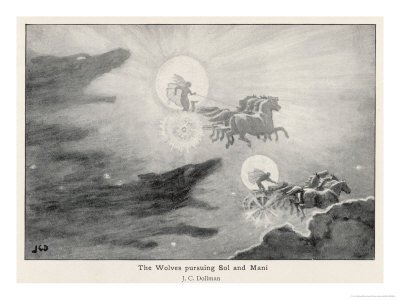

March 20th 2015
The hidden ones in Viking-Age artefacts – they appeared everywhere..
This week’s blog is a guest blog, written by David Mullaly from the U.S.
Now retired, his recent and long-term buying and selling experience has allowed him to see close up some remarkable Viking Age artefacts, a few of which are discussed here.
The hidden face motif.
Vikings loved gold and silver because they could buy power, and because wearing items made from those precious metals suggested high status for warriors or their women. However, archaeologists and collectors also understand that the Scandinavians and those influenced by them were delighted by visual stimulation. At its simplest, Vikings loved glitter or bling: light reflected off of irregular surfaces. That might help to explain why Viking decoration frequently involved a myriad of punches and elaborate etching. However, there was clearly an appetite as well for decorative items which encouraged the observer to see different objects or faces. This is sometimes called the “hidden faces” motif.
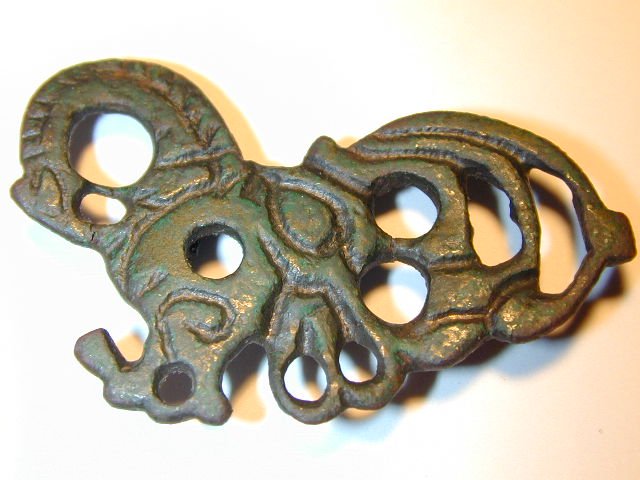
Animals and a helmeted man..
The first example, illustrated in Benet’s Artefacts of England and the United Kingdom (p.317) is an extremely rare and fairly abstract form of Viking bronze brooch, found in Suffolk, which seems to show a dragon’s or horse’s head and arched neck, a bird’s head, and if you look carefully, a helmeted man’s head—the man seems to be laughing. Clearly, the brooch was intended to simultaneously offer multiple things, depending on how the piece was viewed.
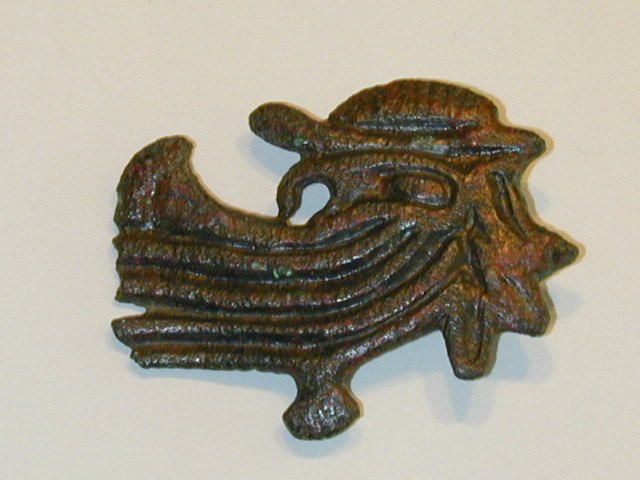
Odin in disguise
The second example, at first glance, appears to be a strange man’s head, facing to the right, although it looks almost as much like a duck as a man. Found in Lincolnshire, this wonderful brooch doesn’t allow you to accept that view without looking further. At some point, you realize that there is another head, this one facing to the left, which has the lower part of the face hidden by long, flowing hair. You see a floppy hat, then an eye and an empty eye socket peering at you, and finally you realize that you are looking at the face of the one-eyed god Odin. The brooch offers you first a cartoon-like face, and then an obscured portrait of the most powerful Viking god.
Finally, you need to look at the picture of a “hidden faces” object which was actually never intended to disguise anything.
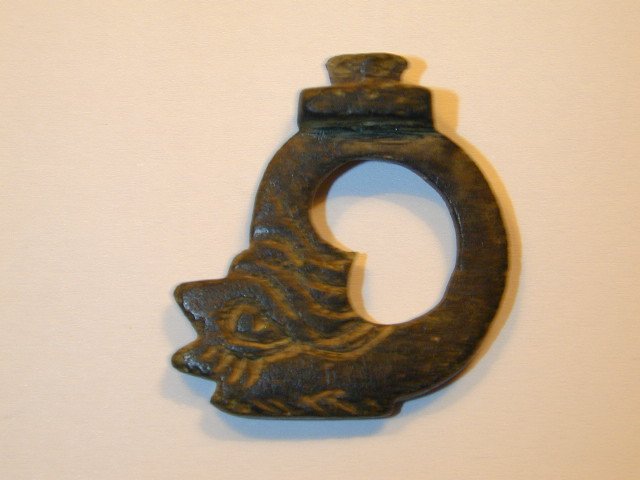
This item, found on the shore of Lough Neagh, a large lake in Northern Ireland, was offered for sale using a picture like this, and the seller suggested it was Viking and showed “a fish of some sort.” However, the tab at the top of the picture reveals something very different. Clearly, the shape of it indicates that it was intended to be permanently imbedded in some material, and not removed, so let us invert the picture.
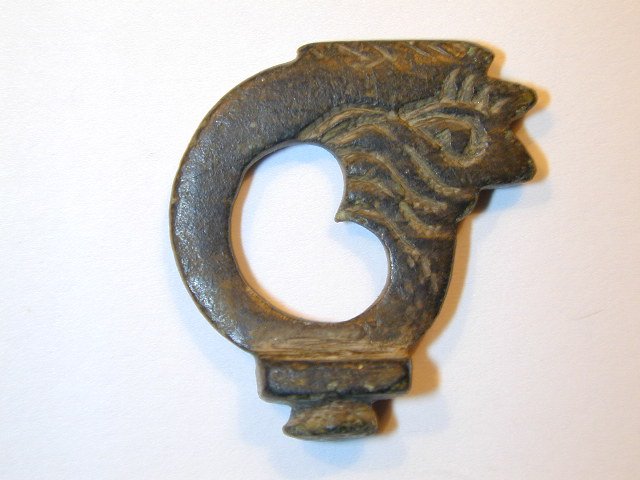
The King piece ?
Now, one can see a profile head with the long lines of hair obscuring the bottom of the face—like the previous brooch. Is that a helmet with a crest on top, or a crown? The same hand etched design is on both sides of the piece, which indicates that this was a game piece, presumably a “king piece” (the only specially marked piece) for a Viking Hnefatafl game. The base was probably a simple lump of lead, which was lost centuries ago. See the final picture.

There are very few definite examples of Hnefatafl king pieces to be found anywhere, so this is an extraordinary understated little find. Many rounded pieces of lead have been found with low profile items—coins, bits of gilded and chip-carved bronze, pieces of glass—and Viking collectors have wanted to believe that these were Hnefatafl “king pieces.” They may be correct, but that is still conjectural; many were probably decorated trade weights. This piece seems to be the real thing.
March 13th 2015
The brave warriors of Livonia – A short case study of a Baltic sword scabbard chape
This week’s blog is a great blog, written by my friend Daniel from Germany, and sort of can be read as a sequel to the Blog of February 20th.
A travel to Daugava River.
The town of Ikšķile lies at the banks of Daugava river, 30 km southeast from Riga, modern Latvia. Near this town there is a city called Ogre. Yes, that’s the name. But don’t be afraid to travel there, you won’t find huge man-eating beasts, but a romantic place rich of eels (“ugri” is Russian and means eel). There, Livonians and Latgallians (two of the ancient tribes of Latvia) lived together in the late Viking period. And these two places are where our journey takes us in this week’s blog…
The chronicles of Latviešu Indriķis.
Henry of Latvia, or Latviešu Indriķis in Latvian language, was a German priest, historian and missionary who lived from the late 12th to the early 13th century and went to Latvia in 1205. There he witnessed the religious battles between the Teutonic Order and the Latvian tribes, who were not willing to give up their pagan rites and their land for the imposed Christendom. Between 1225 and 1227 Henry wrote the Chronicon Livoniae, where those battles are described. Within the chronicles, the historian mentions a war council of the Livonians, held in 1206 upon a hill nearby the city of Ogre.

Fig. 1: Territorial division of Livonia in 1260, highlighting today towns of Ogre and Ikšķile.
Remains of battle.
In the early 13th century, numerous battles between local tribes and the western invaders were fought in the region of Daugava river. The remains of one of those battles were found in Ikšķile, nearby Ogre, were the Livonian war council took place according to Henry of Latvia.
One of the items found there is the chape of a sword scabbard. The closed cast-bronze artefact measures 5.8 x 3.75 cm, a comparably small dimension. It has a tip on the bottom and ornaments on both sides. The lateral spurs show line ornaments and hardly visible traces of silvering. The central spur of each side ends in a triangular palmette, with a little hole in the center of only one side. This is interesting, as the Scandinavian counterparts are supposed to be fixed at the scabbard without nails or rivets.
However, few Baltic finds show similar means to attach the chape to the scabbard tip. Maybe the owner added this hole after the chape fell of the scabbard. The main ornaments show a triangular end, with a net of holes and lines below, ending in the bottom tip.


Fig. 2: Cast-bronze sword scabbard chape with palmette and Baltic-Varangian ornamentation (after Paulsen).
Where is this item from? – Approach of a revisited classification
The chape shown in Fig. 2 is remarkably rare, especially in this undamaged condition, and references are accordingly scarce. However, a damaged chape with exactly the same main ornament is known from Kiauten, East Prussia. It is shown in a book of Peter Paulsen [1].
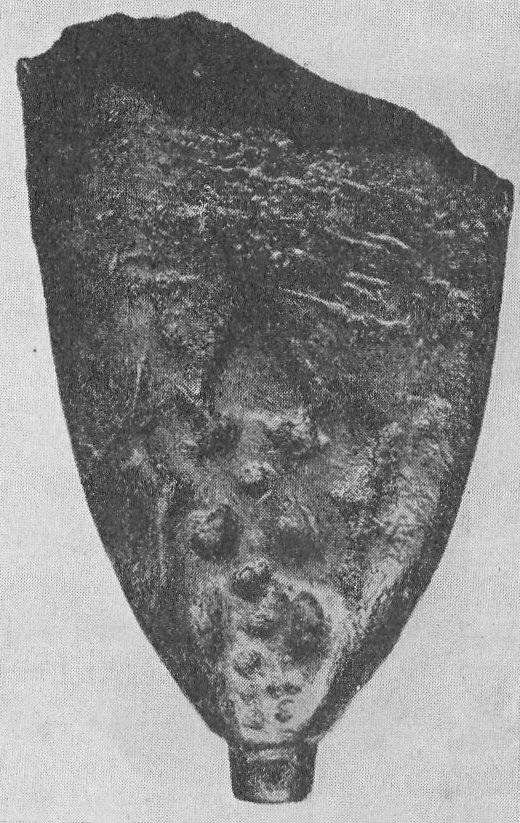
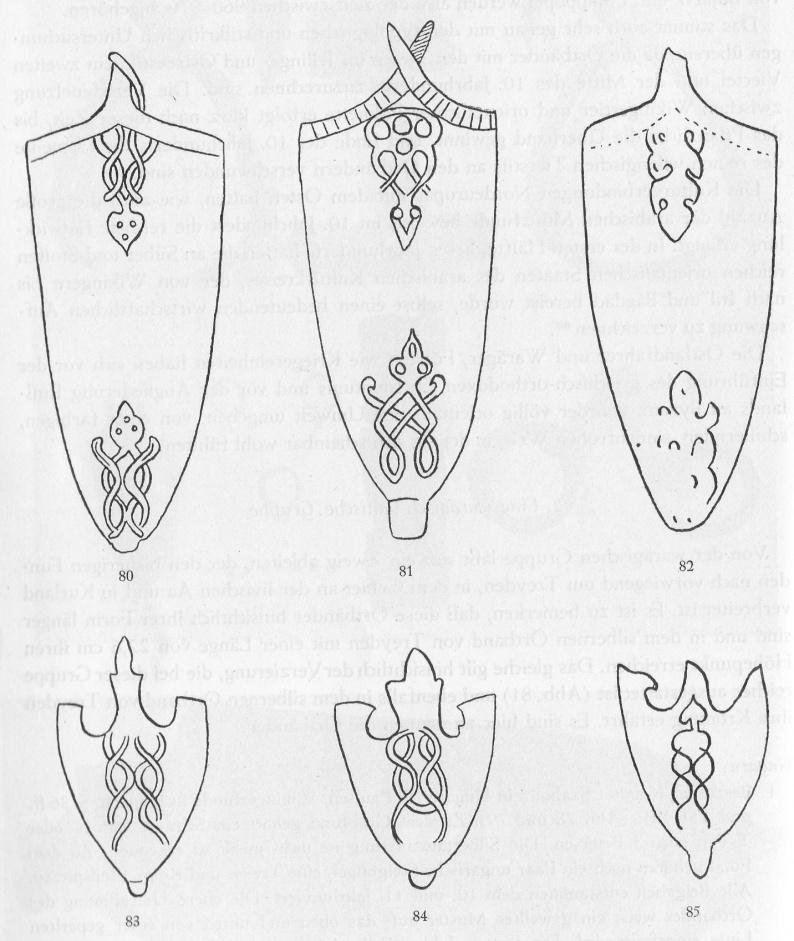
Fig. 3: Left side – Ornament detail of sword scabbard chape of Baltic-Varangian group (no. 86), found in Kiauten, Kr. Samland, East Prussia (Photo from Prussia-Mus., Königsberg, former East Prussia).
Right side – examples for different expressions of chapes beloning to the Varangian-Baltic group: 80 – Bauske, Curonia, Latvia; 81 – Treyden, Livonia, Latvia; 82 – Alt-Rahden, Kr. Bauske, Curonia, Latvia; 83 – Kapenieki, Kr. Goldingen, Curonia, Latvia; 84, 85 – Katzdangen, Curonia, Latvia. (Taken from Paulsen, 1953).
Unfortunately this reference shows only the detailed photo of a chape with the upper part missing and one has to guess if it once had the same type of palmette as the one of Fig. 2. Presumably this is not the case, as there is a large area above the ornamentation left.
Although it was found in East Prussia, Paulsen classifies the chape ornamentation (Fig. 3, left) to the Varangian-Baltic group (see the blog entry from February 26th for more information). Chapes of this group are either of elongated or compact form. The chape discussed here belongs to a more compact type, represented best by picture no. 84 (Fig. 3, right side).
But, with special regard to the spurs, it is also similar to chapes from the Baltic-East Prussian group. Especially chape no. 155 shows similarities to the introduced object (Fig. 4). But unlike chape No. 84, it shows the same rugged ornamentation like the broken, originally elongated chape no. 86 (Fig. 3, left side).
Does the addressed chape shown in Fig. 2 represents a kind of “missing link”?
If Paulsen has had this object for the studies that led to his book, would he have re-classified the chape no. 86 as Prussian instead of Baltic-Varangian, in accordance with the fact that it was excavated in East Prussia? Or is it indeed a chape that can be classified as truly Baltic-Varangian? Anyhow it is, as well as the chapes no. 80-85, excavated in Latvia, and combines two characteristics that belong to this group, probably just not shown in a single object before.
The circumstance that the Baltic region had a dense net of tradeways during the late Viking period complicates a local classification of such objects. Wherever the chape of Ikšķile was crafted, the hybrid of the mysterious ornamentation and outer shape variations of sword scabbard chapes belonging to either the Baltic-Varangian group or a Curonian-East Prussian subgroup seems to be of scientific value. As some similar chapes were excavated in the province of Livonia, it seems also possible that this special style is a local Livonian expression influenced by the surrounding areas.
This would match the excavation site of the discussed object, Ikšķile, which belonged to the territory of the Livonian Order in the according time around the 12th and 13th century (Fig. 1). Although no other available literature but Paulsen’s book describes a similar piece, it cannot be excluded that analogous artefacts were excavated. However, it could be truly unique.

February 26th 2015
Your Viking-Age artefact blog

The offer of writing a guest blog stands for always.. but.. to win the prize, your guest blog must be sent in at the latest Tuesday March 31th.
As one of my main goals is creating a digital ‘longhouse’ of contacts between Viking Age fanatics who are just stumbling around the corner as well as scholars who have studied the subject of our ‘pretty disease’ for years and years, this is my offer for this week.
So the question mark image.. it has two dimensions.
First of all.. there is no object this week, well at least, not yet !
As always I am wondering if I am the only collector or studying person devoted to Viking-Age artefacts and I know this question can already be answered as the same rethoric one as ‘Is the pope catholic ?.
The deal..
So.. here’s the deal..
I invite EVERYONE who like to draw attention to an artefact of the Viking-Age of his particular interest with the purpose of sharing it with .. well us, to say ! Us, all the people around the world literally, already reading this weekly blog.
Prize !
I will make it even a more thrilling challenge by giving away a prize for the most special co-blog written by you !
This prize will be a true authentic artefact from the Viking Age !
What it is ? That’s the suprise to remain a surprise for a while..
So.. sail out with your ship and bring me a story on vikingsandartefacts@yahoo.com
I’ll be awaiting your guest blog, wich I will publish. Of course there might be more guest blog contributants offers.. if so, I will publish them in the course of time also. prize or no prize 😉
Surprise, and you’ll get surprised..


February 20th 2015
Viking-Age sword chape with oriental palm motif

This week I like to show you a special kind of Viking-Age sword chape. These kind of sword chapes can be devided in three specific groups, all being characterized by their ‘closed casting’, their distinct execution with oriental (palm) motif and their sometimes remarkable size (lenght).
On these chapes the typical Scandinavian animal ornament had been replaced by a oriental palm (motif), although the Nordic nature of the form is there, the openwork charachter (as can be seen p.e. on the sword chape with falcon motif, discussed in the blog of January 13th had been replaced by a closed casting.
The three catagories of groups of these kind of sword chapes wich can be defined are:
– a Varangian group;
– a Varangian-Baltic group and
– a Baltic-East Prussian group.
I’m not quite sure if the sword chape here discussed is of Varangian-Baltic origin, or of Baltic East-Prussian origin.
It’s lenght – 12 centimeters – (4 3/4″) finds a parallel in a sword chape of Varangian-Baltic type, being found in Beszterec in Hungary, although it is less ornamented especially on top of the chape. As not is known where this sword chape was found, we have to concentrate on the specific area to wich this sword chape had been addressed to: East-Prussian.

Of course, ‘Baltic’ and ‘Baltic-East Prussian’ are modern addressed names to define an area geographically where these kind of chapes were found.
The Varangians term however is a true ancient describtion given by the Greeks and the East-Slavs to vikings who between the 9th and 11th centuries ruled the medieval state of Rus’ and formed the Byzantine Varangian Guard.
Here we get to the centre of the explanation why a oriental motif like the palm is appearing on these kind of chapes. The original production and origin of the kind of chapes addressed as ‘the Varangian Group’ is situated in the area of Kiev, and found their way of origin even further east on the Wolga river.
Whatever the group it belongs to, the sword chapes with this distinct motif had been found in a great area, consisting finding spots as: Madara in Hungary, the area of Kiev in Ukrain, Philippopel in Bulgary, Biljarsk in Russia, Zloczöw in Poland, Latvia, and besides several other area in East-Prussian, Linkuhnen in East-Prussia (toda’s northeastern area of Poland). Why it has its wide area the map of the Varangian trading routes shows us.
One of the (marked orange) trading routes leads directly to East-Prussia. Travelling all their way to the deep south of Russia and to Constantinople, the Varangians must have either copied an already excisting motif or find their inspiration on the oriental motif of a palm, in use in the southern areas wich whom they travelled. With a addictive intrest in everything from far beyond the known (as can be seen by the trading in beads coming from the far south and Byzanthium) it is no wonder these motifs found their way north.
Nevertheless, these kind of sword chapes – as to my current knowlegde – haven’t been found in Scandinavia itself.
The ‘magnus opus’ of both size and ornament on these specific kind of sword chapes can be found in the group being found in Treyden in Latvia. Being 22.6 (!) cm. length and 4,6 cm width with outstanding ornament execution, this sword chape is one of the finest known from the Viking-Age. Several images can be seen in the book wich I refer to.
The drawings of other sword chapes with oriental palm motif are from a Russian book, wich title I still have to discover and will address later on.

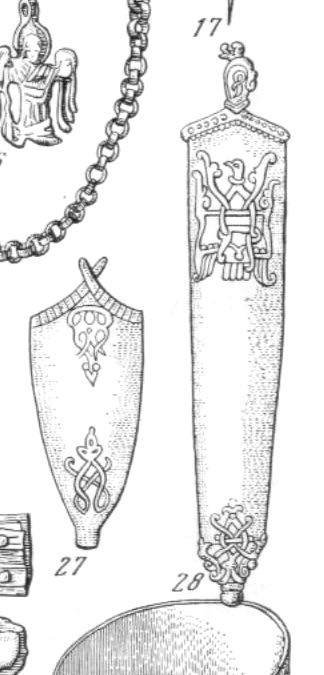

Reference:
Paulsen, Peter, Schwertortbänder der Wikingerzeit, 1953: Ortbänder mit orientalischer Palmette, p. 59 – 87.
Note: a lot of references to books and publications are being mentioned within the Peter Paulsen’s book itself. As the book is from 1953, these publications go way back, nevertheless are frequently very interesting as they hadn’t been republished afterwards and nowadays often only can get aquired antiquarian. (link to online bookstore in Germany:
AntikMakler.
Buchversand für neue, antiquarische und gebrauchte Bücher mit dem Schwerpunktbereichen Archäologie, Geschichte, Antiquitäten und Publikationen.
Not cheap, but worth every penny !
Note: I just ordered an intruiging new book:
Fedir Androshchuk, Viking Swords. Swords and Social aspects of Weaponry in Viking Age Societies, 2014, Te Swedish history Museum, Studies 23ISBN 978-91-89176-51-5
Within this book besides 832 (!) Scandinavian swords wich had been found (never knew it were that amount frankly), also scabbards and scabbard chapes, sword belts and baldrics are being addressed.
On page 113, scabbard chapes, birds of prey and eastern connection are being discussed. If this chapter gives more reference to the kind of sword chape discussed above, I will add this information to this article.
See also:
Viking Swords. Swords and Social aspects of Weaponry in Viking Age Societies (online resumé)
It can be ordered hardcopy here
February 10th 2015
The horse harness strap joiner – the face in the crowd
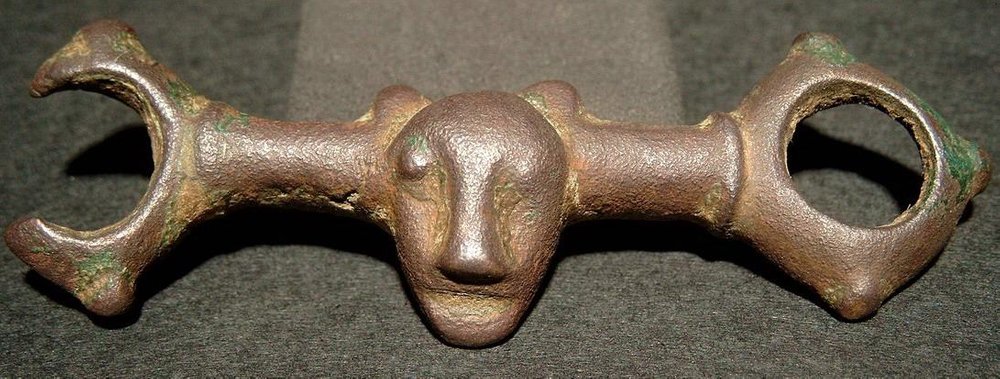
The horse harness strap joiner – the face in the crowd
Back to another intriguing part of the Viking Age horse equestrian equipment: the horse harness strap joiner.
I will use ‘horse harness strap joiner’ as there appears to be a tree of terms to describe these kind of artefact, as : horse harness strap distributor, horse harness strap fitting, horse bridle fitting, horse harness strap junction, horse harness checck piece and even horse harness mount..
These horse harness strap joiners are an 11th century feature within England, and can be addressed ‘Viking-Age’ although they diverse stylistically between ‘Anglo-Saxon’ or ‘Anglo-Scandinavian’. A thorough reference to these specific type of equestrian equipment seems to be lacking to me. A book like ‘The medieval horse and its equipment’ – Medieval finds from excavations in London c. 1150 – c. 1450 AD by John Clark regrettably isn’t addressing these.
The Late Saxon Stirrup-strap Mounts: A Classification and Catalogue by David Williams is adressing stirrup mounts and terminals but no other parts of equestrian equipment.
Nevertheless ! If someone can give a better reference to these horse harness strap joiners, let me know ! Back to the subject..
The horse harness strap joiner was part of the bridle of the horse, and like stirrup mounts and terminals and horse harness pendants were executed in a very adorned style..
The horse harness strap joiner on top is of Anglo-Saxon type. It is a cheeck piece with face decoration. These ‘faces’ are executed in very diverse form, as is the main purpose of this article, as you are going to see.
Beneath, an image of the place on the horse harness where the horse harness strap joiner was placed.
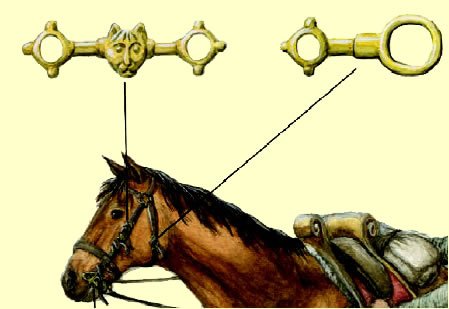
The horse harness strap joiner slide show beneath shows a true Anglo-Scandinavian type. The ‘mask’ face is recalling images on stones from Denmark as the Sjellebro stone and the Aarhus mask stone, although in a very deformed way.. I have never seen this specific type of horse harness strap joiner before and it would have a very special meaning regrettably only known by the smith and its owner..
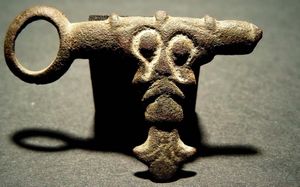

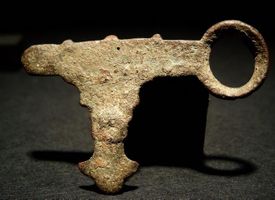
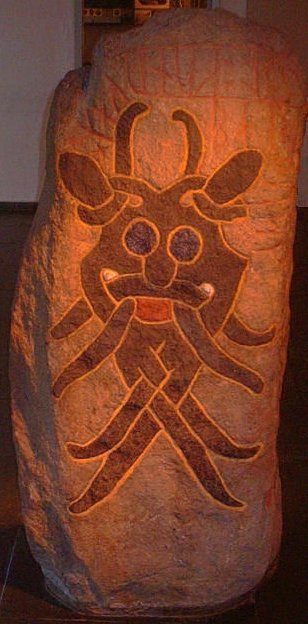
On the slide show beneath another form of a face horse harness strap joiner of Anglo-Saxon type. Although ‘Anglo-Saxon’ these type could also have been used by ‘Anglo-Scandinavians’ or true vikings. The image on this horse harness strap joiner could depict anything, from a cat to the devil or… Loki ?
The Norse god Loki was known as a shapeshifter, and could turn up within a horse harness strap joiner as well..


Another remarkable horse harness strap joiner I’d like to show you in the slide show here under. It is of an Anglo-Saxon type I haven’t came across either and is clearly showing us a human face.
Glaring at us with great, almost surprised or frightened eyes, it appeals to our imagination. Although a part broken – the same kind of problem as appears with the trefoil brooches found within England – a truly amazing piece of art.
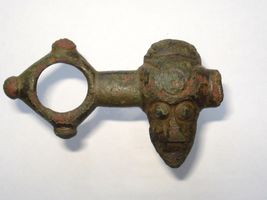

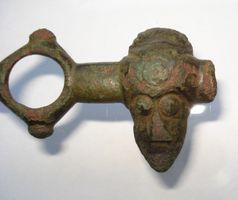
‘One for the road’ is this last horse harness strap joiner beneath..another intruiging form of a face, we wished it could talk back to us…


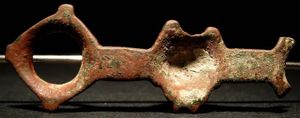
Finally, some more images of the horse harness strap joiner on top of this weeks article..
If I get to know more background information and references, of course I will ad them in the forthcoming time.
Meanwhile I hope I have entertained you with the slide shows !
Attention:
I am always interested in other people’s articles/images from an artefact they know, or have themselves. If you like to write a guest blog – you are more than welcome !
Please contact me at : vikingsandartefacts@yahoo.com
Reference:
Graham-Campbell, James, Anglo-Scandinavian equestrian equipment in eleventh-century England, p. 87-89 (I have ordered this, because relevant information might be addressed here also);
Hammond, B. British Artefacts, Volume 2 – Middle Saxon & Viking, 2010p. 85;
Pedersen, A, Riding gear from Late Viking-age Denmark, Journal of Danish Archaeology, Volume 13, 1996-1997, Odense University Press, p. 137 see:
https://www.academia.edu/4144256/Riding_gear_from_late_Viking-Age_Denmark
http://www.colchestertreasurehunting.co.uk/saxonharnessfittings.html
January 31th 2015
The trefoil brooch – where did it came from ?

Before going back to another part of equistarian equipment, this week I like to tell something more about a true characteristic Viking Age feature in jewellry, the trefoil brooch.
Brooches of this type were used to fasten a cloak or shawl on the breast. The form is modelled on Carolingian trefoil fittings from sword-belts of the ninth century, presumably either seized by the Vikings in raids on the Continent, or perhaps obtained peacefully through trade or the exchange of gifts. The decoration, however, uses animal rather than plant motifs, a style with which the Vikings were familiar. Simpler versions appear to have been mass-produced. Although appeared to modelled on Carolingian trefoil fittings, the trefoil model already shows up in Roman times, see here.
As one can see here this sword strap distributor is modelled in this trefoil shape, accidentally at first considered by me as a trefoil brooch (though in Iceland an example was reused as a trefoil brooch, and who can blame them 😉
The viking truly Scandinavian style trefoil brooch on the image above and just here under is – although it shows clear signs of being worn – a finely made and highly ornate gilt copper-alloy brooch. It is comprising a central circular boss and three lobed extensions.
The profile of the brooch is dished with the pin and catchplate housed beneath. The decoration comprises looped and knotted serpentine creatures in Borre/Jellinge Style surrounding a hexagonal “rosette” motif of conjoined animal heads. Most books define this kind of brooch as Borre Style.
Showing his highly ornate nature, this trefoil brooch can be addressed as Scandinavian. The trefoil brooch (just like the simpler version imaged beneath) was found in England.
Many examples (although ‘many’ is a relative statement here) found in England are in fragmentary condition. One the one hand because of soil conditions, when fertilizer and pesticides had been used, causing corroding of the artefacts. On the other had, and this is the case with the simpler versions, like the trefoil brooch on the right beneath corner, because of their lesser quality forthcoming out of mass production and the way they were casted. The debased ornament on these brooches make them Anglo-Scandinavian products.
A true example of the Anglo-Scandinavian Style is a clay mould for a trefoil brooch combining the Borre Style with Anglo-Saxon animal motifs, wich was found in York with pottery of the late tenth or early eleventh century.
Here an example of a very fragmentated trefoil brooch of Anglo-Scandinavian type, found near Norwich. The lobes of this type of trefoil brooch very vurnable to breakage.
Until 2008, in England,a total of 18 Scandinavian style trefoil brooches were found, and a number of 29 Anglo-Scandinavian. Because of the fragmentary condition, 26 examples remained unclassifiable, making up to a total of 73 brooches. This number making them quite a rare find, and even rarer turning up in antiquities market.
Most trefoil brooches appear in the area of Viking-Age Denmark. Numerous trefoil brooch mould fragments heve been recovered at Hedeby.

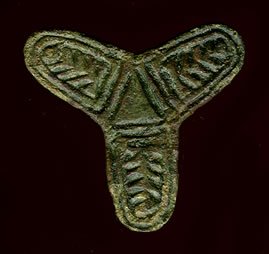
References:
Francheski, G. – Jorn, A. and Magnus B., Bird, Beast and Man in Nordic Iron Age Art;
fig. 148 – Carolingian trefoil ornament of silver with plant ornamentation
fig. 212 – trefoil brooch of bronze with ornaments in Borre Style.
Hall, Viking Age York, p. 110;
Hammond, B., British Artefacts, Volume 2 – Middle Saxon & Viking 2010, fig. 1.1.5-a and fig. 1.1.5-b;
Kershaw, J.F., Viking Identities: Scandinavian Jewellry in England, 2013, p. 82-86, Trefoil brooches with geometric decoration (Type G); (colour) Plate 6;
Maixner, B, Die gegossenen kleeblattförmigen Fibeln der Wikingerzeit aus Skandinavien, Universitätsforschungen zur Prähistorischen Archäologie, aus dem Institut für Ur- und Frühgeschichte der Universität Kiel, Band 116, 2005, – The Scandinavian gilded trefoil brooch: Taf. 12 Kleeblattfibeln. Dekortype Z 1.5 (see description on p. 306, no. 428) and Taf. 41-45 Kleeblattfibeln vom Typ Z 1.5; The Anglo-Scandinavian (‘herringbone’) trefoil brooch: Taf. 35. Kleeblattfibeln des Typs G.1.3.1;
McLeod, The Beginning of Scandinavian Settlement in England; The Viking ‘Great Army’ and Early Settlers, c. 865 – 900, 2014, p.160;
Mills, N., Saxon & Viking artefacts, 2001, p. 54, fig. V115;
Murawski, P.G., Benet’s artefacts of England & the United Kingdom, Milennium Second Edition 2003, p. 315, fig. V07.0201;
The Portable Antiques Scheme Database: http://finds.org.uk/database/search/results/q/trefoil+brooch
More images of diverse trefoil brooches:
http://www.pbase.com/hajar/image/152328602
http://www.salisburymuseum.org.uk/news/vikings-wiltshire
January 22th 2015
Stirrup terminal in Anglo-Scandinavian style.


This week I like to show you a part of the equestrian riding equipment of typical Anglo-Scandinavian nature.
Anglo-Scandinavian; a definition..
But first the term ‘Anglo-Scandinavian’ somewhat more addressed, as it pops up here en there on my website.
The terms ‘Scandinavian’ and ‘Anglo-Scandinavian’ are both used to describe objects found In England. ‘Scandinavian’ object are identical in appearance to objects found in the Scandinavian homelands; they carry pure Scandinavian ornament and bear the hallmarks of Scandinavian manifacture.
By contrast, ‘Anglo-Scandinavian’ objects reveal a blend of Scandinavian and Anglo-Saxon forms and styles; they may, for instance, combine an Anglo-Saxon brooch form with a Scandinavian (art style) motif. Thus, Scandinavian items found in England may have been produced locally by craftsmen working in a Scandinavian tradition, or have been imported, via trade or migration.
Most of the ‘Scandinavian’ items found in England are actually in a hybrid Anglo-Scandinavian style and are part of both communities creating a nwe identity. Such items are as likely to have appealed to Anglo-Saxons in the settlement areas as to Scandinavians themselves. An Scandinavian man might like to have given his Anglo-Saxon wife a jewel showing his background. An Anglo-Saxon woman might like to have given her Scandinavian man something like a stirrup terminal showing the characteristics of Scandinavian art style to him..for example.
One can imagine several options..
The in Ringerike continuïng in Urnes style executed stirrup mounts are a good example showing this.
The stirrup terminal and mount; a quite late introduction.. ?
The stirrup itself was unknown to the Ancient World, and was introduced into England quite late in our history by the Vikings. The word itself derives fro the Anglo-Saxon stigan to mount and rap or rope. The earliest Scandinavian example known comes from a 9th century grave excavated in Norway. The earliest depiction of stirrups in use in England appears on the Bayeux tapestry.

The so called viking stirrups are the earliest appearance of this important piece of riding equipment in Britain. It is argued, from a distribution of known find-spots, that they were not introduced by the Scandinavian settlers of the 9th century but are more likely to relate to the ravaging of the war bands led by Olaf Trygvasson, Sweyn Forkbeard and Cnut the Great during the reign of Aethelraed. Two distinctive British classes emerge, derived from north European types, suggesting that they were already being made in this country.
The drawing of the stirrup with stirrup terminal at the top of the blog, shows us that there would have been one of these fittings on each side, and sometimes smaller ones on the top of the edges. Several examples have been found in England with part of the iron stirrup still in place. Stirrup terminals are hollow underside to receive the lower edge of the iron stirrup. The detailling is of quite high relief with raised oval eyes, projecting snout, and a tusk at each side. It may represent a dragon but this design is generally referred to as a “beast” as it has elements of the horse, wolf and boar within its iconography.

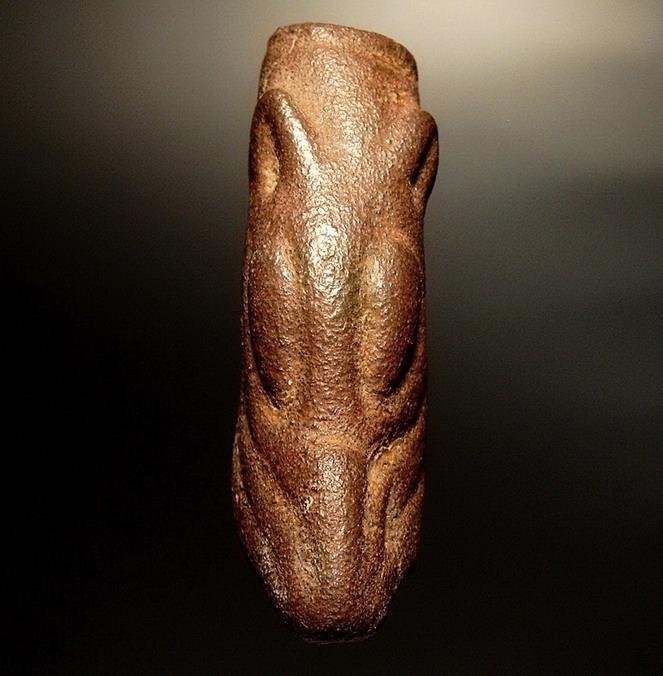
There is quite a range of different shapes and styles of decoration on these stirrup mounts (as a second example at the bottom of this article clearly shows us, with outspoken Urnes style snout – wich is derived from the interlaced entwined snake/beast foliate motif on the doorpanels of the famous Urnes stavechurch in Norway).
The decoration on stirrup terminals as well as stirrup mounts – wich I like to adress to you in the forthcoming blog – shows , as said, Ringerike Style elements and Urnes Style elements: two facts indicate a date-range of circa AD 1020 to 1050 for their use, with some areas maintaining them up to about AD 1100.
It is tempting to link their introduction into England with the increased influence under King Cnut (AD 1016-35) but more detailed study will have (and is, see reference Viking Stirrups from England and their Background) to be undertaken before any such proposal can be advanced seriously.


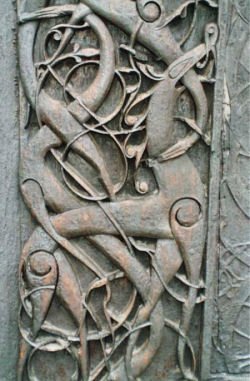
References:
Hammond, Brett, British artefacts Volume 3- Late Saxon, Late Viking & Norman, (2013), chapter 1.9 ‘Riding equipment’, p. 84/85;
Kershaw, Jane F., Viking identities, Scandinavian jewellry in England (2013); p. 5;
McLeod, Shane, The beginning of Scandinnavian settlement in England; The Viking ‘Great Army’ and Early Settlers, c 865-900 (2014), p.41
Mills, Nigel, Saxon & Viking artefacts (2001), p. 78, Chapter 8 Stirrup mounts & harness fittings;
Murawski, Paul G., Benet’s second edition of England & The United Kingdom – Artefacts of England & The United Kingdom Milennium Second edition 2003 AD, p. 319-320;
Owen-Crocker, Gale R., King Harold II and the Bayeux Tapestry, chapter ‘Graphic commentary on the horses of the Bayeux tapestry’, (2005) p. 99;
Seaby, Wilfred A. and Woodfield, Paul, Viking Stirrups from England and their Background
UK detector finds database, Early Medieval (5th-11thC) » Stirrup fittings see:
http://www.ukdfd.co.uk/ukdfddata/showrecords.php?product=46389&title=stirrup-terminal&cat=110
Saxon harness and strap fittings, stirrup mounts, reigns guides & cheek pieces
see: http://www.colchestertreasurehunting.co.uk/saxonharnessfittings.html
Portable Antiques Scheme
see: http://finds.org.uk/database/search/results/q/stirrup+terminal
January 13th 2015
Viking sword chape with falcon
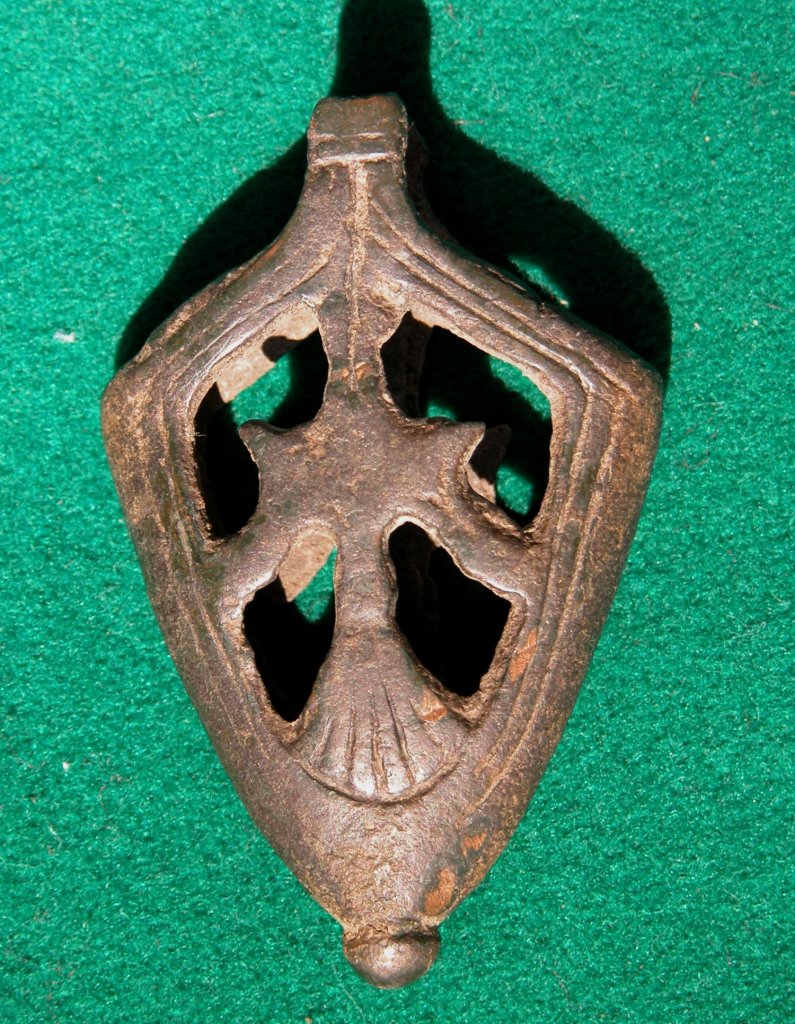
This week I like to show you a viking sword chape of eastern type. With ‘eastern type’, this type of sword chape is addressed to the kind of sword chapes mainly found (south)east from Norway.
The image is a representation of a bird in bronze within a scabbard or sword chape. Similar motif are among the exeptional finds from the so called ‘Birka excavations’ wich took place between 1990 – 1995. The bird images have been identified as falcons (and not, as the salesman of this sword chape was adressing it as one of Odin’s raven..).
Motifs of this kind are not exclusive to scabbard chapes and are found on other artifacts from the late Viking Age such as coins, keys, and other forms of metalwork.
Such objects are often linked with the early principality of Russia and the motif has been interpreted as an emblem or coat of arms of Rurik’s kin in Novgorod and Kiev. The motif may derive from the Edda, in wich Odin’s wife, Frigg, is able to take on the guise of a falcon and fly over the world. The mythical saga motif is thought to have become combined with the aristocratic hunting falcon, producing toem images and coats of arms for one of the leading princely families of Northern Europe.
The sword chape of falcon type imaged here is said to have been found in York. Nevertheless I do not have ‘hard evidence’ for this, and if found in York, it would represent a unique find of this kind of sword chape within England, as the map of the distribution pattern of these specific falcon type of viking sword chapes beneath this article shows us. With this restriction addressed, it is of course possible within itself that a sword chape made in the eastern Scandinavian area ‘travelled’ to England, as a sword chape with falcon type motif was found as far as in Normandy…(see the distribution map on the bottom of this blog).
When showing the falcon type sword chape to Charlotte Hedenstierna-Jonson by mail, she responded:
‘The chape from York is a clear Falcon-category chape. This category dates to the 10th century and have mainly been found in Viking urban centres along the Eastern trade route. York is an exception, as is a find from Bretagne. The chapes are most likely connected to warriors that participated in the network between trading centres like Birka, Staraja Ladoga, Gnezdovo, Kiev etc. They are often found in burials, which is not always the case when it comes to chapes. As chapes go they are one of the more extensive groups, but still rare in actual numbers. The motif has been called the Birka falcon as they are most numerous there. This is also the only known place of production, indicated by a mould for casting a similar chape. There was most likely production in other places but we do not know for a fact’.
References:
Björn Ambrosiani, Birka Studies Vlume 5, Excavations in the Black Earth 1990 – 1995: Eastern Connections Part One: The Falcon motif (2001) p. 11-27.
Charlotte Hedenstierna-Jonson, Rus’, Varangians and Birka Warriors, chapter Falcon sword-chapes and other artefacts, p. 169 and further. See Figure 95. Scandinavian-Varangian sword-chapes, in accordance with Paulsen 1953, after Arne 1913 link to publication
Charlotte Hedenstierna-Jonson, A group of Viking Age sword chapes reflecting the political geography of the time, Journal of Nordic Archaeological Science 13, pp. 103–112 (2002) link to publication
Michaela Helmbrecht, A Winged Figure From Uppåkra. Fornvännen 107. Stockholm (2012) link to publication
Peter Paulsen, Schwertortbänder der Wikingerzeit, 1953. (available every now and then in antiquarian shops).
See p.17 1. Ortbänder mit germanischen Vogelmotiv and further: p. 22 – 29 Untergruppe b.
Esther Cameron, Sheaths and Scabbards in England AD400-1100 (British Archaeological Reports British Series) Paperback – January 1, 2000
http://www.vikingage.org/wiki/index.php?title=Sword_Scabbard_Chapes


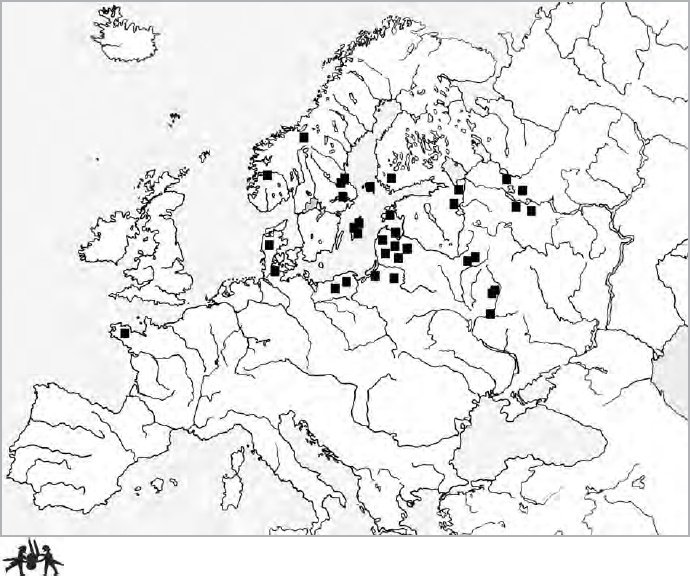
January 5th 2015
Viking lozenge brooch with an interlaced circle.


A mysterious lozenge brooch, a question unanswered and an equally rare lozenge brooch type also found in England..
This week I’d like to tell some more about a specific type of Viking Age brooches: the so called ‘lozenge brooch’.
The openwork lozenge brooch, with a raised central rosette and four arms terminating in impulded Borre-style animal heads, is a 9th century Scandinavian brooch type wich is found with some frequency in the eastern countries of England. Within Scandinavia, it is found mainly in the area of Viking-Age Denmark.
The lozenge brooch on the images above is of a rare type, because of it’s open design and interlaced circle execution. Showing this example to Jane Kershaw, as she had written a truly magnificent book on Scandinavian-style jewellry from England, she reacted to me:
“…The lozenge brooch is highly unusual in its openwork design. The description says 11thC, but it will be late 9th or early 10thC, as the terminal heads are still in the Borre style. I wonder if the cross had a religious significance? There is only one other one like it, a metal-detector find from Denmark”.
I have addressed the question to the National Museum of Denmark, to find the reference to the metal detector find mentioned, but did not receive a reaction. I have asked Jane Kershaw if she could help me on this further. If so, I will add this information.
On the images beneath, a more common known type of viking lozenge brooch can be seen. Although somewhat abraised, one can determine this brooch to the Type II A lozenge brooch, as can be compared to an image in the book by Jane Kershaw: Viking identities; Scandinavian jewellry in England on p. 49 fig. 3.6 found in Hasketon, Suffolk.
The lozenge brooch from Hasketon are likely to represent a Scandinavian lozenge-brooch variant not yet known from Scandinavia.
Whatever form it is: a rare type of viking brooch, not commonly known ! Apart from the given typology by Xaroline Paterson (see reference), there is no established typology for the lozenge brooches, a reflection of the young age of the excisiting corpus.
See for references:
Jane Kershaw: Viking identities; Scandinavian jewellry in England (2013) p. 43 – 49, Lozenge brooches
Kevin Leahy and Caroline Paterson: New light on the Viking presence in Lincolnshire: The artefactual evidence (1993).
Annemarieke Willemsen: Vikingen ! Overvallen in het stroomgebied van Rijn en Maas, 800 – 1000 (2004) p. 27. Reconstruction of male viking dress with similar lozenge brooch, on the photo of the reconstruction used on the tunique.
Brett Hammond, British artefacts Volume 2 – Middle Saxon and Viking, p.46, fig. 1.1.6-f and fif. 1.1.6-g. (2010)
Also see website Portable Antiques Scheme for similarlike lozenge brooches: http://finds.org.uk/database/artefacts/record/id/9894
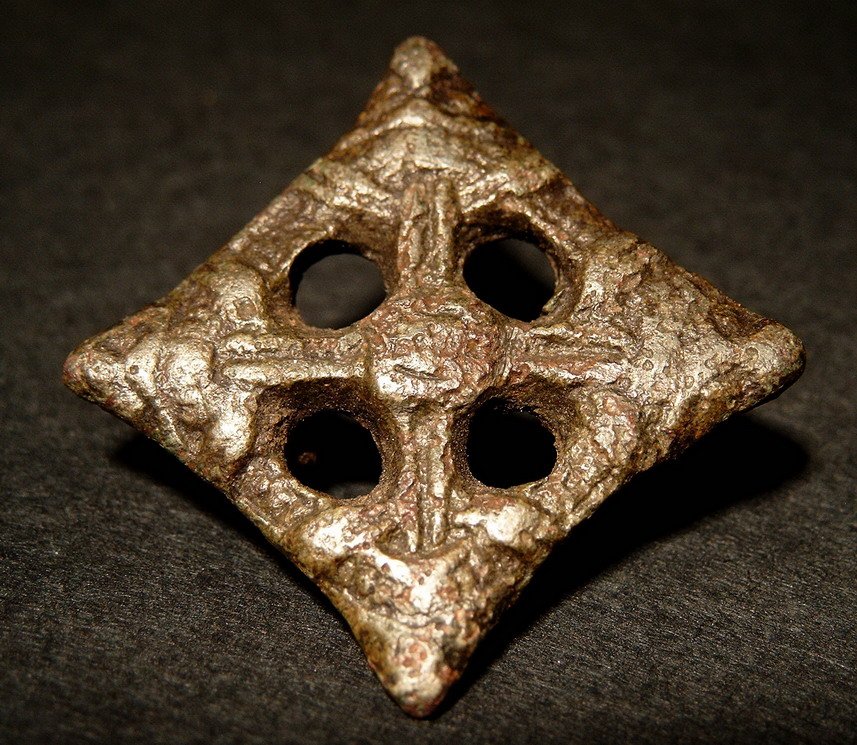

December 29th 2014
A Scandinavian Viking type spearhead with silver covered socket in Ringerike style.
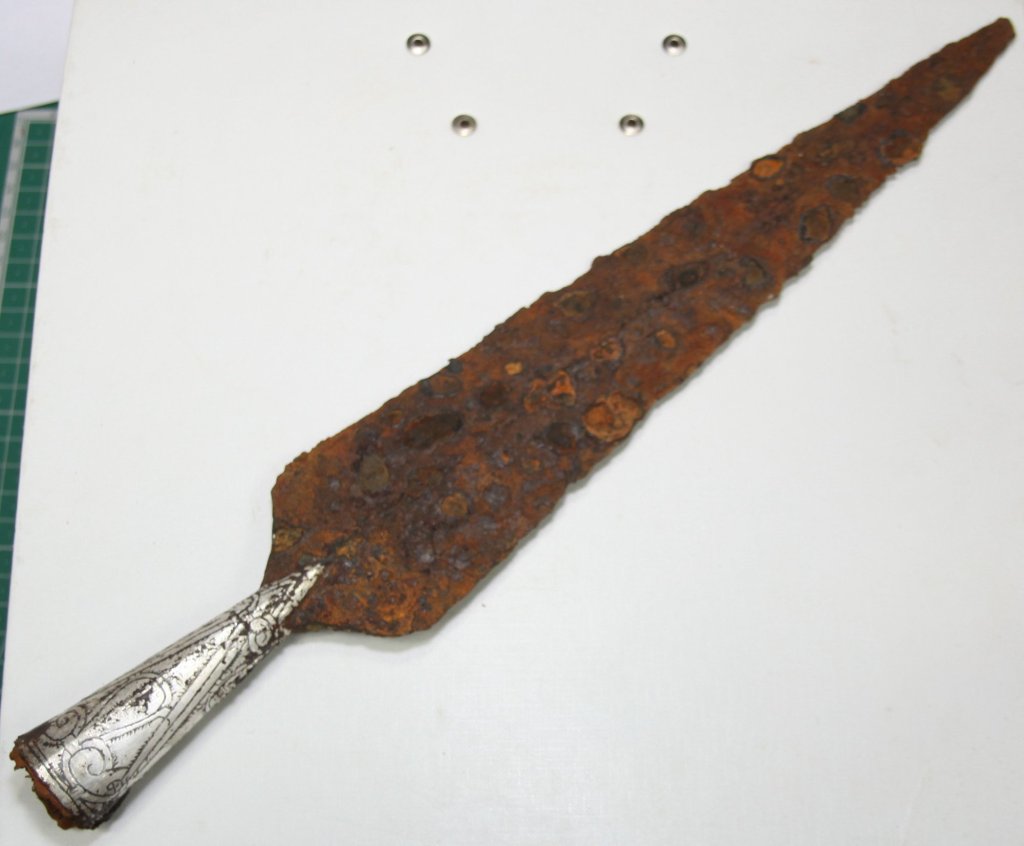
This week I like to show you a Viking Age spear head of Scandinavian type. These distinct type of spear head is very attractive looking because of its silver covering and decoration of the socket. I will also tell something about the specific art style, the Ringerike style, wich with this silver is decorated in.
Why specific Scandinavian ?
More than 60 Late Viking-Age spearheads found in Finland have silver ornamented sockets, the majority of which are ‘decorated with runic animals’ (in the Swedish ‘Runestone’ style). At least seven different animal forms of Urnes-style type are distinguished, with parallels on Gotland.
Surveys a group of Viking-Age silver-ornamented spearheads (late ninth/ early tenth-century to eleventh century) found in Estonia, Latvia and Finland. Concludes that, although the majority were imported from Scandinavia, there may have been some attempts at local manufacture, following Scandinavian models, towards the end of the Viking Age.
Another example of a find is centred around a rich blacksmith’s grave at By in Hedmark, is of late Viking Age origin, mainly 11th century (Martens 969; 2002). Here the sockets of the M-type spearheads are decorated in Ringerike style, which makes it very likely that they were made in the Nordic countries (Fuglesang 1980:42).
Ringerike Style
The socket decoration on the spear head is of Ringerike style of pattern type B.
The Ringerike Style and the Urnes Style are the two art-styles that flourished consecutively during the 11th century in Scandinavia – until the end of the Viking Age, with the introduction of the European Romanesque – may be considered to encapsulate much of the essence of the Viking Age itself. Main characteristics in Ringerike Style decoration is the foliate motif, the use of intertwining tendrils, combined with alternating lobs and tendrils. A common feature within the decoration is the form of a spiral in the hip of a so called ‘Great Beast’ (see also the Ringerike style sword strap devider in The Artefacts section).
This distinct use of a spiral curl can be seen on the lower part of the silver decoration on the socket, as well as on top of it.
The Ringerike Style was fashionable in Scandinavia during the period between about 990 and 1050, by wich time it was already in transition to become the Urnes Style.
James Graham-Campbell, Viking Art, 2013, p. 116 – 133
I would also like to express my thanks to him, giving me some very fine references on this subject (the underlined references are clickable as links to the reference text).
See p. 133 Fig. 7 Socket decorations on spearheads: Blindheim’s pattern types Aa, Ab, and B (Ringerike Style)
See p. 216 Fig. 2 Some ornaments in the Ringerike style on the sockets of Estonian spearheads
See image p. 123 Fig. 1. Ringerike style patterns on spearhead sockets.
Image beneath: (I will address the reference later, as I just found this image on someone’s Pinterest page)
Spears and javelins from the Viking Age – type 6: addressed here as ‘a typical pattern’.
Also see: Vikings; Life and legend (2013) The British Museum (catalogue accompanying the exhibition held in several national musea in Europe during 2013 and 2014), p. 106, spearhead with silver-inlaid socket, 11th century from Vilusenharju, Tampere, Upper Satakunta, Finland.
Similar style silver decorated spear heads images can also be seen clicking at this link.

December 18th 2014
A runestone and a Curonian neck torc.
a guest blog by Daniel Behrendt from Germany.
(words and images Daniel, except from the runestone see: http://bodilzalesky.com/blog/2006/12/13/mervallastenen-mera-sten/)


This is a runestone at Selaö, an island in lake Mälaren, Sweden.
siriþ· lit· resa· stan · (þin)a (· ) at· suen· sin· (b)unta· h(n)· uft· siklt· til· simkala· turu(m)·knari· um· tumisnis
The inscription means: “Sigrid erected this stone for Sven, her husband. He sailed with his valuable Knorr to Zemgale, driving past Domesnes.”
So Sven sailed with his heavy tradeship to the ancient territory of the Semigallian tribe, passing Domesnes, nowadays called Cape Kolka. It is the most northern point of the ancient province of Kurland in Latvia.
Lauma, the daughter of a mighty Curonian chieftain..
What has Sven done there? I think he was trading Arabian silver, bronze cast jewellery he took up in Gotland, amber and furs. When he came back and crossed Cape Kolka again, he stopped in Kurland and met Lauma (which means forest spirit), the daughter of Ilmārs, a mighty Curonian chieftain.
Lauma was promised to a Semigallian local prince to strengthen her father’s influence in the central territories and to improve the relationships between Curonians and Semigallians. But Lauma would not accept her destiny of being married to a men she didn’t love…
Sven came back from his trip to Zemgale and entered the shores of Kurland, where he sailed down the Venta, and finally came to the town of Kuldīga for trading the rest of his valuable goods that he could not sale at the mouth of river Rīdzene (where Riga is situated today). When Ilmārs allowed Sven to trade his goods on the market place, Lauma met him and both fell in love the first time they saw each other.
A secret relation
As Laumas father should not know about the relationship and also Sven wanted nobody to know this, for his wife Sigrid had many contacts with other tradesman who headed into this area, the two needed to meet secretly. Since Lauma loved to play in the nearby woods when she was a child, she knew many hidden places where nobody could find them. But Ilmārs got suspicious, as he recognized that his daughter went to the market place in the afternoon nearly every day, when all trade was already done, and coming back not before the late evening.
So he sent a group of his guard to follow Lauma unremarkably. As Sven and Lauma reached their secret place and loved each other, they were trapped by Ilmārs’ armed soldiers. Sven, just bearing a small knife but no other weapon, could not protect Lauma, who struggled against her father’s men and lost her expensive bronze neck torc, before both were brought back to town and interrogated by Ilmārs. Although he loved his daughter, he could for political reasons not accept that she would marry another man than the prince. Therefore she was sent to the town of Ogre immediately, where the wedding ceremony was held.
Paying the price of love
Sven had to pay a penalty in the weight of 10 silver dirhams to Ilmārs and was forbidden to enter Kuldīga and trade his goods ever again. So he sailed back to his loving wife in Sweden, where he kept the secret, ashamed of his disloyality, and forgot about Lauma over the years. But he continued sailing and trading his commodities and became honorable and famous, so his wife decided that his first journey to the eastern shores should be remembered by a runestone. It was placed at the island of Selaö, nearby their home, by Sigrids brother Wieland, a passionate stone carver.
Nothing reminds of the short, unlucky love in the mild spring of the year 1028, only an amazing piece of female jewellery found in 1m depth below the ground, besides a forest road in the woods nearby the town of Kuldīga…
Words: Daniel B.
Note: I like to express my thanks to Daniel, who stumbled upon my website a while ago and in who I have met a kind of brother in Viking Age artefacts ‘madness’.
Reading my first blog, he was inspired in writing his own phantasy story linked to an artefact he has in his collection. Although ‘totally phantasy’ is not the right term here as he states:
‘The story of course is from my imagination, but based on the real runestone and of course the provenance of my corresponding artefact, which was found as described in the text. I decided to date the story to 1028, as the torc is dated from 9th to 12th century, and the runestone is also dated to 1000, which of course cannot be said precisely, just according to the picture style’.
Background information and reference:
A copy of the runestone of Selaö is also exhibited in Latvijas Nacionālais Vēstures muzejs in Riga, so people seem to remember Sven even there. Mervallastenen is only one of approximately 100 runestones telling us of Swedish guys travelling over the Baltic Sea eastwards, each with it’s own story to inspire our fantasy of adventures in ancient times.
Book reference for my torc:
Author: Kulikauskienė R., Rimantienė R.
Title: Lietuvių liaudies menas. Papuošalai (I knyga)
Pubication: 1958 (I think in Vilnius)
Languages: Lithuanian, Russian
The picture reference is no. 369 in the book (see attached photo scan). This piece was found in Šaukotas, Central Lithuania, and has an inner diameter of 16 cm, but consists only of three single strands which are partly broken.
Daniel’s description of the torc:
Curonian forged bronze neck torc riveted togther from four single strands bent backwards at the end, with punched and filed geometrical ornaments in shape of continuous and open-work lines and circles
Symbolism: Curonian expression of the mythical hill symbolising the roof of the world, and the three positions of the sun (sunrise, zenith and sunset), also found in context of other tribes (for example Latgallian)
Dated 9th-12h century, oval shape, largest inner diameter 17 cm, weight approx. 500 grams, museum quality
It was found besides a forest road in 1m depth in the woods nearby Kuldīga, Western Latvia (historical Kurland).
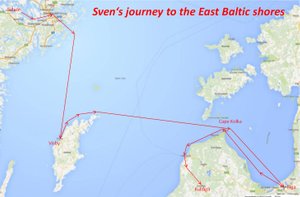

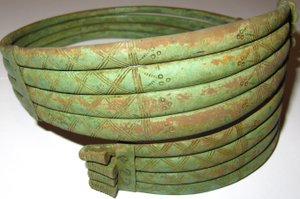
December 11th 2014
Once..

Once
There were a viking man and woman…
The man was very vain and always combed his curled hair and moustache in the morning. Sometimes in the evening before going to dinner also !
What to give such a man for his birthday ? The woman deliberated and deliberated.
The month before his birthday she walked to the smith. ‘Can you make the face of Thomsson with curly hair and moustache’ she said. The smith looked up, surprised. He had never had such a proposition before. Never he had afterwards either. ‘I do not have much to offer’ said the woman, ‘but I’d like to give him a personal present he will appreciate’.
‘I’ll try my dying best and make it for free’ the smith said – lively jumping up in his head as this was a challenge in his bit unchalleging becoming life as a smith, smithing mostly horse shoes and sickles.
The woman walked out on the smith with joy in her heart and some expectations. The whole day she had a smile on her face with anticipatory pleasure. The man wondered wat caused her happiness..
Just over three weeks later the smith winked at her. ‘It is finished’ he said proudly.
She walked to his dark house with virtually no day light coming in, and against the flickering flames of the fire he showed a bronze shining object to her. She was lost for words.
The smith had made his ‘piece de resistance’, his ‘magnus opus’. There was just the face of her man, with the bewildered curlings and moustache. She gave the smith ten kisses making him feel very shy.
The early morning of his birthday the man was awake early and combing his hair.
At that moment, the woman gave the present to him saying ‘Doesn’t he look much like you ?’
The man was baffled. He had never seen something like this. The comb fell out of his hand and he stood frozen.
In the afternoon he attached the piece at the harness of his horse and it shone in the sun. Then he jumped upon his horse, to show his birthday present to the whole village.
It was the 11th of December of the year 1014.
The smith wouldn’t have to do boring smithing anymore. More people asked him to create a unique piece of art.
Sometimes nowadays, one is being found..
 www.vikingartefacts.com