
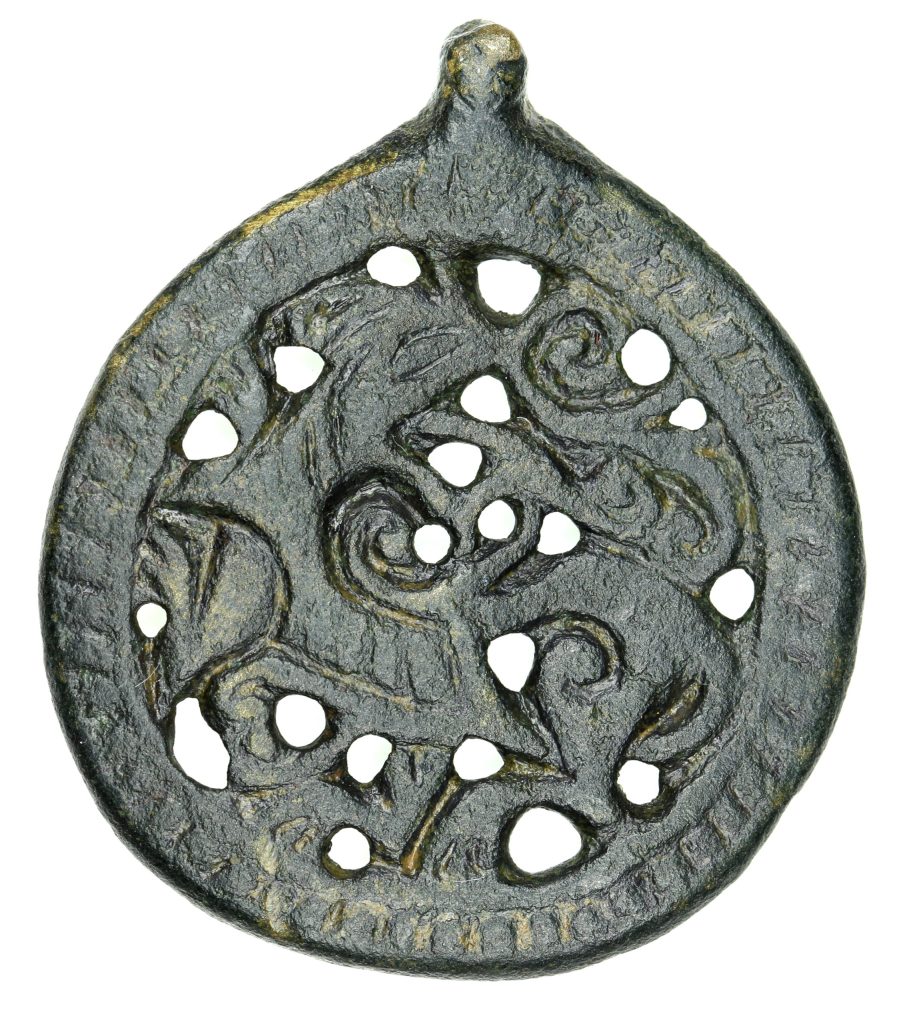
Recently I was able to add an extremely interesting piece to my collection: a bronze pendant from – presumably – the 12th century, found in England.
The remarkable thing about it is that it has both Romanesque style features, as these emerged during the Anglo-Norman period – 1066 A.D. – 1154 A.D. – and style features that can be traced back directly to the decoration on objects from the Viking period.
The pendant – it is unknown whether this was worn by a human, another possibility is that it was a horse harness pendant, measures 42 by 50 millimeters and weighs 20.24 grams. It was found in or near Basingstoke in Hampshire, England. At the time of the so-called Domesday Survey, a market was already established there. The Domesday Book is a detailed survey and valuation of land ownership in England at the end of the 11th century. The survey was ordered by William the Conqueror at Christmas 1085 and was carried out the following year. It records who owned the land and how it was used, and also includes information on how this had changed since the Norman Conquest in 1066.
Basingstoke lies to the south-west of London, on the road to Winchester. Winchester has a clear connection with the Norman invasion of England from France. The Siege of Winchester took place in 1066 when the army of the Norman nobleman William FitzOsbern besieged and captured the important Anglo-Saxon city of Winchester. After the Battle of Hastings, William the Conqueror sent an army to seize the English royal treasury at Winchester as he advanced on the English capital of London. FitzOsbern defeated a West Saxon counter-attack at the Battle of Havant and marched his army north-west, occupying Portchester and Southampton unopposed. He then laid siege to the English city of Winchester, which he stormed after building siege engines over the course of two weeks. The fall of the city allowed King William to appoint Eustace as governor of Hampshire.
It is not illogical that a pendant with Romanesque style influences is found about 30 kilometres northeast of Winchester. A direct link with the Vikings is not logical at first sight from a stylistic point of view, because the influence of the (Danish) Vikings only became apparent when the so-called Great Army attacked Saxon Winchester in 871 A.D. and was defeated by Alfred the Great, who then managed to keep these Vikings at bay.
But why do we see decoration style characteristics from the Viking period in addition to the Romanesque style characteristics – the way in which the animal is designed and looks back? In particular, the various spiral elements in the decoration and the almond-shaped eye of the animal are striking. In general, it can be said that style characteristics from the Viking period lived on for some time in the Romanesque decoration style that was imported into England from the continent.
The spiral shapes are already encountered during the so-called Jellinge decoration style period – 900 A.D. – 975 A.D. in the 11th century. The elongated almond-shaped eye is seen as a style characteristic in the Ringerike style – 1000 A.D. – 1075 A.D. and the Urnes style 1050 A.D. – 1125 A.D. Taking this into account, it suddenly becomes no longer strange to see style characteristics from the Viking period in an object with a Romanesque decoration style character.
Of course, the question remains where this object is made and where it originally comes from. That can never be said with certainty, unless a mold is found more or less on site with exactly the imprint of the object. Objects from this period are often unique and designed and cast once. But that the object was made in England, under the influence of the (Anglo) Normans is beyond dispute.
In addition to the Romanesque style features, the style features from the late Viking period that were still very much in evidence at that time were also incorporated.
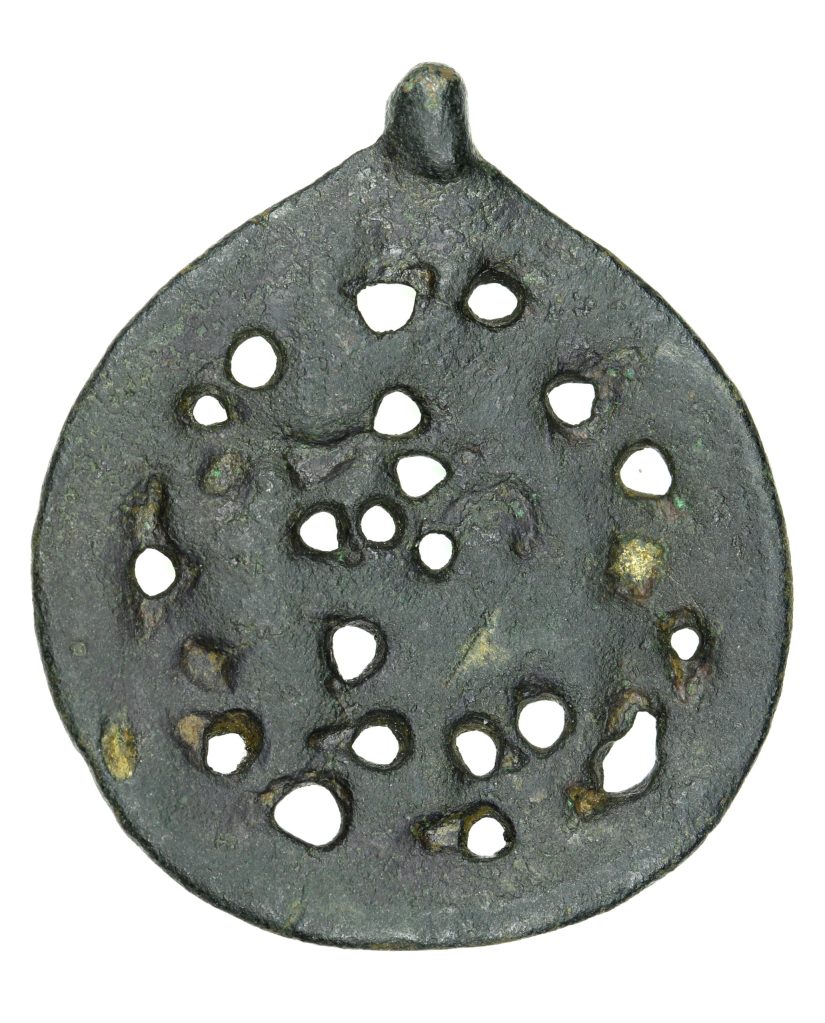
Leaving open the possibility that the pendant was an ornamental pendant on the horse harness: this form of decoration came into use in the 12th century in particular. Traces of gilding on the side and back of the pendant show that it must originally have been completely covered in gold. That it belonged to someone of high social standing – worn by a person, or as a decorative part of the horse harness – is certain. What the image meant remains unclear. It could be purely decorative, but it could also be a preconceived design, with the intention of conveying a message – whether or not understood by the viewer or only internalized and silently carried by the wearer/user of the pendant.
In any case, this pendant made a good impression.
And actually, to this day, it still does.
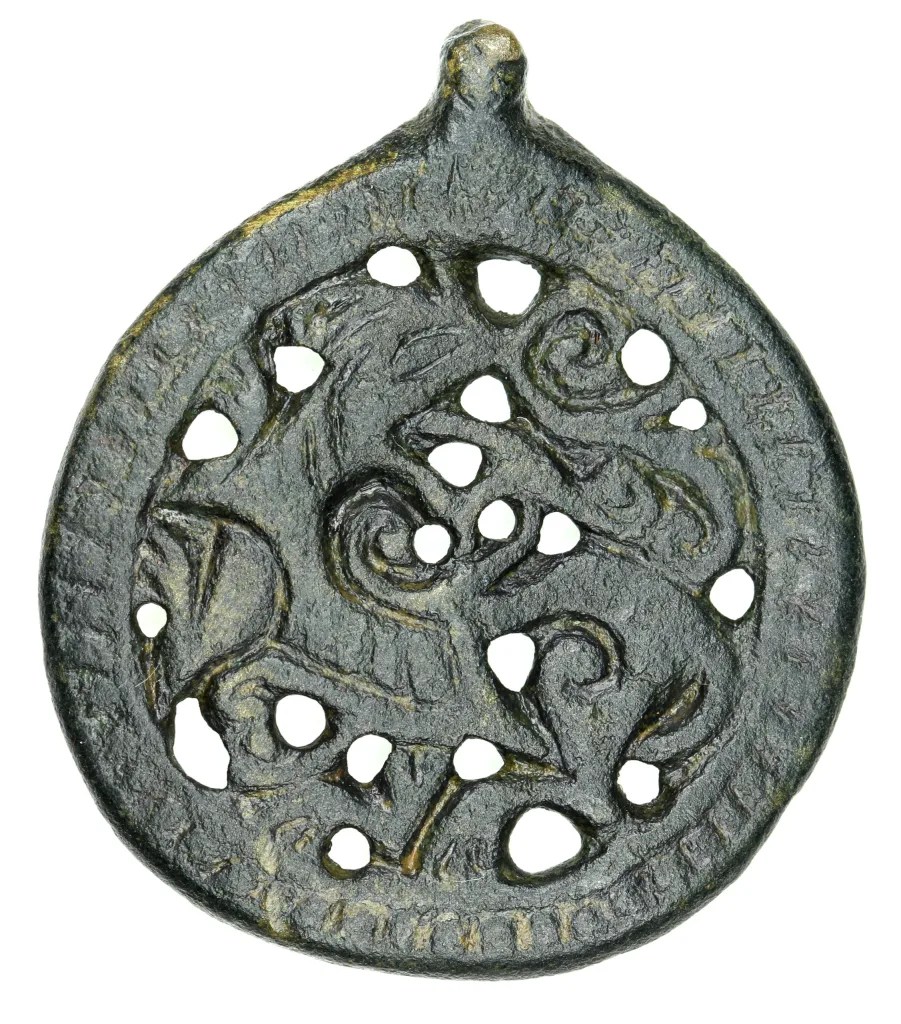
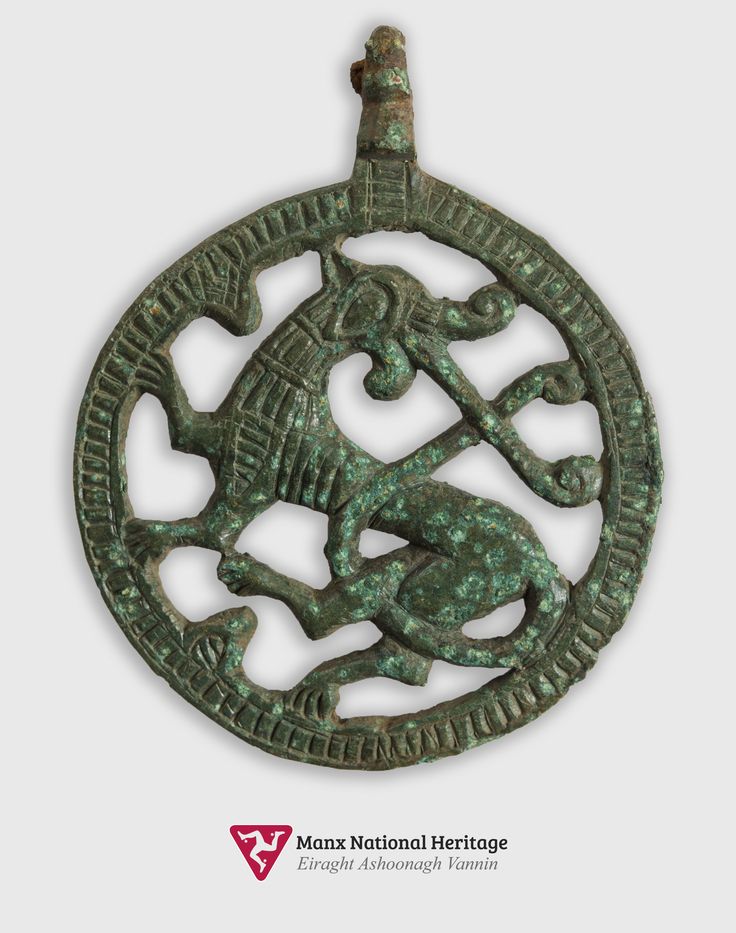
Addition: a – somewhat – imagery like similar pendant I have found on the internet, earmarked as belonging to the Manx museum (Manx National Heritage). The style is far more openworked, giving in the possibility of having been a horse harness pendant. Its similarity lays especially in the feel of the artefact and the backward depicted east, although the Manx example – considering art style – seems to develop further in the direction of the Urnes style. The distinct “striped” border decoration on the pendant is striking similar to the Basingstoke example. I have asked the Manx Museum for more information on their example.
 www.vikingartefacts.com