

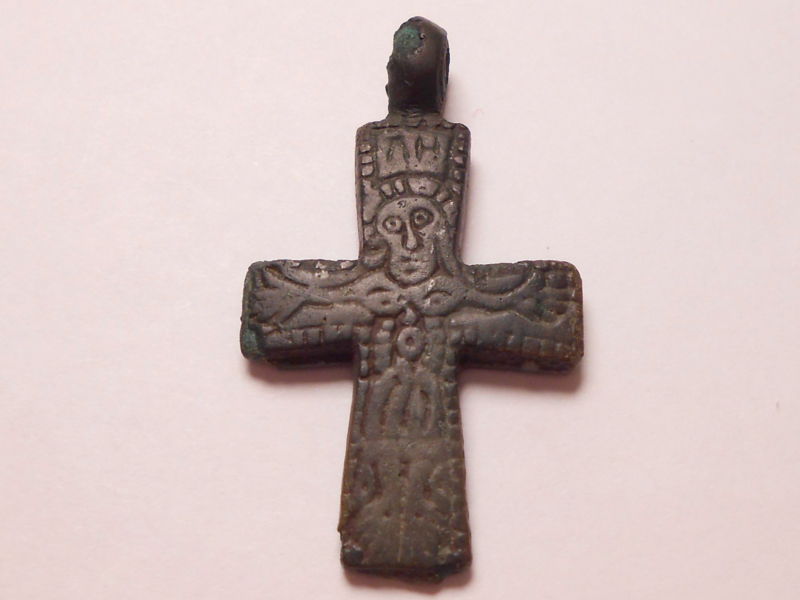
In the countries bordering Russia and in Russia itself many objects from the Viking Age have been found, sometimes unmistakably provided with a Scandinavian similar Viking art style, but always special and often distinguishable in their design from the objects that were made in Scandinavia itself. This crucifix cross pendant, found at Belaya Turkov in Kiev, Ukraine, is a good example of this.
It dates from the 9th – 10th century A.D. and is made of bronze and measures 40 mm in length and 23 mm in width and weighs 6.57 grams. On both surfaces of the pendant a figure is depicted in Jellinge style ornamentation with outstretched arms.
The reverse side – the left side in the photo – is much more worn from contact with the wearer’s clothes. At the top of the back are two letters, alpha and omega, which stand for ‘the beginning and the end’, a standard Christian designation from the early medieval period. Below, the halo shown around the head occupies the rest of the upper cross end. The naked chest, arms and shown hands are shown extended in the left and right sides of the cross. The torso and legs are shown on the lower arm of the cross. The midriff shows the navel as a round dot.
A billet border concludes the design. A special object with a Christian representation, shown in a Viking art style.
The history of the so-called Kievan Rus is an impressive one. Many people do not realize today that the Vikings had close contacts with today’s Russia; that is why various Scandinavian (style) objects are found in the region where the Kievan Rus had settlements and the areas around it.
 www.vikingartefacts.com