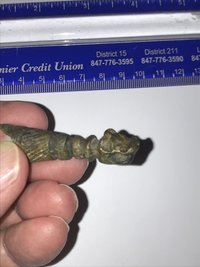
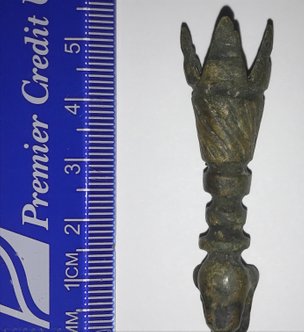
Drinking horn finals from the early medieval period are extremely rare. Let aside, those having an outspoken viking (or hybrid Anglo-)Scandinavian style as the example here published. This bronze example had been found near Lincoln in Lincolnshire, England.
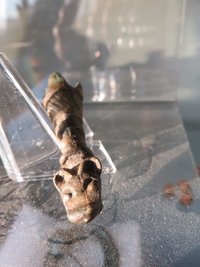
The, complete, example seemingly having a simple form of decoration and casting, but, and here one recognizes the distinguished, and what it sets it apart from everything else, viking art, once again, zooming in, taking a closer look. The details are of an astonishing quality – and if I might say: force. Looking at the end of the final where one sees an animal face, a slight rotation of it unravels the intimate perspective looking at a wolves head.
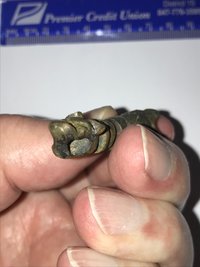
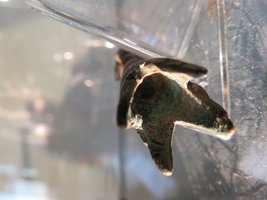
The form of the wolve head is in its design superficially Anglo-Scandinavian, but has a more refined casting than the average Anglo-Scandinavan style, linking him directly towards the true Borre style. If we look on top of the head, the head transformates another kind of animal head: that of a bear with rounded ears. Seen from a position when holding the final with the head to the right, the image almost becomes fierceful, dragon – or lion – like, like the head on the stern of a ‘drakkar’ ship. The different images of faces is a very feature of the art of the vikings. From every angle another new image unfolds.
I’m researching if similarlike type of drinking horn finals are known, either from England or outside. In the Portable Antiques Scheme, no similarlike examples are known until now, let aside, types wich even vaguely coming near a true viking or (Anglo-)Scandinavian origin for style and decoration. A lot of types are typologized as Anglo-Saxon, medieval, a few with romanesque features, and some from the Roman or Iron Age. But literally no one from the Viking Age. A vaguely similar but more decorated example, found in Scotland, can be seen on Pinterest.
I was wondering how such a finial would have been attached towards the drinking horn. First, possibly naive, thinking of something like glue, the curator of museum Dorestad pointed out to me that very likely the finial was made to fit the horn, instead of the other way around. The triangular endings would have been bend and entangled on the ending of the horn.
Carol Neuman de Vegvar, living in the United States, once visited me studying another drinking horn final, of presumably Irish or Anglo-Scandinavian origin, considering its seize and decoration. She is working on an overall publication of early medieval drinking horn finals. I have asked here if she ever came across a similarlike type like the one discussed here.
She commented:
‘So, this is interesting.. the sort of dragonesque end with the upright ears tends to be a later feature (stylistic in time, red.) as to these projecting flanges that are used as attachment points usually are also later developments. So I would guess 9th/10th century, something like that. You see, that is one of the things I would come and look for, was, that there are traces of river holes and that would have projecting flanges. Because, that’s how these things normally in this period with this projecting looks with flanges, how the terminal would have attached tot he horn, with the rivet wich would go tot he metal and be attached tot he horn itself.
The size is not a problem. The tapering is not a problem by the kind of wide, narrow point is very typical horne fittings as we know. The socket is interesting, I’m wondering.. I’m just looking down here, there seems to be some corrosion products in there. I don’t know if there is enough down there right on the bottom to get a sample. You know someone who can check that, because that would tell it is horn, it is horn point. It looks like something’s in there, what might be the point of a horn.
On the other hand, I have roundmouths checked couple of years ago and we have found out it was not horn, but wood, in the side of the roundmouth. In a roundmouth from Maidstone in Kent. So, it might be worth checking. So, if you know somebody who could do on DNA analysis or that kind of thing, could do that for you. Because, that would tell you right away, if it is horn point or something else.
All kind of things it could be… the ridge of a shrine, with the ridge hall, and this would be the one end of the ridge ending, and thee would be another at the other end. Or it could have been attached tos ome other kind of object. ‘
I point out to Carol the change in shape of the animal’s head when one turns the object, and that I see different animals in it.
‘Sometimes.. but I see this as actually something like a hound (jachthond red.) Like a big Mastiff, a big dog. Because the people who had this, also had dogs. We’ve seen Harold carrying dogs on shipboard on the Bayeux Tapestry. And they are pretty good sized dogs, this is not your average Pekinees, this is a powerful hound.
It is copper alloy. I don’t see traces of enamel on it. Although there might be some in the grooves, the diagonal grooves on the socket. It is clearly cast. Not applicated. It doesn’t have the flat bottom the later ones from Ireland have and those are twice as long and much heavier.
So, yeah, it is quite remarkable…object. Like I would saying, the open mouth for a suspension chain or ring or some combination of the two. And I imagine these sometimes had some sort of suspended decoration on the rings or.. (laughing) One of my students last year called danglies.. I suspect also given the amount of wear on the mouth, specially between the convector between the upper and lower jaw. I would say this would be, at least partly be, for a suspension chain. The movement of the chain would make that hole bigger.
Truly interesting piece.’




 www.vikingartefacts.com