
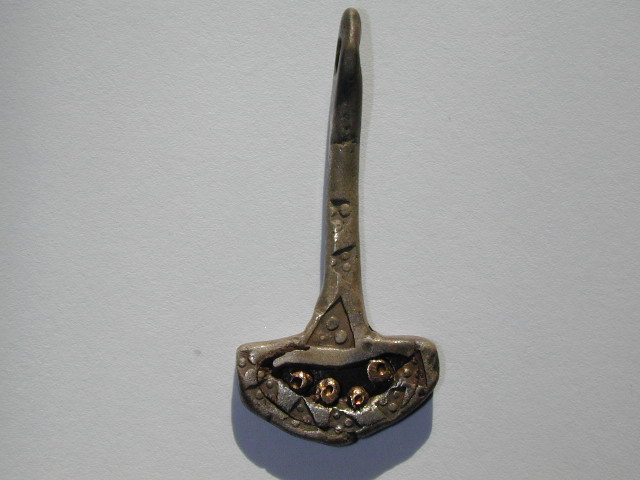
Gold rings and silver Thor hammers… one could write a book about them; they are much sought-after and collected objects from the Viking Age. Consequently, they are often forged and counterfeited. The trick, over the years, is then to find out what one recognises as authentic objects from the Viking Age (or: a Scandinavian look). Grosso modo then, in the case of, say, Thor’s hammers, three aspects come into play.
First: what does the surface of the silver look like. Does it have irregularities, characteristic of objects forged ‘over time’ ? Are the ‘pellet in triangle’ decorations from uneven, not (too) precise punching (read: not mechanically, evenly applied) and does a so-called XRF analysis reveal a ratio of metals by which one can recognise that the silver is ‘out of time’? Silver from the Viking Age is always impure, meaning that impurities could not yet be filtered out of the silver.
The silver must therefore contain at least traces of gold. Gold occurs naturally – in very small quantities – in silver in most ancient silver. After performing and XRF analysis, it was found that this was indeed the case.


This is a silver Thor’s hammer, found in eastern England (more precise location unknown) with four gold (coloured) decoration balls incorporated in and on the hammer. What was curious at first glance was that the decoration was one-sided, and not on both sides of the pendant. The dimensions are: length, 45 mm, width 21 mm, the thickness of the hammer is 3 mm, extending to 6 mm at the suspension. The weight is 8.71 grams.
Already knowing a slightly more precise locality, eastern England, XRF analysis has been carried out twice on this Thor’s hammer. Once by the US vendor at the Advanced Life Cycle Engineering at the University of Maryland, on both the silver and gold decoration balls.
The result provides insight into the ratio in which materials have been used. The golden question, of course, is: what should be in it, regardless of what and why is it so?
Sterling silver, which is most contemporary silver, consists of 92.5% silver and 7.5% copper. This is an international standard. In this type of silver, as mentioned earlier, gold has been filtered out, which naturally occurs in small traces in silver. Analysis of the silver hammer with gold balls yielded the following result:
University of Maryland silver analysis:
47 Ag (silver) 90.72 %
29 Cu (copper) 9.28%
As this analysis did not mention any traces of gold, I asked for further clarification. This came and read:
‘Looking at the scan you sent, I think it is highly likely that there is a small amount of gold in the sample, though I couldn’t say how much exactly. 0.1% is the limit of detection for our XRF, but looking at the scan I would guess you have more gold than that, it just didn’t get picked up in the automated analysis of the spectrum. The reason I think it is there is that there is an unidentified peak at around 9.7 keV, and that corresponds to the L-alpha line of gold. If it is gold, then we should see less intense peaks at 11.4 and 11.6, and it looks like we do have some response in that part of the spectrum. So I would say there is a very high likelihood that there is a small amount of gold in the sample.’
Analysis gold balls University of Maryland:
28 Cu (copper) 39.33%
79 Au (gold) 34.11%
47 Ag (silver) 25.15%
30 Zn (zinc) 1.40%
As I wanted an independent counter-analysis against this, I also had an XRF analysis done myself by Edelmetaalwaarborg in Joure.
The results were:
Silver:
47 Ag Zilver 937,1 o/oo
45 Rh Rhodium < 0,055 o/oo
29 Cu Copper 62,79 o/oo
30 Zn Zinc < 0,094 o/oo
79 Au Gold < 0,20 o/oo
78 Pt Platinum 0,175 o/oo
46 Pd Palladium < 0,18 o/oo
48 Cd Cadmium < 0,88 o/oo
50 Sn Tin < 6,2 o/oo
28 Ni Nickel < 0,037 o/oo
41 Nb Niobium < 0,20 o/oo
45 Rh Rhodium < 0,055 o/oo
51 Sb Antimony < 0,51 o/oo
82 Pb Lead < 0,20 o/oo
23 V Vanadium < 0,35 o/oo
24 Cr Chromium < 0,30 o/oo
26 Fe Iron < 0,17 o/oo
27 Co Cobalt < 0,074 o/oo
48 Cd Cadmium < 0,88 o/oo
49 In Indium < 1,2 o/oo
25 Mn Manganese < 0,11 o/oo
22 Ti Titanium < 0,41 o/oo
42 Mo Molybdenum < 0, 51 o/oo
50 Sn Tin < 6,2 o/oo (twice mentioned in the analysis)
Gold:
79 Au Gold 368,4 o/oo
45 Rh Rhodium < 0,098 o/oo
47 Ag Silver < 240,1 o/oo
29 Cu Copper 362,6 o/oo
30 Zn Zinc 29,26 o/oo
46 Pd Palladium < 0,13 o/oo
28 Ni Nickel < 0,033 o/oo
78 Pt Platinum < 0,44 o/oo
25 Mn Manganese < 0,072 o/oo
28 Ni Nickel < 0,033 o/oo
41 Nb Niobium < 0,20 o/oo
45 Rh Rhodium < 0,098 o/oo
51 Sb Antimony < 0,51 o/oo
82 Pb Lead < 0,20 o/oo
23 V Vanadium < 0,35 o/oo
24 Cr Chromium < 0,30 o/oo
26 Fe Iron < 0,12 o/oo
27 Co Cobalt < 0,050 o/oo
48 Cd Cadmium < 0,38 o/oo
49 In Indium < 0,50 o/oo
25 Mn Manganese < 0,072 o/oo (twice mentioned in the analysis)
22 Ti Titanium < 0,41 o/oo
42 Mo Molybdenum< 0,51 o/oo
50 Sn Tin < 1,7 o/oo
An exhaustive summary as this may be, it serves mainly the purpose of continuing future research on Thor hammers.
Jane Kershaw notes at the same time that:
‘Normally, XRF would be used in museums, which is a surface-only form of analysis. This means the results will reflect the surface composition, which, because of factors such as corrosion or deliberate blanching, may be different from the interior bulk. Also, some recent results suggests that XRF exaggerate the gold content in silver artefacts – so even a reading of 1% may be too high. The only way to be sure, is to take a sample, make a solution, and analyse it (e.g. by ICP-MS). But this is destructive, and expensive, so Museums rarely allow it. If it the silver has no gold whatsoever, and this has been established by solution analysis, I would say this rules it out as a medieval piece. The only exception would be if parting had been practiced – but the extent of this in the Viking period is uncertain.’
I also showed the Thor hammer to Dr Kevin Leahy, National Adviser on Early Medieval Metalwork for the Portable Antiques Scheme in England. He gave two responses after only seeing the images, and not presenting the results of the XRF analyses:
‘I’ve not seen anything like this before except in a general sense. It looks like they have used a stamp on it of the sort that we see on Gotlandish silver work. I’ve not seen the recessed panel with what looks like gold granulation before, although the use of granulation is OK. An interesting piece.’
Asked to specify his opinion a little further, he responded:
‘It is difficult to be certain just looking at images (and when handling the object) but I feel that this thing looks OK. My reasoning is that:
To make this someone would have had to have made two stamps (they look like real stamp impressions and not cast). This would involve as much work as went into making the hammer.
Forgers are not noted for their originally it not being in their interests to produces something like this that lacks a parallel.
All of the elements used to decorate this object fit into the Viking tool box. While I am unwilling to stick my neck out and say that this is genuine I would not to reject it.’
And after looking at the pictures of the parts on which the XRF analysis was performed:
‘Well so far so good. I am not an expert on the alloys used on Viking period metalwork and all I can say is that these don’t appear to be modern alloys: the gold is not 9ct and the silver is not sterling. Looking at the microscope images I still think that this object looks OK.’
The person in possession of the Thor’s hammer asked why he specifically thought the hammer would be real/out of date, he replied – and this was before he knew about the article written by Jane Kershaw:
‘First of all, keep in mind that fakers are going to use scrap metal (with likely modern components) for the fakes. They are not going to refine metals and create plausible alloy compositions—they are not that sophisticated. Now, if a faker was going make a really expensive fake, he would take an ancient silver item and melt it down to create his bogus masterpiece. …
Silver and copper are a reasonable composition for ancient silver. Notice there are no unusual a/k/a modern metals involved.
The balls? Copper and zinc are common constituents of bronze. So the results suggest that the balls were made of bronze, coated with a thick coating of gold (with some silver in it), and it is possible some of the silver content is a bleed through from the metal underneath.
What you are always looking for are a) elements which are appropriate, b) a ratio of elements which is appropriate, and c) an absence of elements which do not belong. And the two tests pass in good order.’
All this taken into account, together with the irregular – uneven – punching of the ‘triangle with pellets’ motifs, also make this Thor’s hammer with a probability bordering on certainty, real/out of date.
 www.vikingartefacts.com