

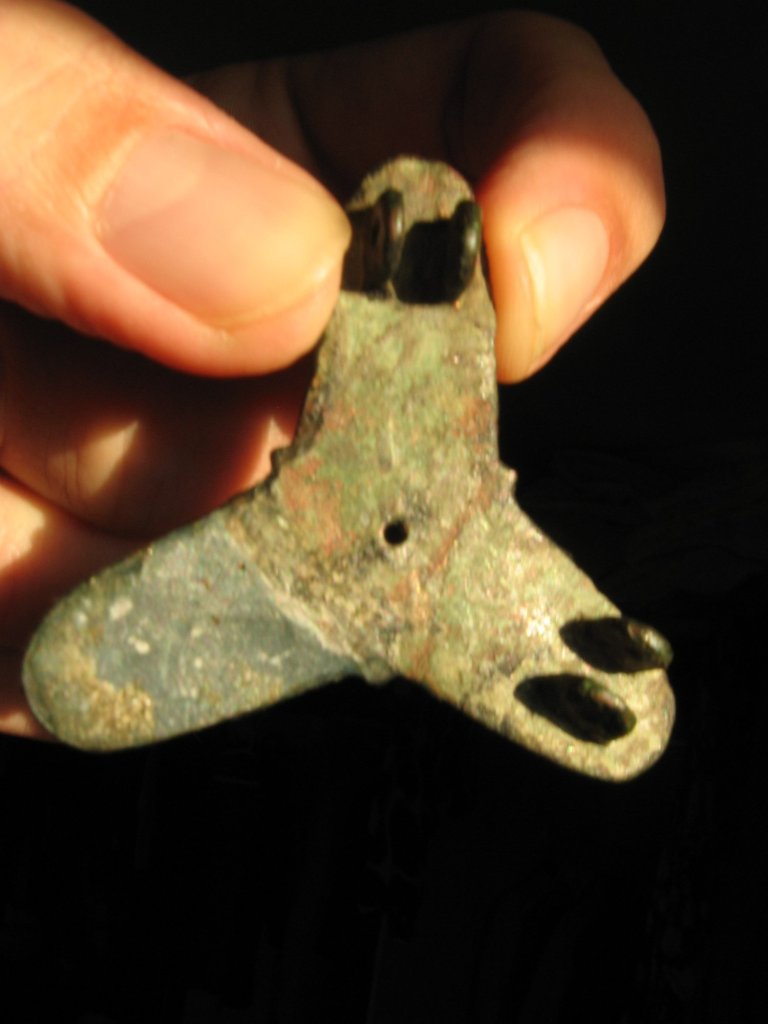
Although restored at one lug – wich only was becoming apparent when the strap devider was cleaned professionally – it was first considered to be a classic trefoil brooch. Until I showed my example to the author of a new book I was reading – Viking identities – Scandiavian Jewellry in England -, written by Jane F. Kershaw. She immediately responded to me:
‘The trefoil brooch is actually not a brooch but a strap-distributor, perhaps for a harness, of a type known from Iceland and Scotland. The projections at the side near the central plate show that the design comes from Carolingian baldric mounts, which have a similar shape. The central hole will have original held a rivet. The art style is not Ringerike, but Jellinge, although it seems to have been misunderstood in places. I’d place it in the first half of the 10thC.’
She also sended me an intruiging article on these kind of trefoil mounts/strap distributors.
In this article – hereunder attached – from 1997, there are two examples known found at Hafurbjarnarstadir and Holl in Iceland and one known (part of) example of Jarlshof at the Shetland Isles (found 1956), and two examples found in 1996 in Skipton-on-Swale, near Thirsk, North Yorkshire and Ewerby, near Sleaford, Lincolnshire.
The example shown on this page is said to be found in York in 1976. The vendor who sold it, sold another example – see image hereunder – but cannot recall it in his memory. It has to be another example as the strap distributor clearly is different from the one published on this page.
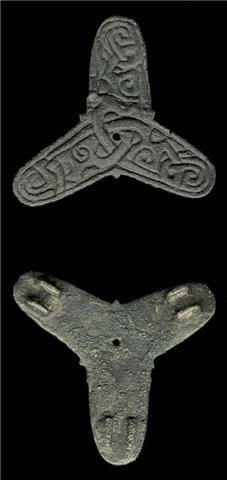
Apart from these 7 examples, I have seen a 8th on display in the National Museum of Iceland.
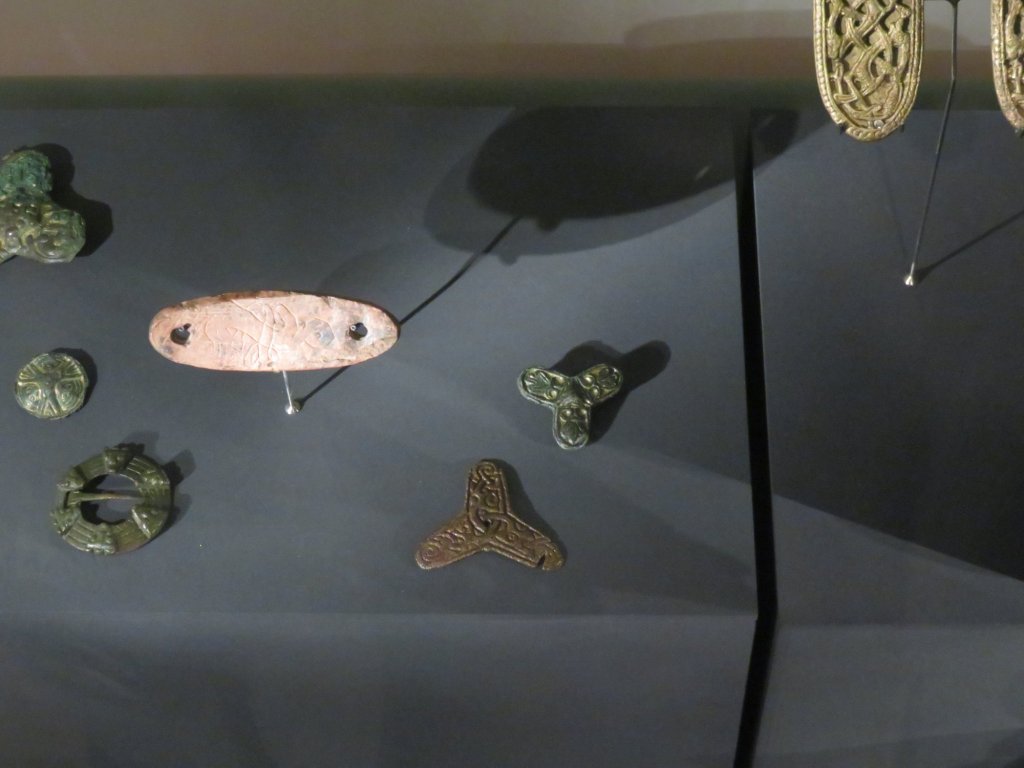
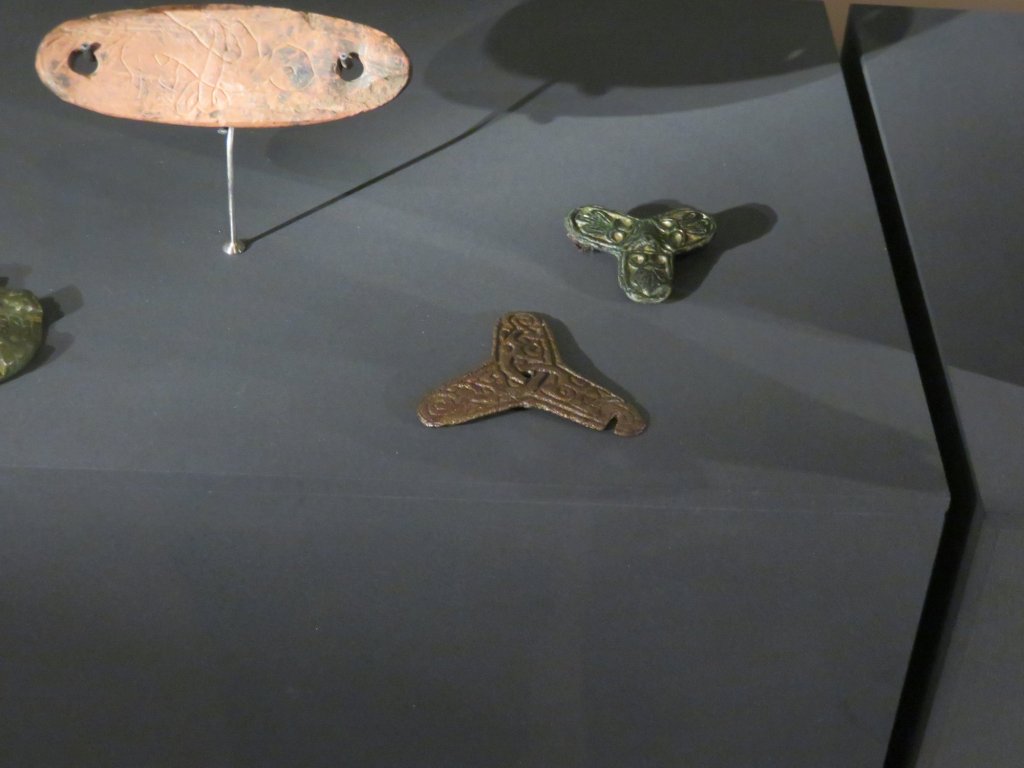
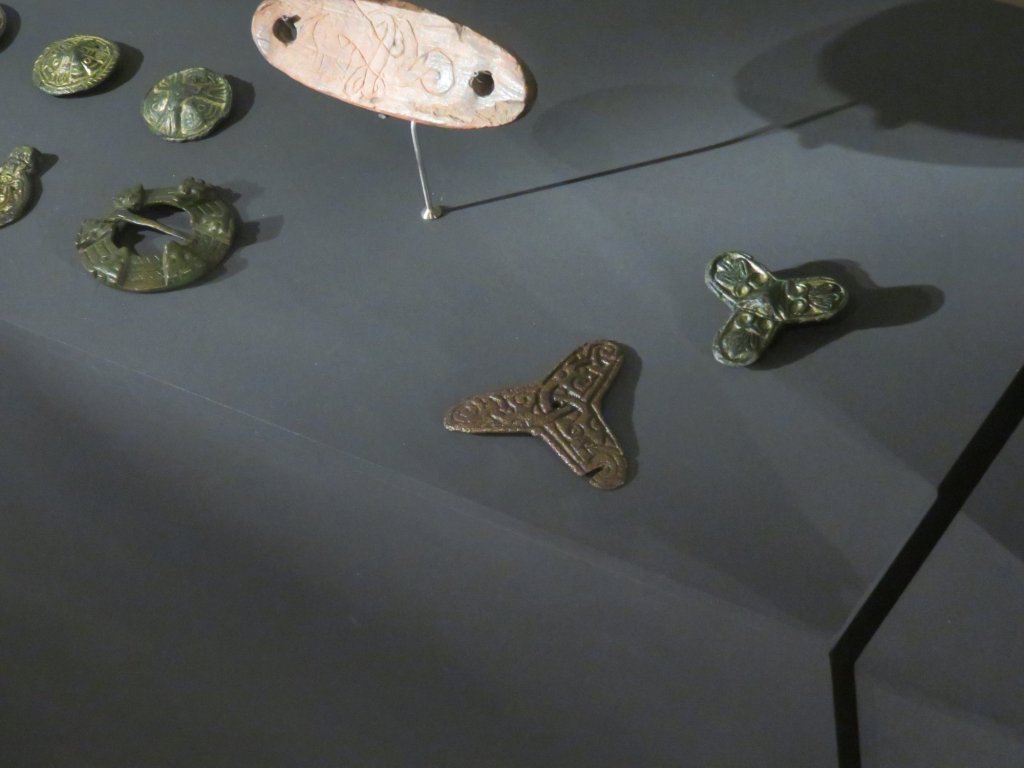
A 9th example is published (also as a trefoil brooch) in Benet’s second edition Artefacts of England & the United Kingdom – current values (2003) page 315, item no.: V-07-0202.
Ironically – as mentioned in the article – the trefoil mount from Hafurbjarnarstadir, Iceland was from a pagan burial where it was clearly worn in typical Scandinavian fashion as a brooch, with textile surviving attached to the lugs on its back. But this must have been a so called secondary use form. The Icelandic example also had an additional perforation through one of its arms, wich may suggest that the trefoil was worn as a pendant at some stage.
Just under 10 known examples – to me at last ! – a rare kind and type of viking artefact..
But who’s counting ?

 www.vikingartefacts.com